


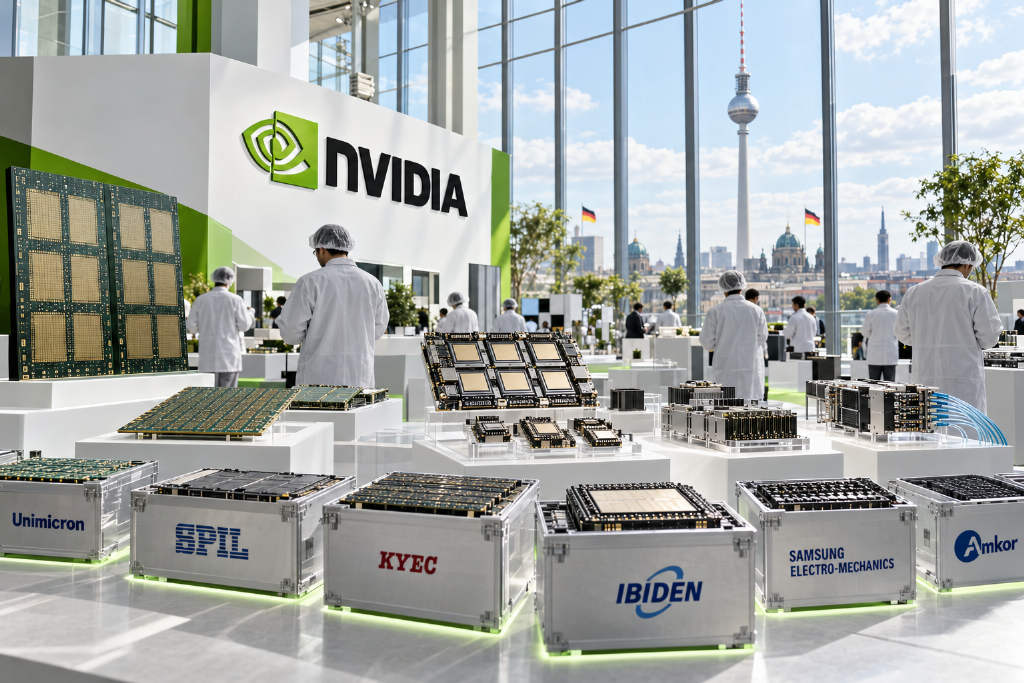
Nvidia said on Oct. 21 at its GTC event in Berlin that it is expanding production capacity with six supply-chain partners across substrates, advanced packaging, testing, and optical engines for co-packaged optics, or CPO. Taiwan-based Unimicron, Siliconware Precision Industries (SPIL), and King Yuan Electronics are among the companies named.
The company said it plans to raise substrate capacity for its products to 2.5 times current levels over the next three years. Chief Executive Officer Jensen Huang said in a news release, 「We are in the largest infrastructure wave in human history. Demand is extraordinary, and capacity is the constraint.」
Substrate expansion centers on Ibiden, Samsung Electro-Mechanics, and Unimicron
Three companies are involved in the substrate buildout. Earlier this year, Japan’s Ibiden said Nvidia had provided capacity reservation prepayments worth tens of billions of dollars to support expansion at its Ono plant in Japan. The target is to lift output at that facility to three times current levels, with added capacity expected to begin volume ramp in the first quarter of 2028.
Samsung Electro-Mechanics of South Korea is a new addition to Nvidia’s substrate supply chain. It will begin by supplying from existing production lines in South Korea. Nvidia is also backing facility upgrades and new plants in Sejong and Busan. According to the release, by 2028, output allocated to Nvidia is expected to account for a significant share of Samsung Electro-Mechanics’ annual package substrate capacity.
Unimicron has signed a capacity reservation agreement with Nvidia to expand its KF substrate lines in Taiwan. Additional capacity is expected to start coming online in the second quarter of 2027, with full utilization targeted by mid-2028. Nvidia said agreements with all three suppliers will support its substrate expansion plan, and that more agreements are in progress.
Amkor to expand interposer wafer capacity, SPIL optical engines targeted for 15x increase
In advanced packaging, Nvidia and Amkor plan to expand operations in South Korea. The goal is to increase interposer wafer capacity by more than 300% by the end of 2028 to support Nvidia’s current and next-generation platforms.
For co-packaged optics, Nvidia and SPIL plan to expand optical-engine capacity in Taiwan. The target is to reach 15 times current levels by mid-2027, with another doubling sought by the end of 2028.
Testing capacity expected to double from 2026 to 2027
Nvidia said total testing capacity is expected to double from 2026 to 2027, with capacity spread across the United States, Taiwan, and Singapore.
As part of that effort, Nvidia provided King Yuan Electronics with a $1.1 billion capacity reservation prepayment to support a testing plant and equipment purchases in the United States. The target is mass production in April 2027. King Yuan Electronics had previously disclosed the prepayment agreement. Expanded testing lines in Singapore are expected to enter mass production in February 2027.
Quarterly filing shows supply and capacity commitments rose to $279 billion
In its quarterly report as of July 26, Nvidia said supply and capacity commitments increased from $119 billion in the previous quarter to $279 billion. The filing said those commitments were "primarily for memory and manufacturing facilities" used to produce data-center infrastructure systems.
The companies named in this latest release are focused on back-end areas including substrates, packaging, testing, and optical engines. Nvidia did not disclose the value of the new agreements and did not say whether they are already included in the commitments reported in the quarterly filing.