
Negative news surrounding Nvidia Chief Executive Jensen Huang has intensified scrutiny of Oracle, whose business depends heavily on the US processor giant. Oracle lost $10 billion in market capitalization during yesterday’s after-hours trading. The decline adds to losses for common shareholders of more than 10% over the past month and more than 35% year to date.
The New York Times reported yesterday on Huang’s second affair. The Wall Street Journal reported that Nvidia’s board of directors was preparing to fire him. The reports have sent concerns about Oracle and its reliance on Nvidia sharply higher.
Oracle used its four-year financing allowance in one day
On Oct. 28, Oracle pledged that new stock and bond sales through fiscal 2030 would be capped at $20 billion, excluding refinancing. On Nov. 2, the company agreed to sell 86 million new shares for $10 billion and priced $10 billion of bonds.
That committed the entire four-year budget in a single day. For a company that is approaching the limits of its credit through massive bond offerings, borrowing usually becomes more expensive. A higher US Federal Reserve benchmark interest rate has not helped.
Oracle is paying more to sell bonds
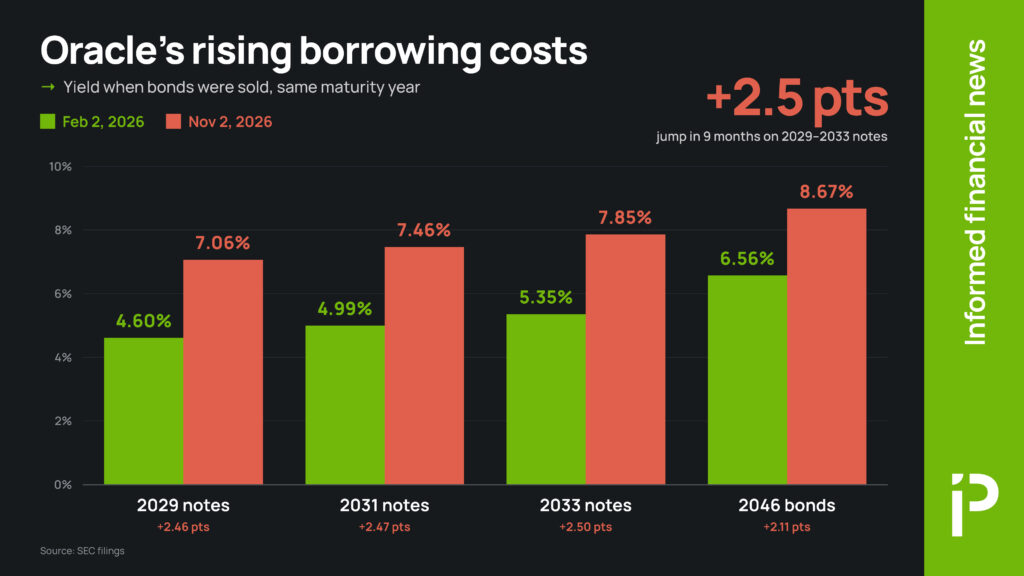
Oracle has had to offer bond traders much more generous coupons this month than it offered nine months ago. The comparison covers yields at pricing for Oracle’s new issues on Feb. 2 and Nov. 2, 2026.
In February, Oracle sold notes maturing in 2029 with a yield, technically a yield to maturity, of 4.6%. In November, it had to offer a 7% yield on bonds with the same maturity year. A higher corporate bond yield is not a favorable development for the issuer.
Higher US Treasury yields explain part of the increase. Oracle’s premium over Treasuries, however, also widened from 0.95 percentage points to 2.40 percentage points. That was a decisive move in the wrong direction.
For debt maturing in 2046, Oracle’s yield to maturity rose to 8.67% in its November sale, from 6.56% in February.
Credit default swaps have risen fivefold
Traders are beginning to speculate about an outright default on the debt Oracle is accumulating. Oracle’s five-year credit default swaps traded near 305 basis points last week, up from 58 basis points a year earlier. The latest level is roughly five times the earlier one.
Fresh setbacks for the artificial intelligence industry, combined with an obvious rise in borrowing costs, have investors watching for a potential Oracle downgrade to junk, or non-investment-grade status.
S&P currently rates Oracle BBB-, one notch above junk. Moody’s and Fitch rate the company two notches above junk, although Moody’s has a negative outlook on Oracle. Any of the three independent ratings agencies could cut its rating at any time.
In July, when S&P Global Ratings cut Oracle’s creditworthiness to BBB-, analysts forecast leverage in the mid-4x range for fiscal 2027. That level is well above S&P’s preferred mid-3x threshold for considering a credit-rating improvement.
With Moody’s negative outlook, leverage above the level S&P favors, and a series of negative Nvidia developments this week, Oracle’s downward-sloping stock chart points to continued credit pressure.
More pressure on Oracle’s AI business
Oracle is also facing setbacks in its artificial intelligence business. Microsoft is winding down its rentals of Oracle AI compute. Oracle’s data center for OpenAI in New Mexico is facing an open-ended permit delay, meaning the delay is indefinite.
The site, known as Project Jupiter, has had a difficult few days. On Monday, state regulators blamed the permitting delay on the project’s power developer missing procedural deadlines. On Tuesday, Doña Ana County voted to warn the project’s backers that they may be in breach of contract. It was the county’s second warning within a month.
Buildings already constructed at Oracle’s data center site still lack power. Recovering lost revenue while servicing empty buildings is adding pressure to an already stretched balance sheet.
OpenAI accounts for roughly half of Oracle’s backlog
Oracle’s revenue mix is highly concentrated. A single company, OpenAI, contributes roughly half of Oracle’s revenue backlog.
S&P analysts warned: “Oracle’s AI strategy carries material credit risks given the aggressive spending and uncertain path to positive cash flow.”
Oracle countered: “Demand for [Oracle’s] AI infrastructure remains strong, including for earlier-generation GPUs.”
S&P said it could cut Oracle again if the company’s leverage ratio is set to remain above 4.5x, or if positive free cash flow by fiscal 2029 begins to look out of reach. In July, S&P called an upgrade “unlikely over the next two years.”
As of Wednesday, a thinly traded Polymarket contract priced about a 36% chance that Moody’s or S&P would cut Oracle to junk by June 30, 2027.
The report was published by Protos.



