
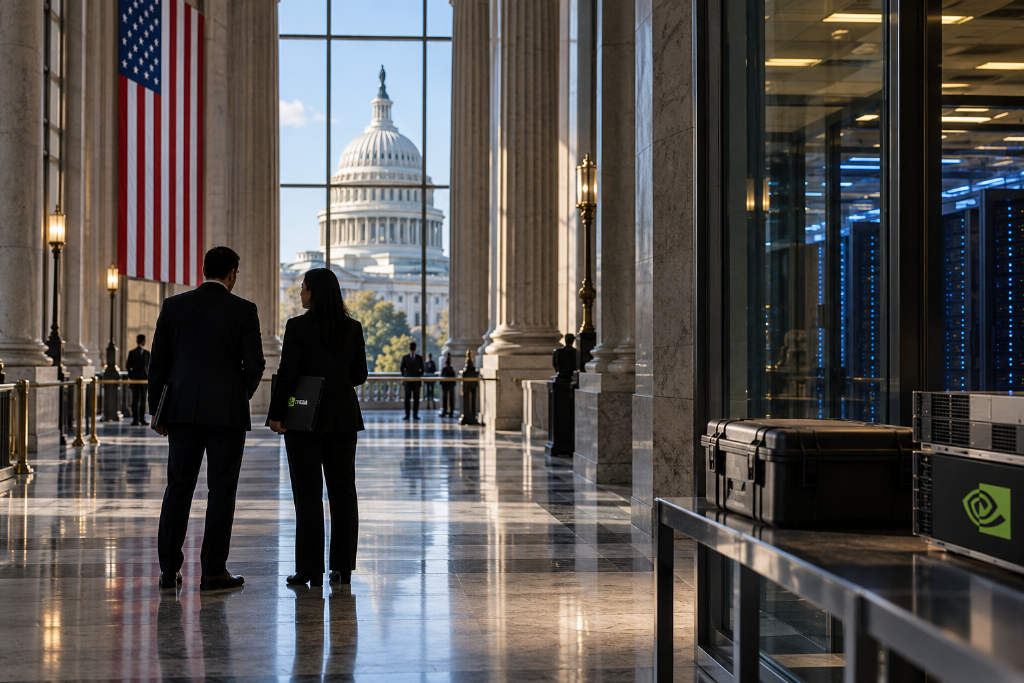
The New York Times reported that U.S. intelligence agencies concluded Alice Huang, a senior executive at Singapore data center company Megaspeed, was a Chinese intelligence asset and had close ties with NVIDIA Chief Executive Officer Jensen Huang. The report said Donald Trump was briefed on the intelligence about a year ago but did not take action, partly out of concern over the effect on NVIDIA chip sales and the risk of adding new uncertainty to U.S.-China trade relations.
The report also said U.S. officials did not accuse Jensen Huang of knowingly helping Chinese intelligence operations, and did not conclude that he disclosed secrets to the other side. Even so, intelligence showing that Alice Huang could get close to a Silicon Valley executive with major influence on White House technology policy raised alarms in Washington.
U.S. probe focused on Alice Huang’s contacts with Jensen Huang
According to intelligence materials obtained by The New York Times, U.S. officials first investigated whether Alice Huang helped direct advanced NVIDIA artificial intelligence chips to China. Later wiretaps led officials to conclude that she was also reporting intelligence back to Beijing.
The report said what worried officials even more was surveillance indicating that she had developed a close relationship with Jensen Huang. Huang has not received the kind of defensive briefing U.S. authorities commonly provide in such cases. People familiar with the matter said surveillance of Alice Huang is still ongoing, and companies linked to her have continued buying NVIDIA products this year.
NVIDIA spokesperson John Rizzo said the CEO’s interactions with Alice Huang were part of ordinary customer relations and that Jensen Huang meets thousands of customer executives every year. He said customers such as Megaspeed receive only standard commercial information, not NVIDIA trade secrets and not any national security information. He also said the company had previously investigated and rejected claims that the Singapore operator smuggled chips into China.
Megaspeed’s model and the $4.8 billion procurement trail
The report described Megaspeed’s business model as buying NVIDIA chips in Southeast Asia, building data centers, and then renting computing power to Chinese companies. U.S. officials see that setup as an important gray area through which China can access restricted computing capacity. Investigators also suspect that some chips may have entered China illegally.
Trade data platform ImportGenius showed that Megaspeed’s Malaysian sister company purchased at least $4.8 billion worth of advanced AI equipment containing NVIDIA chips and technology between June 2024 and February 2026. For a little-known small operator, the report said, that figure stood out.
The U.S. Commerce Department began investigating Megaspeed in late 2024. Officials who visited a Malaysian server facility found NVIDIA equipment still packed in boxes, making the site look more like a shipping transit point than a local installation. Singapore authorities also questioned Alice Huang in 2025 and later released her. The Commerce Department’s investigation was transferred to the Justice Department this year.
Responses from Megaspeed, China and NVIDIA
Megaspeed told The New York Times that its current leadership takes the allegations seriously, has hired outside lawyers to conduct an internal investigation, and has told U.S. authorities it will fully cooperate. Alice Huang did not respond to requests for comment. People familiar with the matter said her level of activity inside the company has declined since the U.S. investigation began.
Liu Chang, a spokesperson for the Chinese embassy in Washington, said the United States was engaging in “groundless smears and defamation” against China. The White House, the Central Intelligence Agency and the National Security Agency all declined to comment on the report.
NVIDIA again said it complies with U.S. law and that there is no evidence its chips were smuggled into China. A company spokesperson also said the Chinese government has been blocking imports of U.S. AI chips to protect domestic industry.
Jensen Huang’s ties with Trump and the China chip debate
The report said Jensen Huang has lobbied actively during Trump’s second term to loosen AI industry rules and ease restrictions on NVIDIA chip sales to China. It also said he reached an arrangement with the White House under which the U.S. government would take 25% of revenue from certain NVIDIA chips approved for export to China.
Current and former officials told the paper that the close relationship between the president and Jensen Huang caused some proposals for tighter investigations and sanctions on NVIDIA’s overseas chip sales to stall at the Commerce Department. NVIDIA later donated at least $20 million to Trump’s White House ballroom fund and pledged $500 billion in manufacturing investment in the United States. The report added that Jensen Huang sat at the head table when Xi Jinping attended a White House state dinner last month.
For Taiwan’s supply chain and for the crypto and AI computing markets, the intelligence has pushed the issue of routing through Southeast Asian data centers back into focus. The question is not only whether chips can be sold into China, but also who can reach decision-makers and who is renting out computing power from third countries. The Trump administration is still weighing whether to tighten rules again on remote computing services supplied from offshore data centers.



