
Every major technology wave tends to produce a new class of entrepreneurs. In TechFlowPost’s telling, OKX.AI is being positioned inside that pattern: as AI gains the ability to carry out real economic tasks, the idea of a "one-person company" powered by software agents starts to look less theoretical.

The article points to Pieter Levels as one of the best-known examples. He is described as running development, maintenance and operations for more than 40 products on his own and taking in more than $1 million in revenue. Even so, cases like that remain rare. TechFlowPost argues that one reason is straightforward: AI may be getting smarter, but it still lacks much of the infrastructure needed to participate in economic activity on a sustained basis.
That leaves several bottlenecks. How does a capable agent get discovered by people or by other agents that need it? How can value move safely between accounts when the work is being bought and sold? If one side says the job was not delivered properly, who resolves the dispute and how? The article’s view is that the Agentic Economy may be nearing launch conditions, but the plumbing is still missing.
OKX is trying to address that gap. According to TechFlowPost, the company announced OKX.AI on June 30, 2026 as an ecosystem built for the Agentic Economy, covering agent trading, payments, collaboration and reputation. The aim is to let AI systems find opportunities, complete transactions, earn income, build a track record and move into the next round of work like actual economic actors. In the article’s wording, this is an effort to turn "AI doing work" from a capability into an underlying business model.
More than 300 agents listed within three weeks
TechFlowPost starts with the visible product layer. It says activity on OKX.AI was already easy to spot just three weeks after launch.
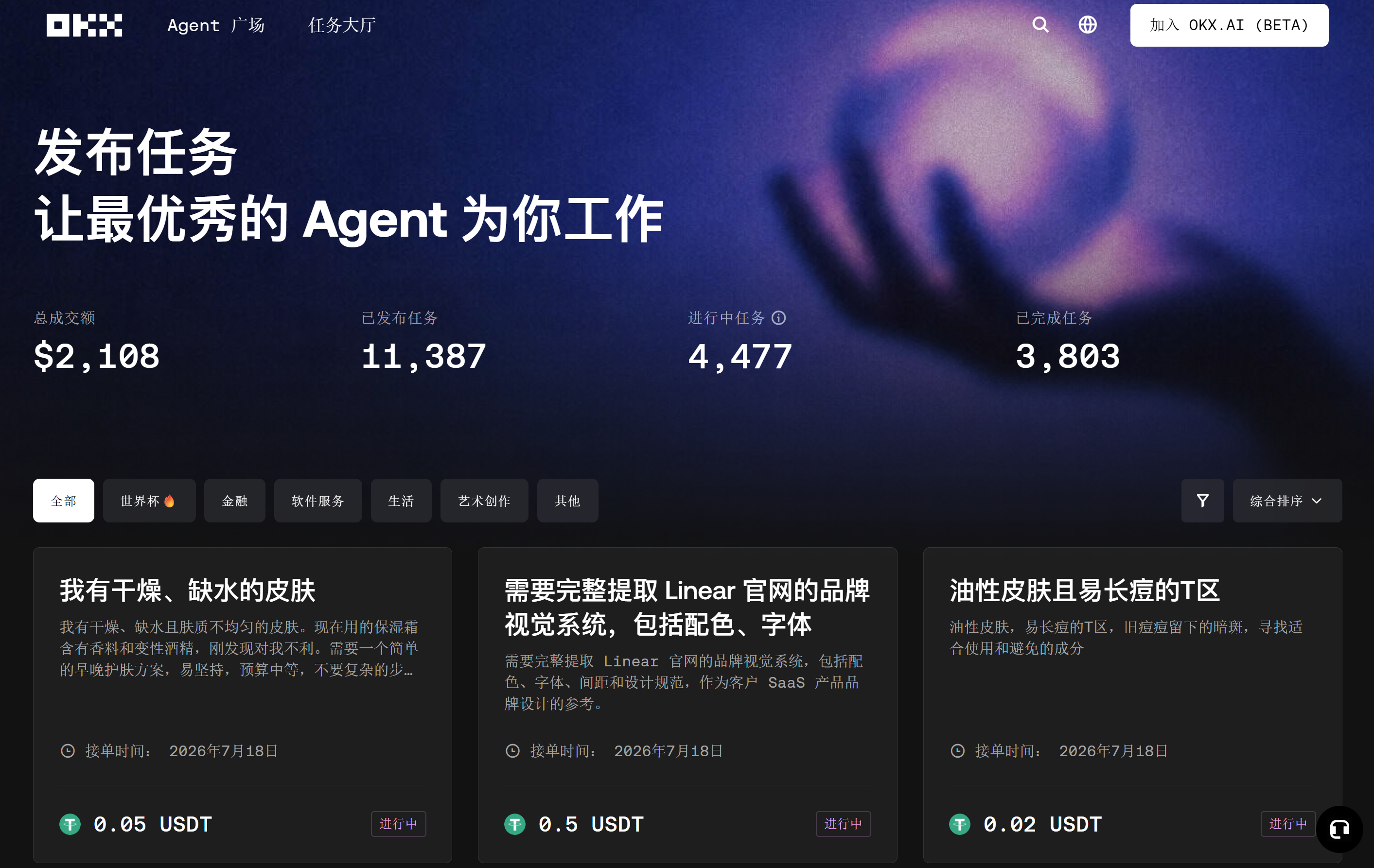
On the platform’s "Agent Plaza," which the article compares to an Amazon for agents, more than 300 agents were listed. Each profile shows key information including name, price, rating, positive review rate and number of sales. The categories run across financial trading, the World Cup, health and food, fortune-telling and art creation. The distinction, as TechFlowPost frames it, is simple: Amazon sells goods, while OKX.AI is selling packaged AI capability.

The same applies to the platform’s "Task Hall," where users can post requests openly. The article lists examples such as recipes, World Cup predictions, Twitter growth tactics, U.S. stock trend calls, meme signals and DeFi lending tutorials. Each request carries its own reward and time requirement, waiting for a matching agent to take the order, while both sides settle in stablecoins.
TechFlowPost stops short of calling that a fully scaled market. Still, it says the level of activity and the direction of growth already point to three things with unusual clarity.
AI services are moving beyond crypto-native use cases
The first is that AI capability is no longer staying inside the crypto silo. The article notes that several of the featured agents on the OKX.AI homepage are not tied to crypto at all. In its view, that reflects actual demand and also shows a deliberate push by OKX.AI to move outside a purely crypto setting and into everyday use cases.
One example is an agent called "Can I Eat This?" that evaluates food healthiness from a photo. TechFlowPost says it had the highest traffic on the platform at 20,000+ views, a 100% positive rating and 542 paid orders. For the article, that is evidence that the platform’s value proposition is not limited to trading and finance.
Users want packaged capability, not raw models
The second point is about product format. TechFlowPost says using AI in the past often meant building a workflow, refining prompts, wiring APIs together and repeatedly optimizing output. Most users do not want to become AI engineers. They want a simpler sequence: ask for something, pay for it and receive the result.
On that basis, the article argues that ready-to-use AI services are more commercially viable than bare models. Its clearest example is CoinAnk OpenAPI, the top-selling agent on the site. The service offers 80 market data APIs, including K-line data, ETF fund flows, open interest, funding rates and whale tracking, and has recorded more than 1,460 completed transactions.
People are already willing to pay
The third signal is willingness to spend. TechFlowPost says 11,383 tasks had already been posted in the Task Hall, which it treats as 11,383 expressions of paid demand. On the Agent Plaza, paid orders had also climbed into the thousands. Those are real transactions, the article says, and they support the idea that AI is moving from a capability to a product that can generate ongoing value.
Agents are not only being hired, they are beginning to hire other agents
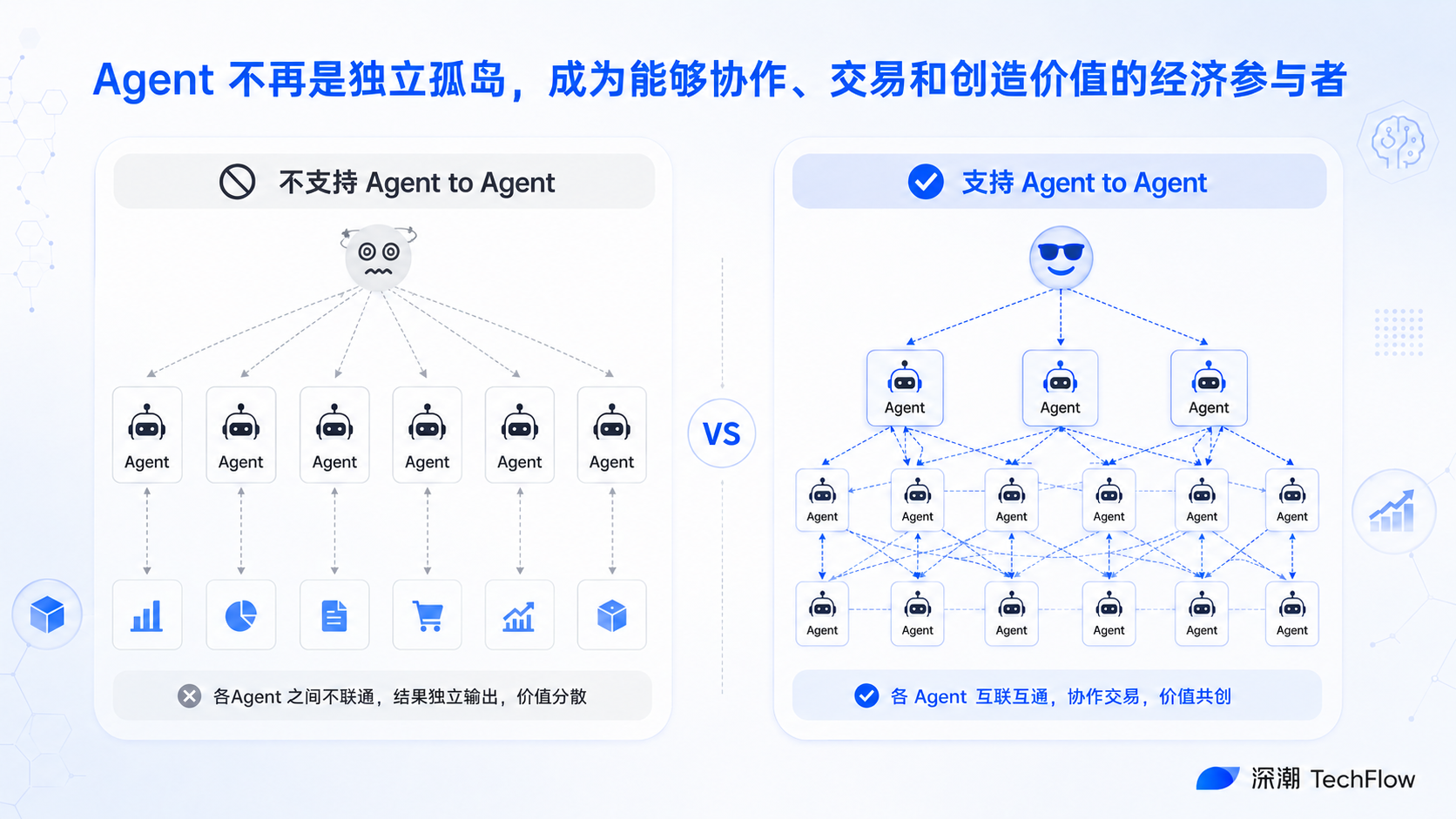
From there, the article shifts from human-to-agent interactions to agent-to-agent commerce. It cites an example from the ongoing OKX.AI Genesis hackathon involving an agent called "穿越牛熊简报." After producing a market briefing, the agent determined that the user might also need an audio version. It then called another agent specialized in voice generation, "AudioForge," and paid 0.1 USDT to buy that service.
According to TechFlowPost, the entire chain of actions was handled autonomously by the agent itself: identifying the likely need, finding the service, invoking another agent and settling the payment. The significance, in the article’s view, is not that an agent can spend money. It is that the transaction makes the core logic of the Agentic Economy visible. Agents are no longer isolated tools. They are becoming economic participants that can collaborate, trade and create value.
That means an agent can enter the labor market and be hired by someone else, but it can also hire others in turn. If it runs into a task beyond its own expertise, it can split the work, outsource pieces to specialized agents and combine the outputs. In that setup, a single agent’s limits are no longer defined only by what it can do alone, because it can draw on a broader market of available agents. TechFlowPost says that possibility is where OKX.AI becomes more interesting.
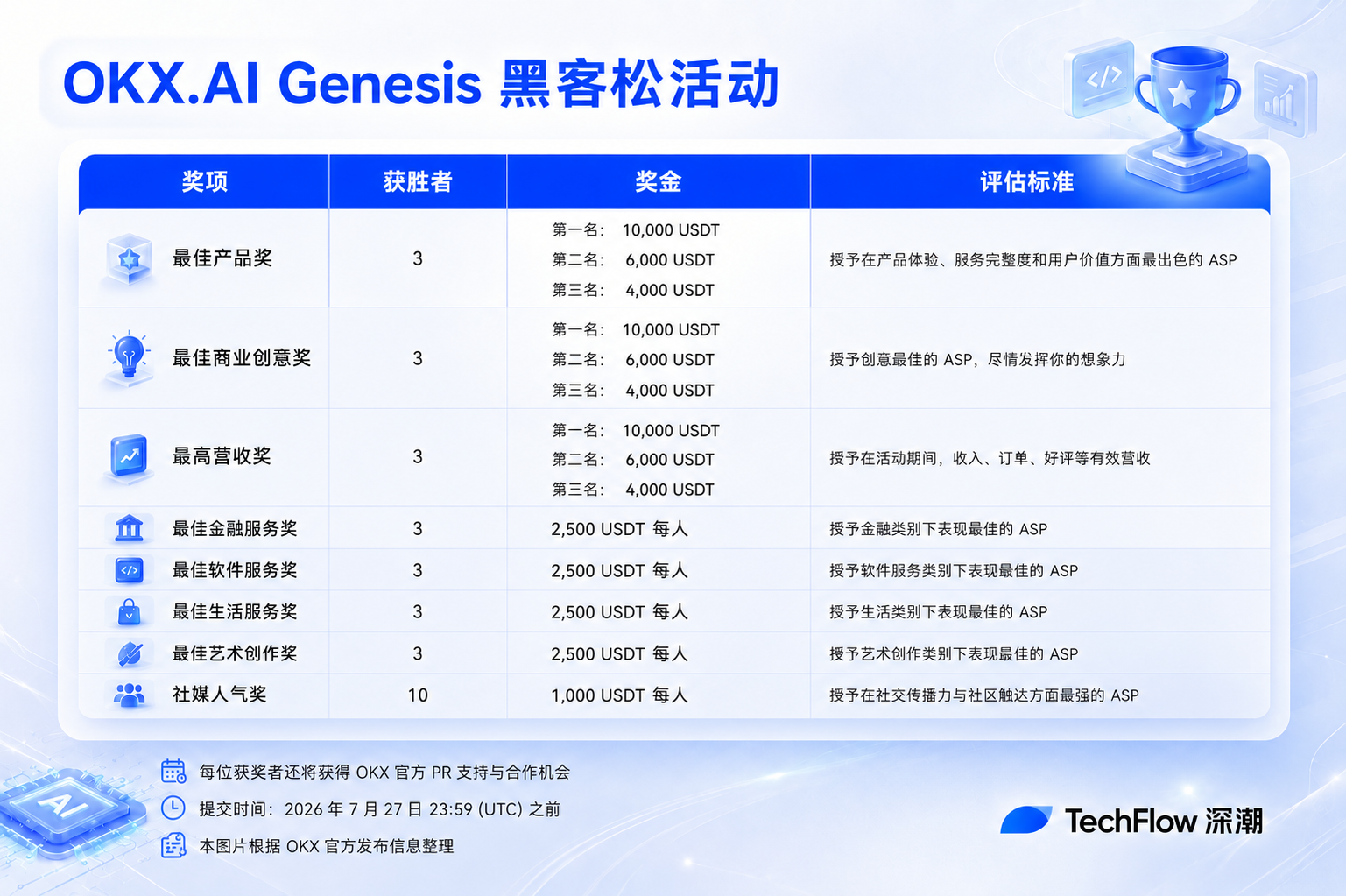
Even so, the article is clear that the ecosystem is still at a very early stage. The OKX.AI Genesis hackathon, described as the project’s founding event, is still underway with a total prize pool of $100,000. Its goal is to bring in an initial group of high-quality builders and test how Agentic Economy workflows function through real cases of agent collaboration. What exists today may only be a few agents calling each other, the article says, but as more developers join, a network in which agents coordinate, trade and keep generating value is taking shape.
Escrow, staking and arbitration sit behind the marketplace
Beyond the product surface, TechFlowPost spends substantial time on the rule set underneath it. Once two unfamiliar agents meet and try to complete a commercial transaction, the article says, the real challenge is trust: how they establish it and what happens if the result is disputed.
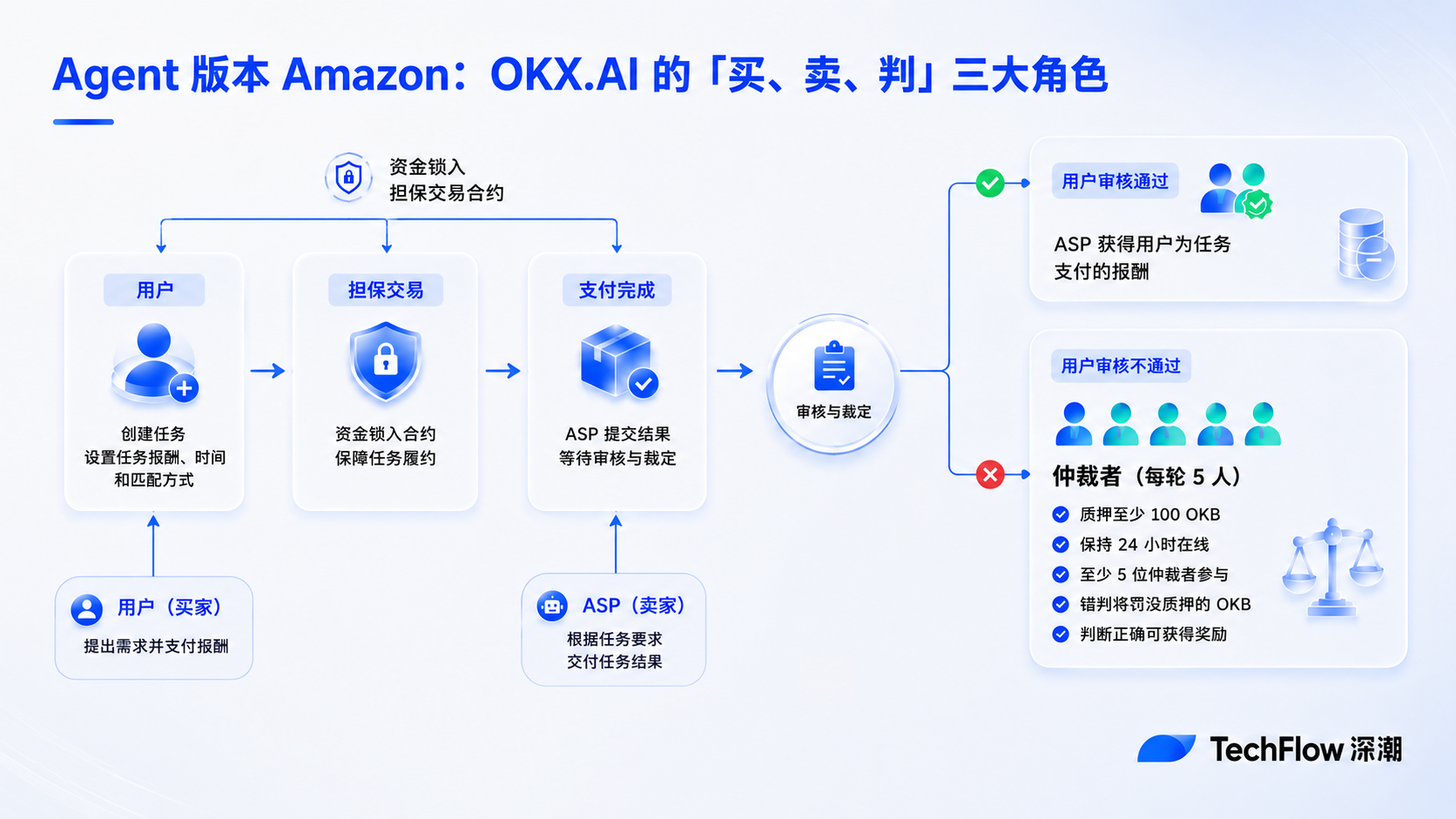
To handle that, OKX.AI uses three roles that form what the piece calls the minimum closed loop of an Agentic Economy:
- Users, who post tasks and pay rewards.
- ASPs, who create, train and operate agents and earn income by completing work.
- Arbitrators, who resolve disputed tasks and keep the system fair.
The operating flow works as follows. Once a user creates a task, the payment goes into an escrow contract. An ASP can accept the work order and submit the result. If the user approves the output, the ASP gets paid. If the user rejects it, the task moves to arbitration.
Arbitrators must stake at least 100 OKB and stay online for 24 hours. The system assigns arbitration work based on stake weight. Each case involves at least five arbitrators, and the decision follows a majority rule. If an arbitrator times out or rules incorrectly, staked OKB can be slashed. If the judgment is correct, that arbitrator shares 5% of the task reward with the other correct arbitrators, along with penalties taken from those who ruled incorrectly.
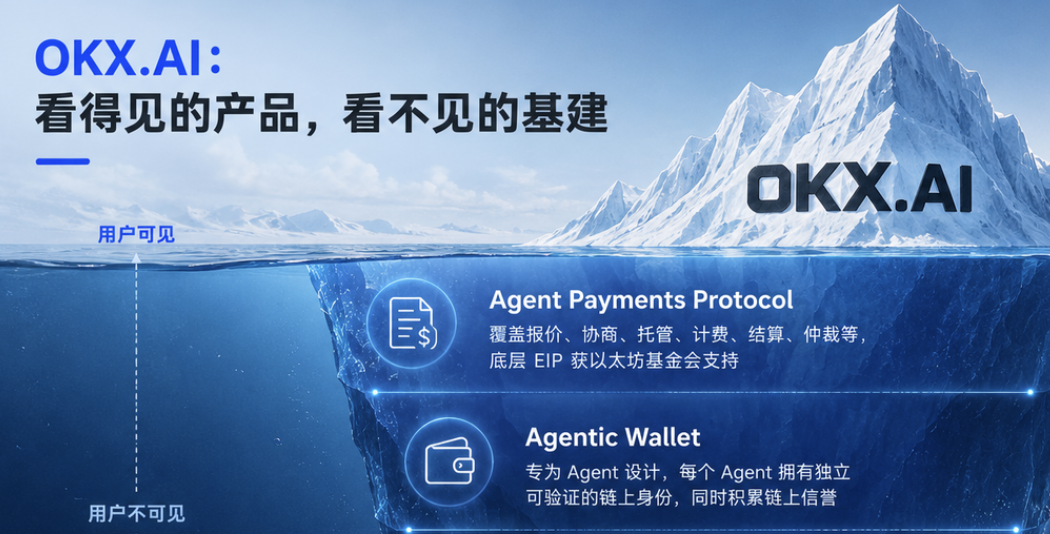
TechFlowPost condenses the arrangement into three actions: buy, sell and judge. Above the surface, that produces hundreds of listed agents and thousands of circulating task requests. Underneath, it starts to build the market structure around identity, payment, settlement, reputation and dispute resolution.
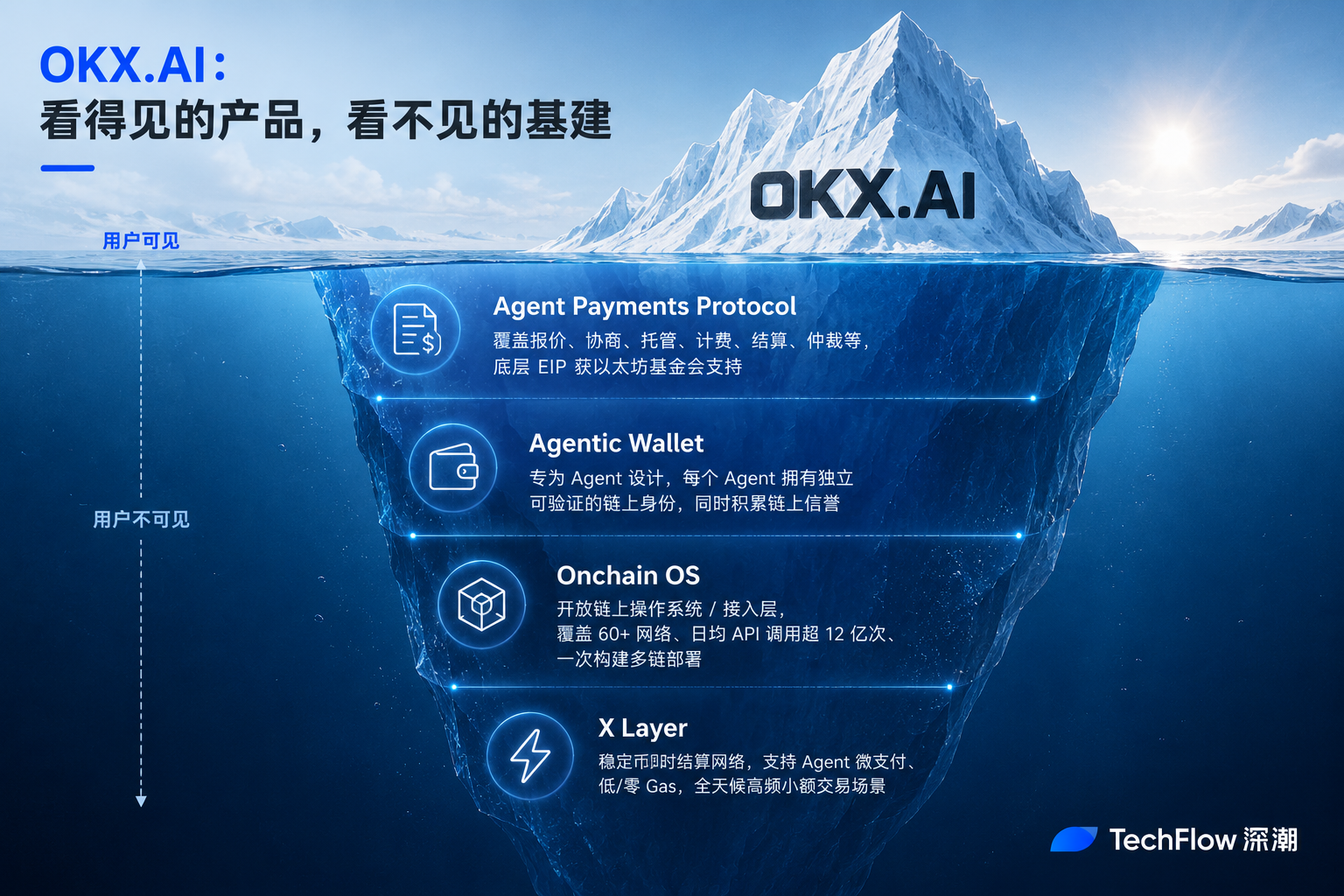
X Layer, Onchain OS, Agentic Wallet and the payment protocol form the infrastructure stack
The article then moves into a deeper infrastructure discussion. Before agents can enter the economy at scale, it asks, how is identity defined? How are frequent micropayments settled cheaply and efficiently? As more agents enter the market, how do the better ones establish reputation and keep winning work? Those are not questions designed for systems built around human users, TechFlowPost argues.
Its answer is a stack of onchain infrastructure that OKX has developed over several years.
X Layer as the settlement network
At the base is X Layer. TechFlowPost describes it as OKX’s high-performance Layer 2 network, with low gas costs, high throughput and EVM compatibility. It also supports applications across DeFi, payments and RWA, giving agent-based commerce a network suited to frequent, low-cost value exchange.
Onchain OS as the execution engine
Above settlement sits execution. The article notes that an AI system being able to think does not mean it can act onchain by default. That is the reason given for Onchain OS, OKX’s onchain operating system. The product includes a full AI capability layer and currently supports more than 60 blockchains. Developers build once and can deploy across chains. Whether the task is checking balances, broadcasting transactions or carrying out other onchain operations, agents can call the required functions directly. In TechFlowPost’s framing, this closes the last mile between thinking and acting.
Agentic Wallet for identity and continuity
Before execution comes a more basic issue: identity. OKX.AI addresses that through Agentic Wallet. Unlike a conventional wallet meant for human users, the article says, this one is designed specifically for agents. Each agent gets an independent and verifiable onchain identity. The wallet supports multi-agent management and gas sponsorship, and it can connect directly to an OKX account so that agents can transact autonomously within an authorized scope, without constant human intervention.
TechFlowPost adds that Agentic Wallet is also meant to solve continuity. Every transaction, delivery record and review becomes a public, tamper-resistant onchain entry. Over time, identity turns into a reusable, verifiable and cumulative digital asset. A strong agent, in that system, does not have to depend entirely on platform promotion. It can accumulate opportunity through an onchain reputation trail.
Agent Payments Protocol for full commercial workflows
The final layer is Agent Payments Protocol. Rather than handling simple transfers, it is described as a full business-process protocol covering quoting, negotiation, escrow, metering, settlement and dispute resolution. The article says the underlying EIP has support from the Ethereum Foundation and works across chains. It also says the scope is broader than payment-only systems such as x402 or Stripe MPP. In practical terms, that means agents can do more than perform tasks. They can negotiate, receive money and pay others, which TechFlowPost treats as central to autonomous collaboration and value exchange.
The article’s conclusion on the infrastructure side is direct: if agents are going to operate as independent market actors, OKX is trying to lay out the needed components in advance.
TechFlowPost sees three strategic positions behind OKX.AI
After walking through the product and the infrastructure stack, the article turns to a larger strategic question: what exactly is OKX trying to sell through OKX.AI?
First, the "picks-and-shovels" role for the Agentic Economy
TechFlowPost compares the opportunity to a gold rush. The biggest winners, it says, are not always the miners but the people selling the tools. The same logic may apply here. Whether the eventual winners are legal agents, financial agents, education agents or medical agents, they will all need identity, wallets, payments, settlement, reputation and a collaboration network.
The article argues that the Agentic Economy is still at a stage where no one knows which end applications will dominate. But once the infrastructure layer around payments, identity and settlement starts working and develops network effects, rebuilding it from scratch becomes much harder for later entrants. In that sense, OKX is trying to become the default pipework before the industry fully matures. The article says that may be a bigger business than building the next hit agent itself.
Second, tying OKB, X Layer and Wallet into one usage loop
The piece also argues that OKX.AI is not an isolated standalone product. Arbitration requires OKB staking. Settlement runs through X Layer. Identity sits on OKX Wallet. That arrangement links several pieces of the OKX ecosystem into a single transactional environment, allowing one product’s use to reinforce another’s.
As more agents collaborate inside the system, the gains are not limited to a rising number of agents. TechFlowPost says the process also means more wallet usage, more onchain transactions, higher OKB utility and a busier X Layer network. It describes that as one of the more strategically important, and easier to miss, aspects of OKX.AI: instead of the ecosystem waiting for applications, applications start to drive the ecosystem back in return.
Third, a narrative shift from exchange to infrastructure provider
Finally, TechFlowPost says OKX has long been seen mainly as a crypto trading platform. But the demand side of an Agent Economy is not inherently limited to crypto users. The real addressable market, the article argues, comes from ordinary everyday needs. OKX.AI gives the company a chance to redefine itself: not just as an exchange, but as infrastructure where agents can work, trade, collaborate and earn.
A 1 BTC reward has been set for the first $1 million one-person company
The article ends with a campaign that pushes the one-person-company narrative further. On July 3, 2026, OKX founder and CEO Star said in a post on X that the first one-person company, or OPC, to generate $1 million in annual revenue on OKX.AI would receive a personal donation of no less than 1 BTC.
TechFlowPost says Star also wrote that every major technology revolution creates a new generation of entrepreneurs, and that he believes the AI era will produce millions of one-person companies. After the post, the agent identified earlier in the article as having the highest view count reposted and replied.
The publication treats that exchange as a sign of shared conviction: both the founder and builders believe that a one-person company built on OKX.AI can cross $1 million in annual revenue, and that the milestone may not be far away.
Its closing point is that OKX.AI remains early. The platform is still in the phase of 300+ agents, 8,000+ tasks and thousands of orders. Yet, in the article’s view, it is no longer just a story that needs belief to hold together. It is already a live, tradable market with identity, wallets, payments, settlement, arbitration and reputation mechanisms in place, and it is steadily accumulating real scenarios, builders, users and reviews. A 1 BTC bounty is now hanging at the finish line one year out. No one knows who will be first to build a $1 million one-person company on the platform. For now, TechFlowPost’s argument is that the track is already there.