
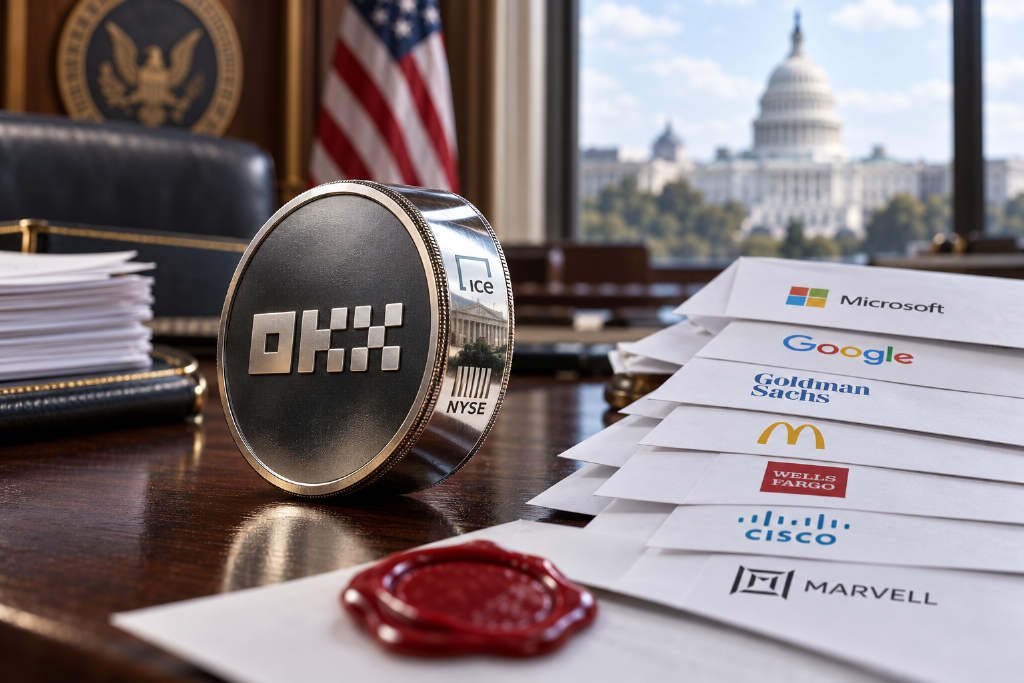
One month after the U.S. Securities and Exchange Commission introduced its Innovation Exemption framework for tokenized securities trading, the OKX-ICE tokenized stock platform has received formal objections from 22 listed companies. The public list includes Microsoft (MSFT), Alphabet (GOOG), Goldman Sachs (GS), McDonald’s (MCD), Wells Fargo (WFC), Cisco (CSCO) and Marvell.
Those companies have objected to having tokenized versions of their shares traded on the platform. After the latest round of opposition on Oct. 24, the number of public objections moved above 20 for the first time.
Objections rose from zero to 22 in three weeks
The timeline in the report says the SEC formally launched the Innovation Exemption framework in mid-September, opening a regulatory path for on-chain trading of tokenized stocks.
On Oct. 19, Microsoft, Alphabet and Goldman Sachs were the first to object. On Oct. 20, OKX-ICE co-CEO Andrew Cuomo described the corporate response as a "natural reaction" in an interview. Five more companies joined on Monday, and another six were added on Friday, bringing the total to 22.
The pace of the objections, according to the report, came faster than most industry participants had expected.
Andrew Cuomo says opposition does not amount to a rejection of tokenization
Cuomo said in comments to the media that issuers were placed on the trading list without enough prior communication, and that objecting publicly was a reasonable corporate decision under those circumstances. He also said the OKX-ICE platform would keep moving ahead and that issuer resistance should not be taken as a verdict against tokenization as a technology path.
That distinction runs through much of the current debate: rejecting tokenized trading of a company’s shares on a specific venue is not the same as rejecting tokenized securities altogether.
Nasdaq backs tokenization but does not want tokenized NDAQ shares on TSV
The report points to Nasdaq as one of the clearest examples of that split. Nasdaq, one of the main U.S. stock exchange operators, has long supported tokenization and received SEC approval in March 2026 to advance tokenized securities trading on its own market.
At the same time, Nasdaq has publicly said it does not want tokenized versions of its own stock, NDAQ, trading on a Tokenized Securities Venue, or TSV.
Its concern is tied to market structure. If a TSV sits outside the National Market System, or NMS, Nasdaq argues that liquidity could become fragmented, price discovery could weaken, and existing protections such as real-time best bid and offer display and the consolidated tape would not be available in the same way.
Nasdaq’s own approach keeps tokenized securities inside the current exchange framework and uses the Depository Trust Company, or DTC, for settlement instead of building a separate parallel market.
In other words, Nasdaq is not objecting to tokenization itself. It is objecting to tokenization outside the existing regulatory and market structure. The report says that differs in substance from the stance taken by the 22 companies, whose concerns are framed more as risk management than as a market structure argument.
Issuers are asking what tokenization does for them
Reid Noch, vice president of U.S. equity market structure at TD Securities, said the central question for issuers is: "What’s in it for them?"
In theory, tokenization could attract new demand for U.S. stocks from overseas investors, especially in Asia and the Middle East. But the report says there is still not enough data to show whether the current SEC framework can generate enough incremental demand to offset the risks tied to 24/7 trading and an unfamiliar market structure.
For conservative legal and compliance teams at listed companies, deciding that the risks outweigh the benefits is a rational choice.
Securitize and BitGo have not objected
Not every crypto industry participant is taking a cautious line. Tokenized securities firm Securitize (SECZ) has said it will not object to being listed on OKX-ICE, and digital asset custodian BitGo (BTGO) has also said it does not object.
Securitize CEO Carlos Domingo said in an interview, "An important education process is happening right now."
According to the report, Securitize has been using webinars to explain different trading models, shareholder rights and potential trade-offs to issuers that may take part in tokenization. That suggests the main bottleneck for tokenized stocks may not be technology or regulation, but the time needed for market education.
What the market is watching next
The wave of objections from 22 large companies sends several signals.
- First, it does not mean tokenization has failed. Many of the companies objecting are traditional finance or technology giants whose legal teams are cautious about arrangements outside the existing market structure.
- Second, the SEC’s Innovation Exemption may move into real-world adoption more slowly than expected. If large issuers keep refusing, early liquidity on OKX-ICE could be limited.
- Third, the Nasdaq-DTC route, which keeps tokenization inside the current framework, may prove more acceptable as a mainstream model, while the parallel-market route represented by OKX-ICE may need more time to win over issuers.
The report identifies several points to watch: whether OKX-ICE will engage directly with objecting companies and offer an opt-in mechanism; the SEC review progress for the Nasdaq-DTC tokenization plan; and whether Securitize’s education effort can bring in the first issuers willing to accept tokenization proactively in early 2027.
The narrative around tokenized U.S. equities is still alive. But the distance between regulatory access and market adoption remains substantial.



