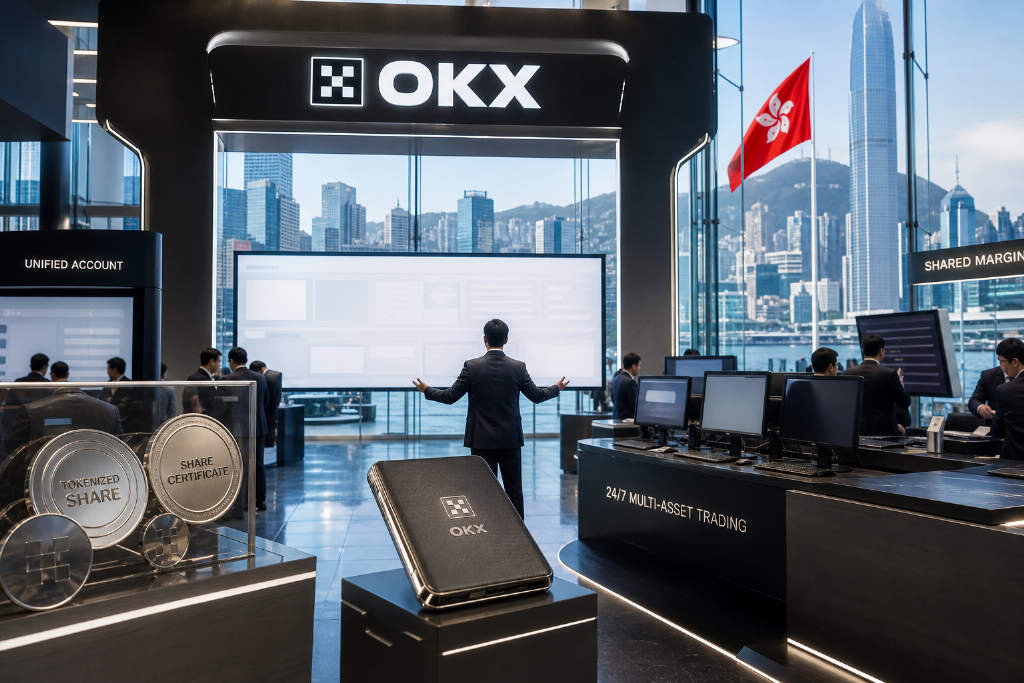
OKX executive Lennix discusses financial super apps and tokenized equities at Bitcoin Asia 2026

OKX executive Lennix discusses financial super apps and tokenized equities at Bitcoin Asia 2026

N
News Editor
2026-08-28 04:41:37
On Aug. 28, OKX Director Lennix spoke at the Bitcoin Asia 2026 roundtable, “The Rise of Financial Super Apps,” where he outlined his view on the convergence of traditional finance and crypto markets, the infrastructure needed to support financial super apps, and the outlook for tokenized equities. He said financial products are moving toward a unified account structure, with users increasingly expecting to trade and manage different classes of assets under the same pool of funds, account system, margin framework, and risk controls. Lennix argued that the visible part of a financial super app is the ability to trade crypto, traditional equities, foreign exchange, and commodities in one application, but the harder task is connecting the underlying systems, including banking rails, wallets, trading accounts, shared margin, and coordinated risk-control and compliance back ends. He also said tokenized stocks and the tokenization of traditional financial assets amount to an upgrade of conventional markets, allowing longer trading hours, broader risk management, and price signals outside regular market sessions once those assets are connected to a crypto exchange’s matching, margin, risk, and compliance systems. Lennix added that Intercontinental Exchange’s strategic investment in OKX Group reflects a move toward tokenization and around-the-clock trading.

On Aug. 28, OKX Director Lennix appeared at the Bitcoin Asia 2026 roundtable, “The Rise of Financial Super Apps,” where he shared his views on the convergence of traditional finance and crypto markets, the underlying buildout required for financial super apps, and the prospects for tokenized equities.

A unified account system is where finance is heading

Lennix said financial products are rapidly converging into a single account structure. In his view, users will want to trade and manage different categories of financial assets under the same pool of capital, the same account, and the same margin and risk-control system. He described that as an important direction for the industry’s continued evolution.

The real obstacle is infrastructure integration

He said the surface-level definition of a financial super app is straightforward: one application where users can trade crypto, traditional equities, foreign exchange, commodities, and other assets. The harder part sits underneath. Lennix pointed to the need to connect banking systems, wallets, trading accounts, shared margin, and coordination across risk-control and compliance back ends.

Tokenized equities as an upgrade to traditional markets

Lennix also said tokenized stocks and the tokenization of traditional financial assets are, in essence, an upgrade to traditional markets. By bringing those assets into a crypto exchange’s matching, margin, risk-control, and compliance systems, the market can support longer trading hours and risk management, while continuing to provide price signals outside standard trading sessions.

Comments on institutional cooperation

Speaking about institutional cooperation, Lennix said Intercontinental Exchange’s strategic investment in OKX Group reflects a shift in financial markets toward tokenization and 24/7 trading. As tokenized equity business continues to grow, he said the sector could become an important direction for the future development of financial markets.

This article was originally published by Bit.Fan. For more cryptocurrency news and market insights, visit www.bit.fan.
70

Disclaimer:

The market information, project data, and third-party content displayed on this platform are for industry information sharing only and do not constitute any form of investment advice or return commitment.

Cryptocurrency trading carries high risks. Users should fully assess their risk tolerance and make independent decisions. All profits, losses, and legal responsibilities are borne by the users themselves.