
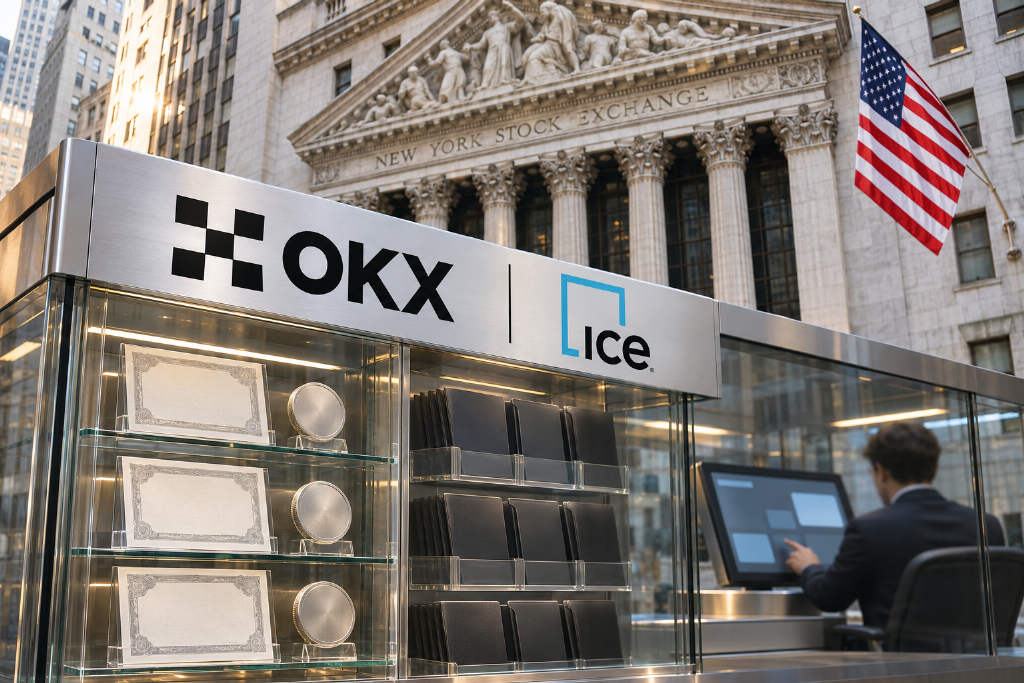
OKX and Intercontinental Exchange (ICE), the parent company of the New York Stock Exchange, say their joint venture OKXICE will launch its Tokenized Securities Venue (TSV) on November 23. The platform plans to offer more than 70 securities, including shares associated with Coinbase, Circle, Robinhood and Strategy, as well as 59 exchange-traded funds (ETFs) from Direxion.
The planned offering has changed after companies including Apple, Tesla and Meta objected to third parties tokenizing their shares on OKXICE. The initial focus on large technology companies has given way to crypto-related businesses and ETFs. Although the platform has confirmed more than 70 planned assets, it has not said that every one of them will be available for trading on launch day.
Initial lineup shifts toward crypto firms and ETFs
According to an OKX announcement on November 11, eligible US users will be able to trade tokenized securities around the clock through the OKX app. OKX and ICE each own 50% of OKXICE. The venture will operate under the Innovation Exemption framework introduced by the US Securities and Exchange Commission (SEC) in September this year.
Companies confirmed for the initial group include Better.com, BitGo, Circle, Coinbase, Robinhood, Securitize and Strategy. Direxion will supply 59 ETFs. Strategy also plans to bring some of its preferred shares onto the platform.
The planned slate differs substantially from the earlier proposal, which called for 63 US stocks. OKXICE had considered adding large companies such as Nvidia, Apple, Microsoft and Tesla, but faced objections from issuers. The planned total has since grown to more than 70 assets, largely through the addition of ETFs and securities from crypto-related companies.
Objections reach 67 companies
The launch announcement comes as US-listed companies push back against third-party tokenized trading of their shares. As of November 5, 67 companies had objected. The list includes Meta, Tesla, Netflix, Costco and Home Depot. Of the 62 companies in OKXICE’s original plan, 56 had filed objections, or about 90%.
The SEC allows stock issuers to object within a specified period, blocking third parties from offering tokenized trading in their shares without direct authorization under the relevant exemption. The objections point to a hurdle beyond technology and regulatory structure: whether issuers will accept this form of trading.
Most of the companies in the initial group have close ties to the crypto industry. Strategy is among the more closely watched participants. The OKX announcement says it plans to list preferred shares including STRC, in addition to its common stock.
Strategy Chief Executive Phong Le said, “Bitcoin is digital capital, while Strategy’s preferred shares, such as STRC, turn that capital into digital credit.” He said tokenization through OKXICE is a natural next step toward round-the-clock trading for those digital credit products. Circle Chief Business Officer Kash Razzaghi said, “Investors want markets to be open at all times, while clearly understanding the rules behind them.”
The companies’ participation shows that some crypto-sector firms are backing the on-chain issuance of traditional securities. It does not mean that large public companies broadly accept the same model.
Tokens backed by shares and held in self-custody
OKXICE’s structure differs from synthetic stock tokens offered in some overseas markets. According to official information, each token will be backed 1:1 by the corresponding US share and represent rights in that security. Subject to applicable conditions, holders may receive dividends and have voting and other corporate-action rights.
Trading will take place on X Layer, OKX’s Ethereum layer-2 network, using liquidity pools on Uniswap v4, an automated market maker (AMM). Securitize will provide the tokenization infrastructure. Users will hold tokens in self-custody wallets; OKXICE will not directly custody user assets or private keys.
At launch, access will be limited to US users who complete identity verification and meet the relevant eligibility requirements. The service will not be available to every OKX user worldwide. OKXICE will operate under the SEC’s temporary Innovation Exemption framework; it is not a registered securities exchange formally approved by the SEC.
Tokenized stock value rises as on-chain transfers fall
The launch date comes as the global tokenized stock market continues to expand. Data queried from RWA.xyz on November 12 put the distributed value of tokenized stocks at about $4.01 billion, up roughly 15.9% over the previous 30 days. The number of holders had reached about 4.82 million.
Monthly on-chain transfer volume moved in the opposite direction. It stood at about $39.42 billion, down roughly 53.9% from the preceding 30-day period. The figures show that asset value and holder numbers have risen without a corresponding increase in on-chain activity.
For OKXICE, a central test will be whether it can build enough liquidity for round-the-clock trading while keeping token prices reasonably aligned with traditional-market prices. During US market closures, thin liquidity, limits on arbitrage and the depth of automated market-maker pools could affect tokenized securities prices.
Technology is not the only constraint on wider adoption of tokenized US stocks. Issuer willingness, investor rights and the quality of trading markets also matter.



