
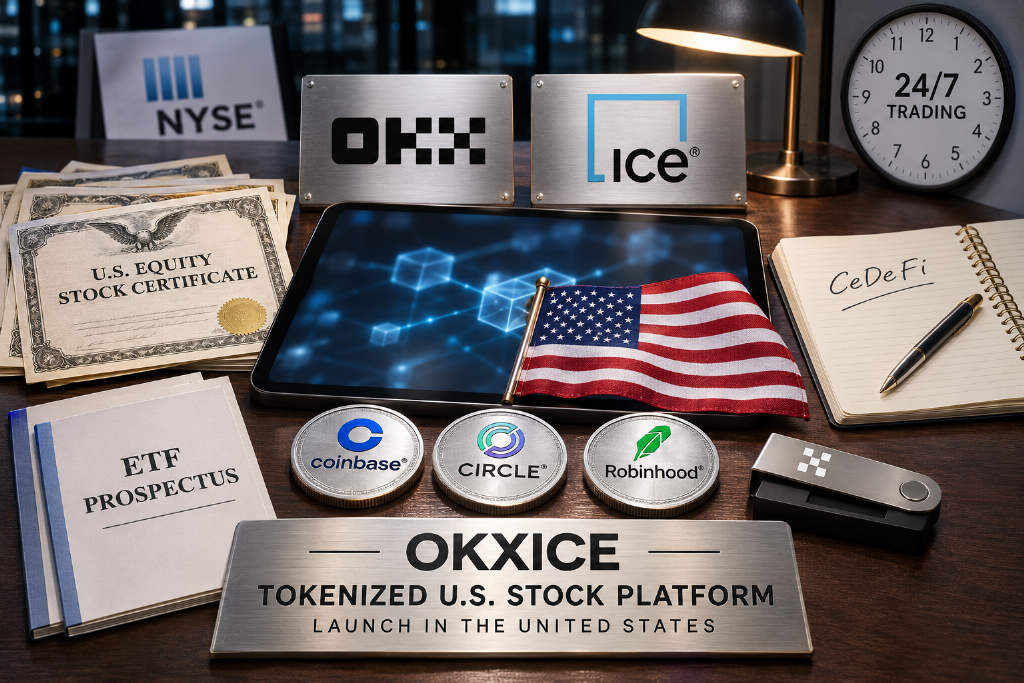
OKX-ICE venture sets November 23 target for tokenized securities venue
OKXICE, the joint venture between crypto exchange OKX and Intercontinental Exchange (ICE), the parent company of the New York Stock Exchange, plans to launch a tokenized securities trading venue on November 23. The service is expected to be available to U.S. users who hold a CeDeFi wallet and have completed the account-opening process.
The operating entity is OKXICE LLC, a Texas company owned equally by Intercontinental Exchange Holdings and OKC USA Holding. The Block reported on November 11 that the platform is expected to list tokenized exposures linked to Coinbase, Circle and Robinhood, along with exchange-traded funds.
OKXICE is not pursuing registration as a traditional securities exchange. Instead, it is using the five-year innovation-exemption framework established by the U.S. Securities and Exchange Commission (SEC). The company describes the venue as a tokenized securities trading platform serving retail traders, institutions, market makers and liquidity providers.
Liquidity pools will replace a conventional order book
OKXICE TSV will not operate a conventional order book. It will use Uniswap v4 liquidity pools on XLayer, together with the platform’s own smart-contract extensions, to control which wallets can participate. Tokenized stocks will be paired with payment stablecoins such as USDC and USDG.
The platform plans to operate 24 hours a day, seven days a week. Each trade will transfer both sides of the transaction in a single on-chain transaction, creating atomic settlement. The process will not rely on a central counterparty or net settlement.
Round-the-clock availability will not make the venue open to every wallet. Participants must complete identity or business verification, anti-money-laundering and sanctions screening, prove control of the relevant wallet, and receive account approval from a tokenization service provider. Once approved, a wallet will receive a non-transferable eligibility token.
The platform will not custody participants’ assets or provide credit financing. Users must hold the assets required for trading in self-custody wallets before a transaction is made, with delivery completed at settlement.
SEC exemption preserves underlying shareholder rights
The SEC published the temporary, conditional innovation exemption on September 17. Under Section 36(a)(1) of the Securities Exchange Act of 1934, eligible venues may receive relief from the act’s definition of an exchange. Certain liquidity providers may also receive relief from the definition of a dealer. The exemption lasts five years.
The exemption does not remove the tokenized stocks from securities-law requirements. The SEC requires the tokens to retain the same rights as comparable traditional shares and imposes conditions covering eligible asset counts, trading volume, public disclosures and smart contracts. Before a third party tokenizes a stock, it must notify the issuer and give the issuer an opportunity to object.
OKXICE’s documents state that third-party tokenization providers must be broker-dealers registered with the SEC and members of the Financial Industry Regulatory Authority (FINRA). They must hold the underlying shares on a one-to-one basis. Token holders are expected to receive the related dividend, voting and liquidation rights rather than synthetic exposure that only tracks a stock’s price.
OKXICE appeared on the SEC’s notice list after a submission dated October 4. The process relies on public notice before launch and continued compliance with the conditions. Inclusion on the list does not mean the SEC has determined that an operator satisfies every requirement of the exemption.
Sixty-seven issuers have objected
As the launch plan moves forward, issuers are still determining which assets can be made available. An OKXICE public notice dated November 5 listed 67 objectors, including Meta, Apple, Nvidia, Tesla, Netflix and Costco. Their objections concern the arrangements for trading tokens linked to their shares on the venue.
Longer trading hours also do not remove the underlying stocks’ halt mechanisms. Under the platform documents, if the original stock is halted on its primary listing exchange, the corresponding tokenized stock must also stop trading. A halt may also be triggered if trading reaches limits set by the innovation exemption.
On-chain prices will be determined by the ratio between the two assets in a liquidity pool rather than copied directly from traditional-market quotes. Outside regular U.S. equity trading hours, or when pool liquidity is thin, a token’s price may diverge from the underlying stock. Large trades may also create a more pronounced price impact.



