
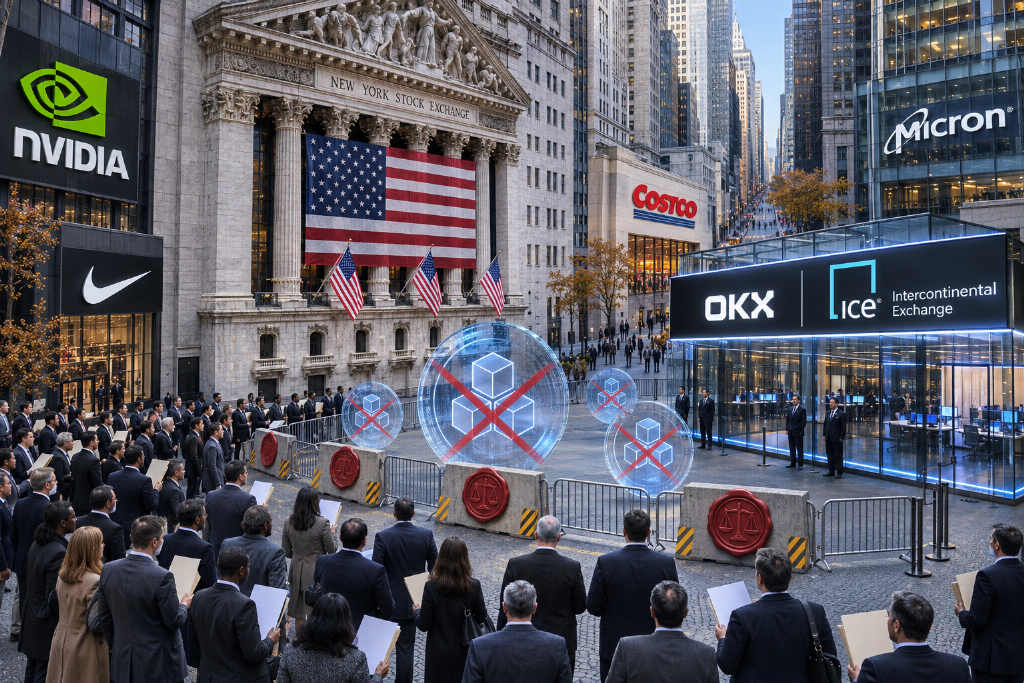
OKXICE’s tokenized U.S. stock platform is running into a wider wall of issuer pushback. Nvidia, Costco, Nike and Micron were among 12 companies added last Friday to the list of firms opposing the trading of tokenized versions of their shares on the venue. A public notice updated by OKXICE on Oct. 30 shows the total number of companies that have formally objected has climbed to 50.
That jump came just as the first group of issuers was nearing the end of its objection period.
12 more companies were added in the latest update
The Oct. 30 OKXICE notice says the newly added companies were Nvidia, Costco, Micron, Nike, CrowdStrike, Corning, IREN, USA Rare Earth, Bloom Energy, Palo Alto Networks, Reddit and Hewlett Packard Enterprise.
In that notice, they appeared as issuers objecting to the listing and trading of their shares on the platform, joining companies that had already made the same call in earlier rounds.
OKXICE is using the SEC’s innovation exemption framework
OKXICE is a joint venture unveiled by OKX and Intercontinental Exchange, or ICE, in June this year. The stated aim: let investors trade tokenized versions of U.S. stocks and ETFs around the clock using stablecoins.
The platform is operating through a tight lane created by the U.S. Securities and Exchange Commission. Under a five-year innovation exemption, a venue like this can start trading under a specific setup, while issuers keep the right to block their stocks when tokenization is arranged by an unaffiliated third party.
So these objections are not some post-launch backlash. They are baked into the veto process built into the structure itself.
43 of the original 62 companies have objected
Based on the public notice, the original list had 62 companies. Of those, 43, or about 69%, have explicitly objected. Another seven objecting companies were not on the original list, pushing the total to 50. Nineteen companies have not objected.
At that point, the possible listing pool is down to roughly one-third of its original size.
The pace of objections picked up near the deadline
The timeline in the source shows 9 objecting companies as of Oct. 18, 16 as of Oct. 21, 22 as of Oct. 25, and then 50 as of Oct. 30.
That pattern points to a slow first half of the process, with weekly increases still in the single digits, and then a hard spike in the final week. Companies did not sprint to reject the proposal the moment notices landed. The responses bunched up closer to the deadline.
Under the rules, issuers can object within 30 calendar days after receiving written notice from the venue. For companies that got notice on Oct. 4, the deadline lands on Tuesday of that week, Nov. 3. But delivery dates were not identical for every issuer, so the Oct. 30 notice does not mean every company was working off one shared cutoff.
The venue also gets up to five business days of disclosure lag. Meaning the public list can lag behind actual responses. So yes, the objection count could still rise next week.
The 19 companies that have not objected
The 19 companies that had not objected at the time of the notice were Apple, Amazon, Tesla, SpaceX, Netflix, Palantir, Strategy, Robinhood, Coinbase, Circle, SoFi, Super Micro, Lam Research, ServiceNow, GE Vernova, Boeing, Home Depot, as well as tokenization service provider Securitize and custodian BitGo.
But staying off the objection list is not the same thing as endorsing the plan, and it does not guarantee those tokenized shares will be available on day one.
The source also said Securitize and BitGo had previously told media outlets they would not object.
Andrew Cuomo said the pushback was expected
At a Friday press conference, OKXICE co-chair and former New York governor Andrew Cuomo said the objections were expected.
He said many companies want to watch how the market functions before deciding whether to join: "As more people become familiar with tokenization and see its benefits, more and more companies will participate" and "We are in the early stage of promoting a market structure that is fundamentally different."
The input also says Cuomo is a member of the OKX board.
JPMorgan offered a different framing
JPMorgan Chase, which had objected earlier, gave a different explanation. The bank said it still sees potential in the technology, but wants a more cautious approach to how shares are represented and how they are traded.
As the source frames it, the problem is not that most issuers are against blockchain itself. It is that they do not want a separate tokenized version of their shares circulating outside their control without consent.
What the 69% objection rate means for the platform
For OKXICE, the plainest effect is a smaller tradable pool. If only 19 of the original 62 names remain possible listing candidates, the platform’s menu shifts from a broad basket of U.S. stocks to a much narrower lineup of large-cap names.
Those 19 still include some of the best-known companies by market value and brand recognition, including Apple, Amazon, Tesla and SpaceX. The source says that softens the blow in outward messaging. But the deeper problem is supply depth. A lot of the AI supply-chain names and higher-volatility stocks investors may want are now less likely to be available.
Issuer consent is now part of the market structure
The source also argues that the SEC innovation exemption puts issuer preference directly into the market structure. In the past, when exchanges listed ADRs or launched derivatives on their own, issuers often had limited ability to stop them ahead of time. In tokenized equities, by contrast, the platform must go through an issuer communication process before each new name can go live.
That also helps explain the late burst of objections. For issuers, the deadline is the last line of defense. Once it passes, stopping a listing gets much harder.



