
Options are already embedded in everyday finance
Most people do not think of themselves as options traders, yet the report argues they have been interacting with options-like structures for most of their lives.
Insurance is one example. A policyholder pays a premium in exchange for a conditional payout in the future, which mirrors a put option because it protects against a drop in the value of the insured asset. A mortgage borrower with the right to refinance early can also be viewed through an options lens. That right resembles a call option because the borrower holds an exclusive right, but not an obligation, to redeem or replace an existing debt contract.
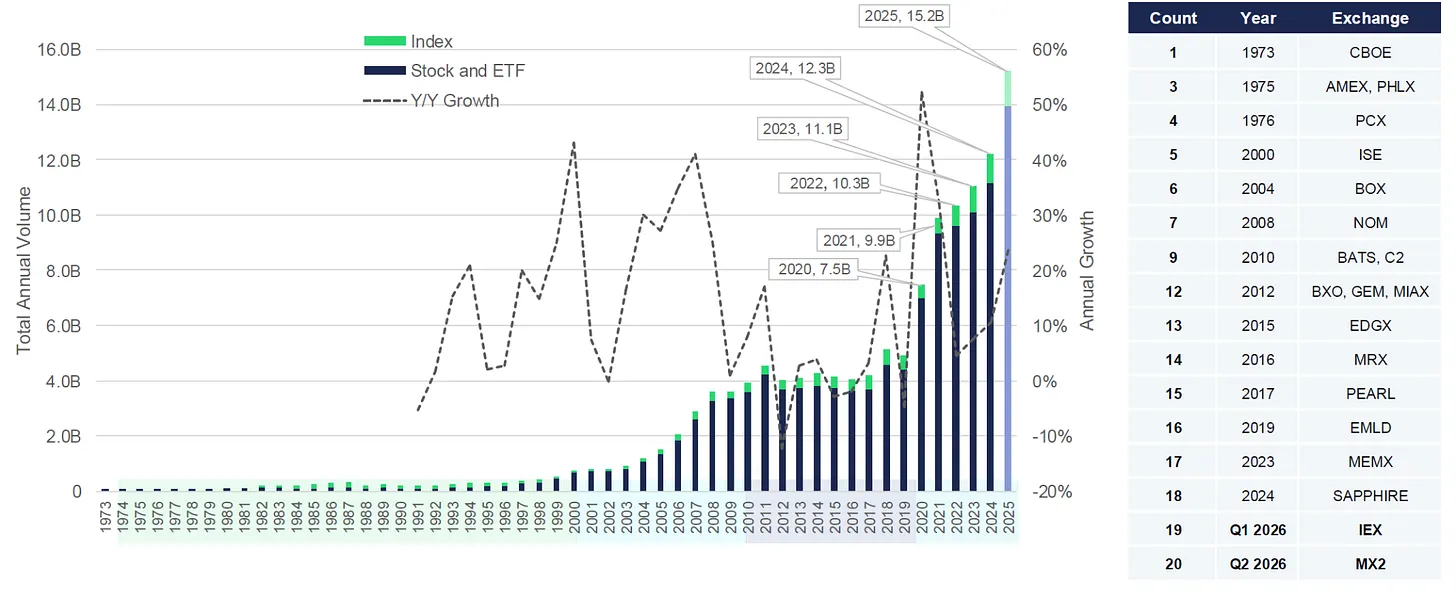
In traditional finance, options have grown far beyond a niche product. The article says options contract volume in 2024 was more than four times futures volume. In 2025, listed options in the United States hit a record for the sixth consecutive year, with about 15.2 billion contracts traded, equal to roughly $36 billion in premium traded per day.
0DTE, or zero-days-to-expiry, contracts have become a major force inside that market. For SPX alone, peak daily notional value topped $1 trillion, with an average of 2.3 million contracts traded each day, accounting for 59% of the product’s 2025 volume. These contracts expire on the same day they are traded. They are widely used to chase large intraday moves, but they also carry the risk of losing 100% of invested capital very quickly.
The report also contrasts participation patterns across regions. In 2024, India’s National Stock Exchange handled about 84% of global stock options contracts by count. By premium value, though, U.S. options buyers still paid about four times as much as buyers in India. The interpretation offered in the piece is straightforward: India’s market is dominated by large numbers of very small retail contracts, while U.S. participants trade fewer contracts with larger size and higher premium.
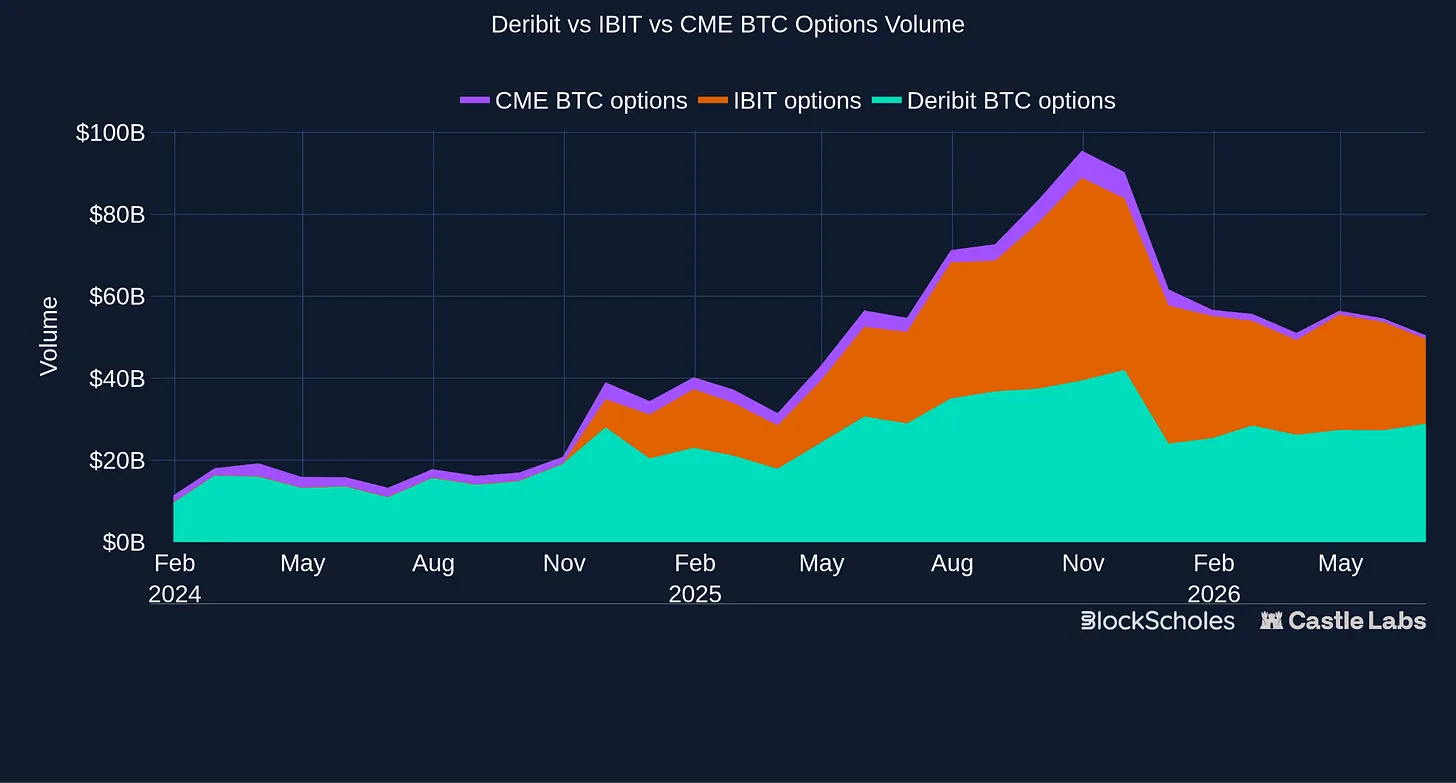
That appeal is now spilling into crypto, although institutional demand remains the main driver. CME, described in the article as the largest regulated derivatives exchange in the U.S., now offers 24/7 crypto options trading. The report treats that as a notable shift by a traditional exchange operator trying to retain users in a market that never closes. It also points to another sign of institutional pull: in April, open interest in BlackRock’s IBIT options rose from $26.9 billion to $27.6 billion and moved ahead of BTC options on Deribit, even though Deribit launched its product more than a decade earlier.
Options matter because they are flexible tools across several use cases:
- Hedging: using puts or calls as insurance against downside or missed upside.
- Income: selling options to collect premium through strategies such as covered calls or cash-secured puts.
- Speculation: expressing a view on price direction, timing or volatility without directly buying the underlying asset.
- Structured strategies: combining multiple options into packaged products used by banks and asset managers for yield or downside protection.
That makes the user base broad, from market makers hedging risk and banks packaging yield to volatility funds and retail traders chasing same-day moves.
Why early on-chain options struggled
Given their role in traditional markets, options seemed like a natural fit for crypto’s volatile on-chain environment. The outcome was much weaker than expected. The report describes the category as one of the most repeated failures in on-chain markets.
Lack of experimentation was not the problem. A long list of projects tried different approaches in earlier cycles.
Opyn tokenized vanilla options on Ethereum in 2019, but thin liquidity, heavy collateral requirements and high mainnet fees held it back. Hegic tried a peer-to-pool model in 2020 to simplify the buyer experience, but pooled LPs were left with risk that was difficult to hedge.
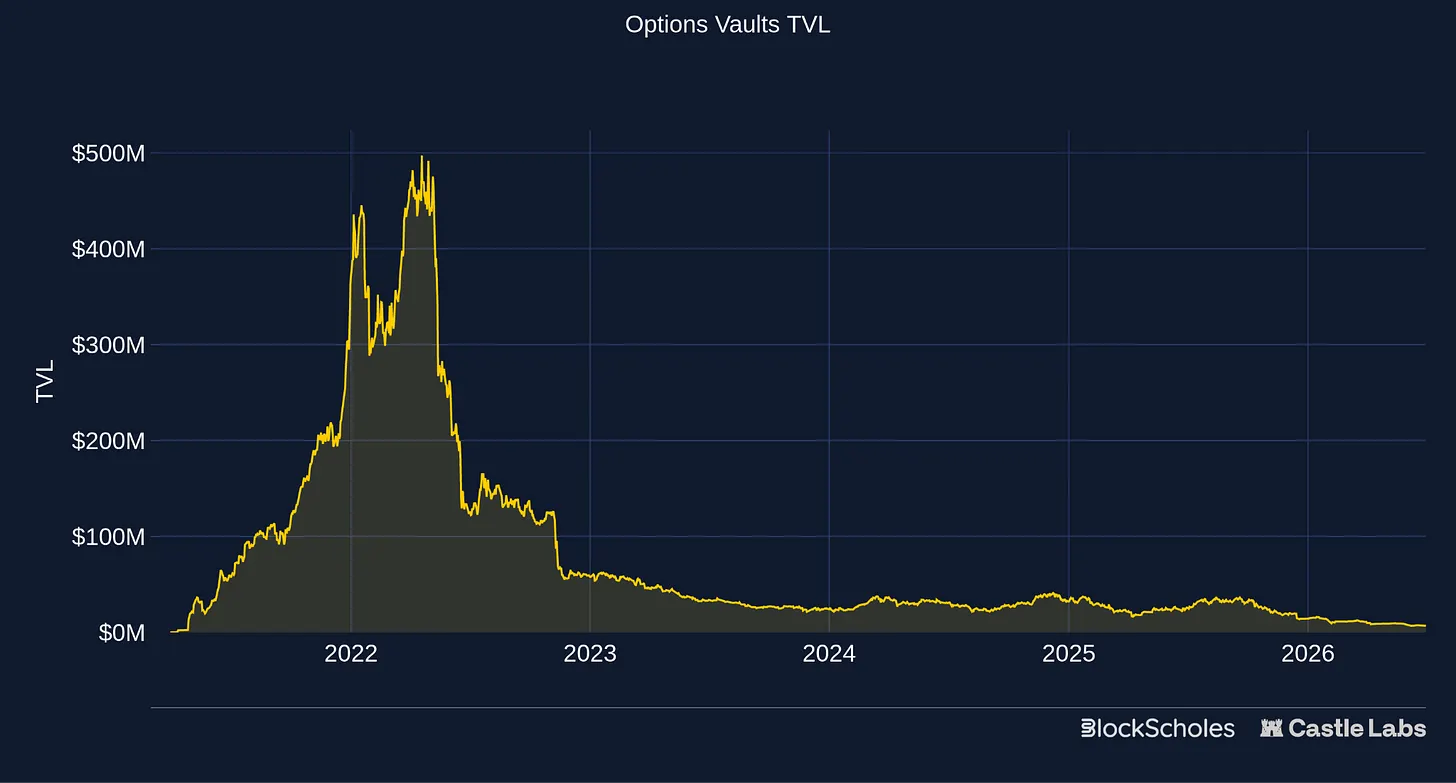
Ribbon, Friktion and Dopex launched vault products in 2021 for users who wanted yield without managing positions directly. Those structures made options feel like deposit products, but volatility was being sold into thin and cyclical demand. Over time, yields were compressed until the premium no longer compensated for the risk taken.
Lyra, Premia, Pods and Siren experimented with options AMMs in an attempt to provide continuous liquidity across strikes and expiries. They ran into pricing and hedging problems. Liquidity providers inherited complex volatility and inventory risk, while organic order flow remained limited.
In 2022, Opyn introduced Squeeth, a perpetual instrument designed to track squared ETH exposure and give users convexity without managing rolling dated options. The product arrived on Ethereum when fees were still high, was difficult to explain, and became expensive to hold when funding costs rose.
The report argues that the sector kept running into structural constraints. Market-maker participation was weak, which meant two-sided liquidity stayed shallow and difficult-to-hedge risk was pushed toward passive LPs. Capital efficiency was poor. Volatility surfaces were unreliable. User experience sat in an awkward middle ground: too complex for retail users, but still missing the architecture institutions expected.
Infrastructure has changed, and so has the setup
Conditions have improved since those early attempts.
Rollups and Ethereum scaling have lowered gas costs enough to make more complex on-chain actions economically viable, while also improving execution and settlement. CLOB and RFQ models are starting to replace AMMs, creating an environment that better fits professional traders and market makers who want to quote specific strikes and expiries, update prices in real time and manage risk more precisely.
Product design has also narrowed its focus. Venues are building for specific user groups rather than trying to serve everyone with the same structure. Prediction markets have helped normalize binary, options-like payoff profiles for mainstream retail traders by reducing conditional trades to simpler yes-or-no outcomes.
Institutional demand for crypto options has been rising steadily through Deribit and, more recently, through IBIT and CME. On-chain metrics have improved as well. The article says on-chain options now generate about $1.44 billion in 30-day notional volume, while premium volume this year has reached a record high.
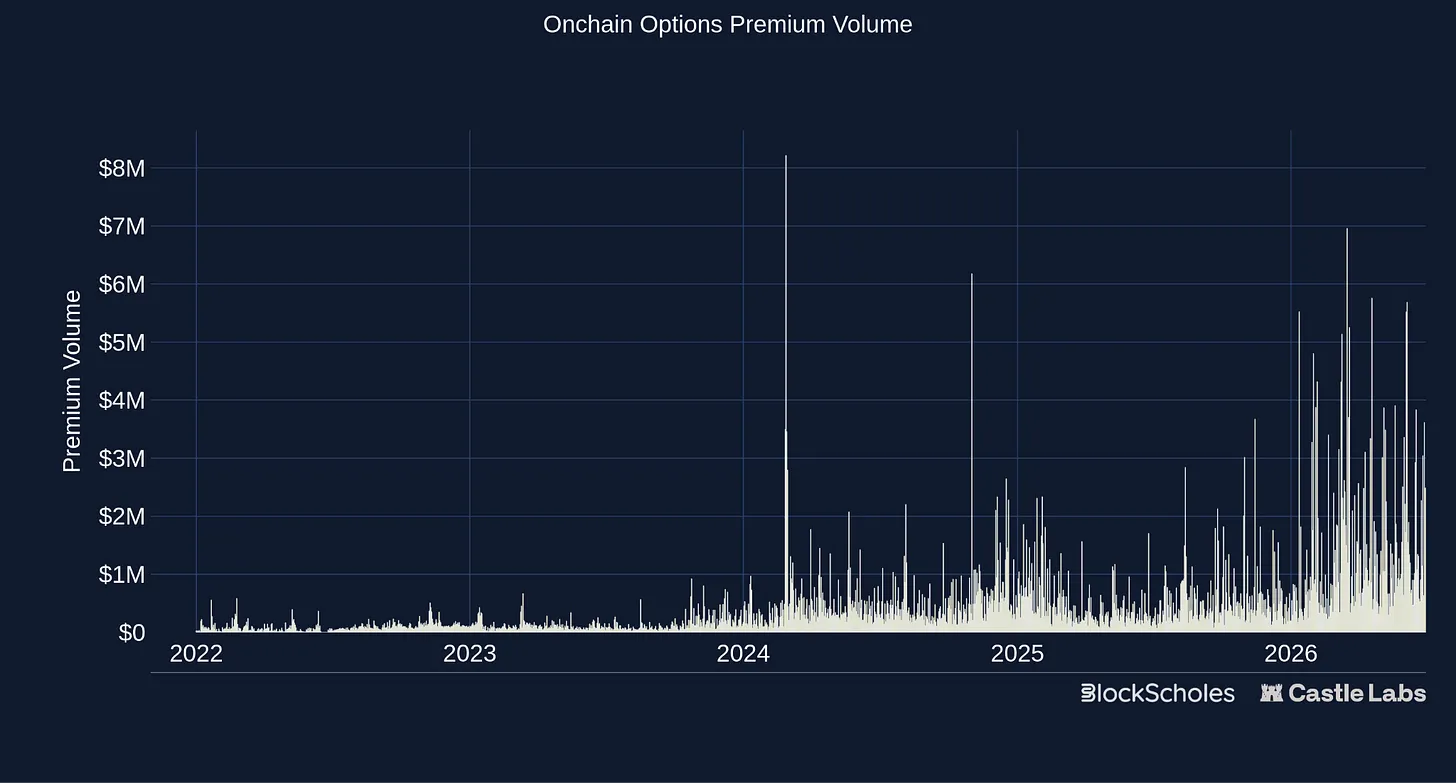
As a result, the category looks very different from the first DeFi options cycle. Protocols are no longer simply trying to become an on-chain version of Deribit. The landscape now includes institutional venues, ETF wrappers, on-chain vanilla options, exotic options and binary-style options expressed through prediction markets.
A market split by settlement and payoff design
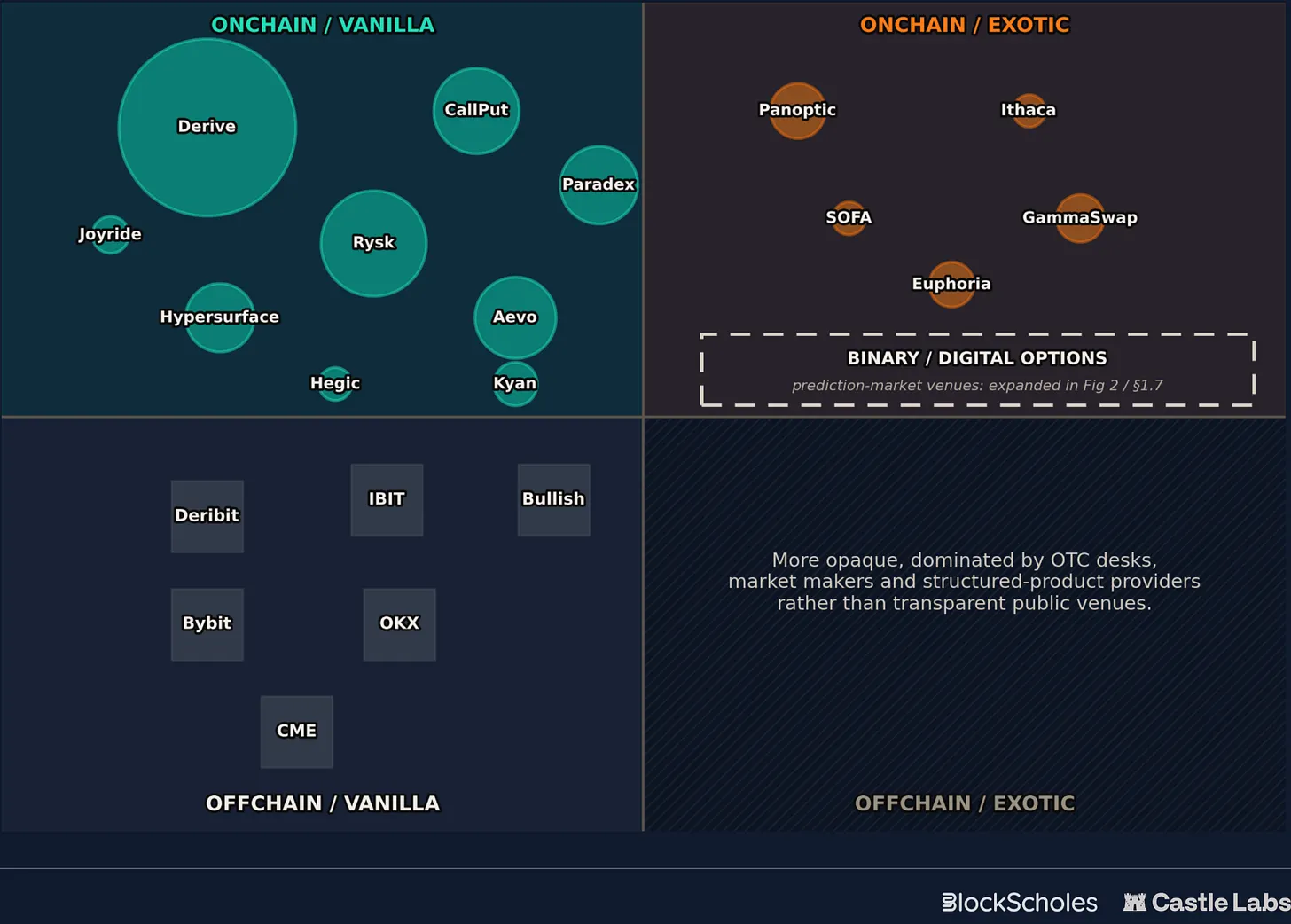
The report maps the crypto options ecosystem across two dimensions:
- Settlement: on-chain to off-chain
- Payoff: vanilla to exotic
Off-chain vanilla options remain the clear leader, with Deribit, IBIT, CME and centralized exchanges such as Binance and OKX at the front. On-chain vanilla venues are rebuilding around CLOBs, RFQs and simpler user-facing products while settling trades on-chain.
More experimental products fall into the on-chain exotic segment, where options or options-like payoffs are used as building blocks rather than listed calls, puts and spreads. The examples in the article include:
- Perpetual options, which replace fixed expiries with streaming premium so traders can hold volatility exposure without constantly rolling positions.
- AMM-native options, which derive options-like exposure from AMM liquidity positions rather than listed contracts.
- Short-dated touch options, which pay a fixed amount as soon as an asset hits or breaks through a defined level.
The fourth quadrant, off-chain exotic options, is described as less transparent and largely controlled by OTC desks, market makers and structured-product providers rather than public trading venues.
The report focuses on the on-chain half of that map: vanilla options venues, exotic options primitives and the binary-style market category most often expressed through prediction markets.
Vanilla on-chain venues: Derive, Rysk and Aevo
Recent progress in on-chain vanilla options has come less from changing the payoff itself and more from improving surrounding infrastructure, product packaging and user experience. Many venues have moved away from passive LP pools and toward CLOB and RFQ systems. They are also making room for portfolio margin, yield-bearing collateral and products with more targeted outcomes.
Derive: a professional exchange built on the Lyra transition
Derive is one of the clearest examples of that transition. It evolved from Lyra’s options AMM into a CLOB-based platform running on its own OP Stack L2, where users can trade cross-margined options and futures through a professional order book interface.
Rather than hiding complexity, Derive leans into it. The target audience is professional traders, market makers, institutions and other experienced volatility traders. The venue looks much closer to a traditional options exchange, with multiple assets, strikes and expiries that can be combined into customized payoff structures.
It uses an off-chain matching engine for near-instant execution and an on-chain L2 for settlement. The article says that setup gives allocators execution speeds comparable to centralized exchanges such as Deribit while preserving non-custodial ownership of assets. Derive also offers vault products, but unlike older attempts, those vaults use the exchange underneath to execute predefined options strategies meant to earn yield for depositors.
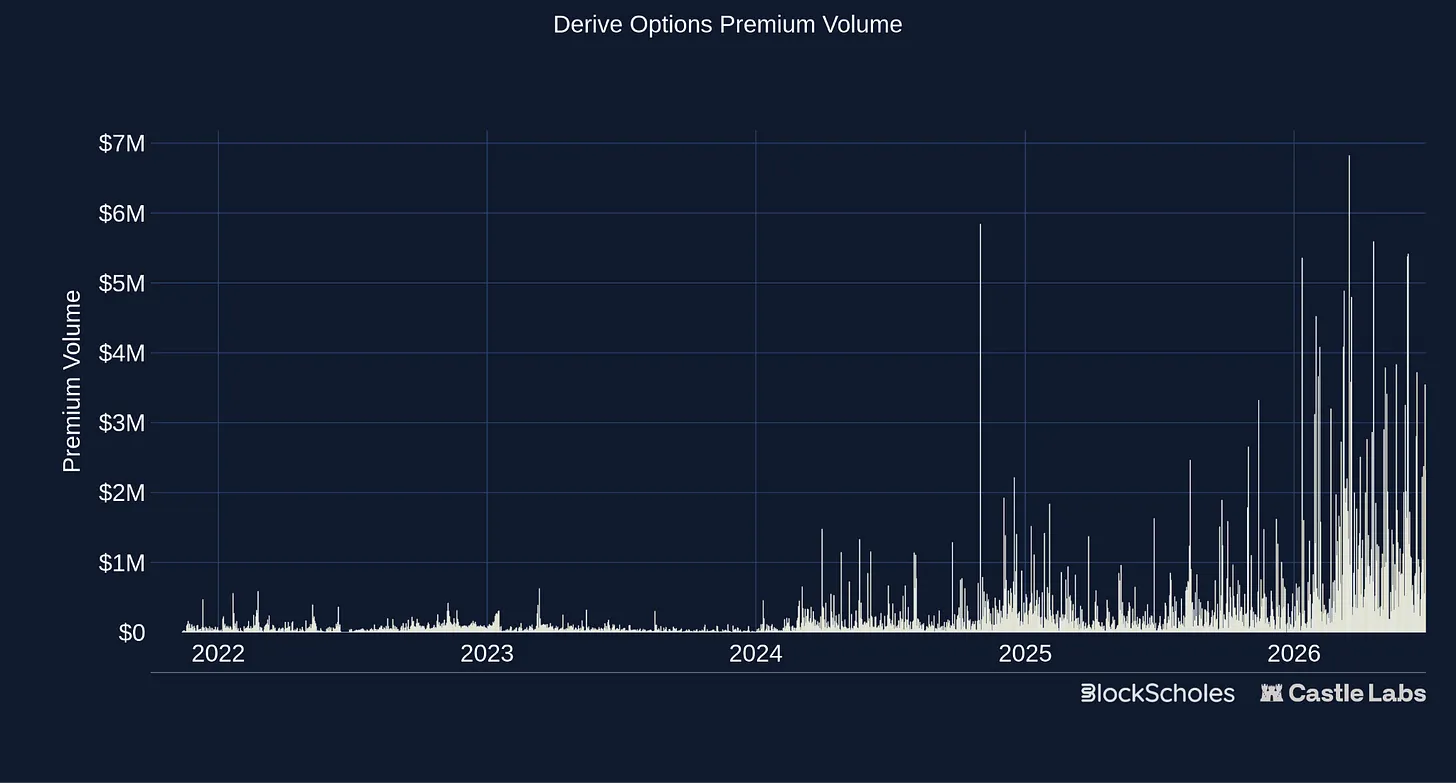
On recent activity, Derive dominates the category. Over the last 30 days it recorded $1.142 billion in notional value and $44.3 million in premium, equal to 79.2% and 87.2% of the category respectively. The report notes that liquidity is supported by market-maker rewards, OP incentives, DRV incentives and rebate programs.
Even with incentives in the picture, Derive shows how far the category has moved: a mature options exchange operating on a high-performance appchain and open to institutions and market makers.
Rysk: reframing options as an income product
Rysk takes a very different route. It is built around covered calls and cash-secured puts, using options as prepaid yield products while still allowing users to choose strike and expiry. That separates it from earlier vault models.
Its RFQ system routes user demand to market makers, who quote specific requests and manage the resulting risk elsewhere. Rysk’s main bet is that options become easier to adopt when the platform simplifies the user outcome rather than exposing the full mechanics. Strong asset selection, clearly defined trade outcomes and a smoother user experience are meant to appeal to both retail and institutional users.
For users, the product is simple: earn yield on an asset while pre-committing to a price level where you would be willing to buy or sell. That translates into a broad user mix. The article points to treasuries, DAOs and funds as long-term holders that often already have a view on where they are comfortable buying or selling, and can earn yield at more distant strikes while they wait. It also cites institutional use. Hyperion, described as a Nasdaq-listed HYPE treasury company, runs curated vault strategies on Rysk’s infrastructure. Because its mandate is to accumulate HYPE, cash-secured puts fit naturally by placing bids at lower prices while collecting premium.
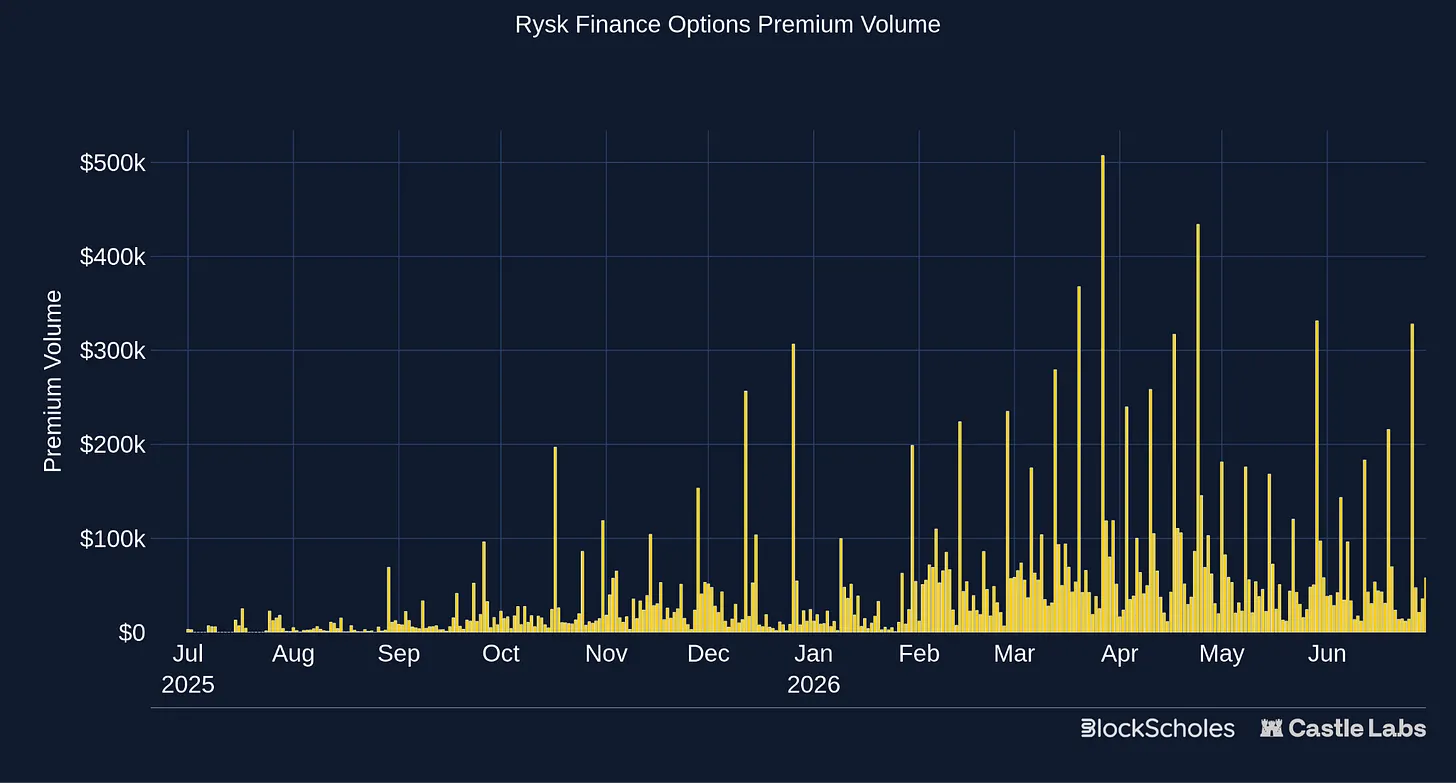
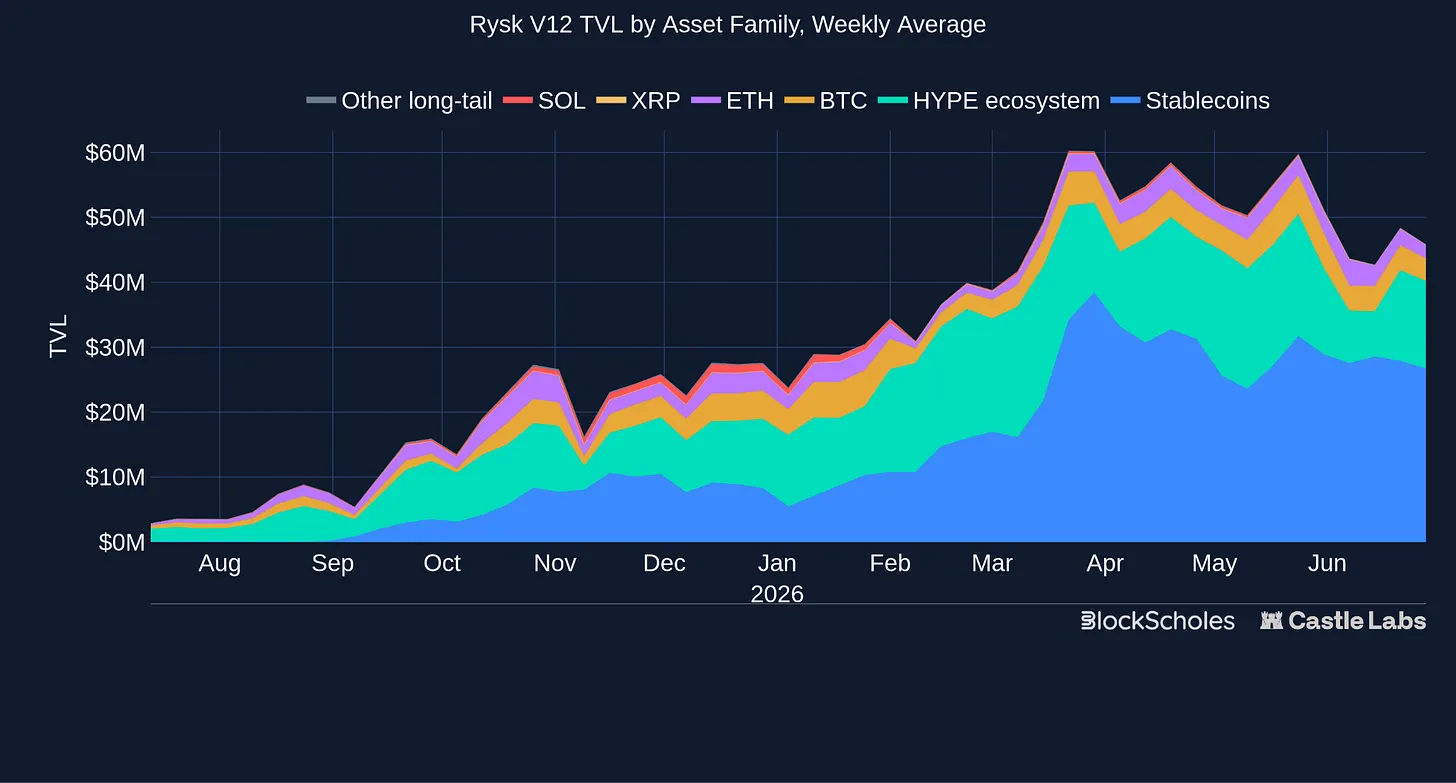
Rysk generated $136.3 million in notional value and $1.94 million in premium over the past 30 days, representing 9.5% of the category by notional value. Monthly notional volume rose from $50 million in January to $182 million in May, while March and April each remained above $175 million.
Unlike Derive, TVL matters more for Rysk because its product is based on collateralized option-selling strategies. Users must deposit full collateral to earn premium. On Derive, by contrast, traders can buy low-premium options to pursue large upside.
The report’s conclusion is that Rysk has found a different kind of product-market fit in options: not as a pure trading tool, but as a volatility-selling yield product. With yields compressing across the industry, that positioning has become more competitive relative to lending, staking and basis products, and the report treats Rysk’s steady growth since launch as evidence.
Aevo: options inside a broader derivatives venue
Aevo, like Derive, moved from an earlier options identity into an order-book exchange model. It grew out of Ribbon Finance, one of the earliest major DeFi options vault projects, before shifting toward a broader derivatives platform.
Today Aevo runs on a custom L2 and offers options, futures, pre-launch markets, OTC trading and automated strategies. It uses off-chain order matching and on-chain settlement. Orders are matched on an off-chain central limit order book in microseconds to mimic the experience of a centralized exchange, while user funds remain in on-chain smart contracts on a custom OP Stack Ethereum L2 rollup.
Aevo launched in 2023 and was most active in options during 2024. Since then, reported TVL and visible options activity have fallen from earlier highs, though premium trading in options has recently started to recover.
Its key differentiator is the unified margin account spanning several products. That includes pre-launch token markets, where users can trade high-leverage options and futures tied to highly watched tokens before those assets reach the spot market.
In the past 30 days, Aevo produced $45.1 million in notional value and $2.52 million in premium, equal to 3.1% of on-chain options notional volume. Monthly notional value increased from $20 million in January to $50 million in May, but live options open interest was only about $3.6 million, far below Derive and also below Rysk’s proxy based on open notional value.
The article says incentives may be supporting part of the activity. Aevo distributes 1 million AEVO in weekly trading rewards, with 30% reserved for options. That may help explain some of the recent pickup in volume. Still, as the exchange migrated toward futures, pre-launch markets and general trading activity, options now appear more like a secondary product than the core business. The team is clearly trying to lift activity in that segment, but the report stops short of saying whether those incentives can fully revive Aevo’s options market.
Other venues are smaller, more fragmented and more varied
Below Derive, Rysk and Aevo, the rest of the market is smaller and more fragmented.
Paradex is another broad derivatives platform, built by the Paradigm.co team, which the article describes as a provider of institutional crypto derivatives liquidity. Paradex offers futures, options and several Vault Traded Funds, or VTFs. It previously supported perpetual options, but has recently paused that feature and shifted focus to dated options that opened in April. To win traders and share, it reintroduced zero-fee trading across futures, spot and options.
Hypersurface looks closer to Rysk, offering income products on HyperEVM through covered calls and cash-secured puts. CallPut differentiates itself by extending beyond crypto and listing stocks including SPCX, TSLA, NVDA and COIN on its vanilla call and put venue, using request-based execution and protocol-managed liquidity.
Kyan evolved from Premia into a broader derivatives exchange, using an order-book model with RFQ support. It offers portfolio margin and multi-leg combination trading for more customized positioning. Ithaca provides a wider range of options, strategies and structured products and has recently integrated AI agents into the protocol for options strategy management. SOFA.org packages options-like outcomes into structured products such as Earn and Surge rather than having users trade options directly.
The article says the lower end of the market is becoming more diverse, and newcomers such as Kyan, Paradex and CallPut have recently captured some share of premium trading volume.
Still, better infrastructure does not create demand on its own. Order books, RFQ systems, cross-margin and portfolio margin improve market structure, but they do not answer why a user should pick options over futures for directional exposure, or options over prediction markets for event trading.
The report argues that demand is clearest when options solve a specific problem for a specific asset holder. It returns to the example of Rysk and HYPE, saying the product works because it gives newly wealthy HYPE holders a way to earn yield, manage entry and exit levels, and monetize exposure without simply selling the asset. If teams want stronger growth, they need products built around user problems that futures and prediction markets cannot easily copy.
Exotic and short-dated on-chain options primitives
The article uses the term exotic and short-dated options primitives for options-like products that go beyond listed calls, puts and spreads. These structures may remove fixed expiry, derive exposure from AMM liquidity, or settle based on whether price enters a target zone in a very short time window.
Vanilla on-chain options are becoming more sophisticated and more professional, but they still mostly reproduce familiar off-chain products. Exotic and short-dated primitives expand the design space, pursuing payoffs that standard listed options do not easily deliver: perpetual convexity, AMM-native exposure and ultra-short touch markets.
The report is cautious, though. Most of these ideas remain commercially unproven. In many cases, they solve for interesting payoff design before they solve for user demand.
Perpetual options
Perpetual options remove expiry from the equation. Instead of selecting a fixed maturity, traders hold a continuous convex exposure that is financed over time, resembling perpetual futures in structure but with more upside asymmetry. Squeeth is the historical example, giving users ETH-squared exposure. Paradex has also tested perpetual options, although its current live market only lists dated products.
The problem is that removing expiry does not remove complexity. Compared with standard futures, users still need to understand convexity and now must also manage ongoing funding or premium costs, deciding when holding the position no longer makes economic sense. That weakens one of the classic advantages of standard options, where the premium and payoff are known upfront. The report treats perpetual options as an interesting primitive, but not one that has yet made the product simpler or broadened adoption.
AMM-native options
Traditional options venues fragment liquidity across strikes and expiries, forcing market makers to update quotes as price moves. Even with faster and cheaper chains, that remains difficult, especially on Ethereum mainnet, and often pushes execution off-chain.
Panoptic and GammaSwap took a different path by using AMM liquidity itself to create options-like exposure.
Panoptic uses Uniswap V3-style liquidity ranges to create perpetual options. Instead of paying a fixed premium upfront for a fixed expiry, buyers pay streaming premium over time, while the liquidity range acts as the basis for strike and exposure. This makes it possible to create options on long-tail assets already trading on an AMM without spinning up a separate order book. The article says Panoptic V2 has just launched with perpetual options trading for ETH and SPCX. Depositors, meanwhile, can enter the Unicorn vault, which stays delta-neutral and scalps gamma, or the PLP Vault, which uses deposited ETH liquidity to earn Uniswap fees, Panoptic premium and borrowing fees.
GammaSwap approached the problem differently in V1 by allowing users to borrow AMM liquidity and create perpetual options exposure. That made it possible to hedge impermanent loss or speculate on token volatility without relying on oracles.
The report describes these products as some of the most complex DeFi-native designs in the category. Panoptic may reduce expiry fragmentation, but it also introduces streaming premium, liquidity-width concepts and AMM range mechanics, which means users still need to understand Uniswap V3 and liquidity provision. GammaSwap, for its part, has now fully pivoted and is trying to address earlier capital-efficiency and complexity issues by using an order book to build crypto-focused binary markets. Those markets offer simple convex trades without liquidation risk: users are either right and win, or wrong and lose.
Short-dated touch options
This category may be the furthest from a standard call or put. Instead of buying upside or downside exposure tied to a fixed strike and expiry, users choose a simple condition inside a short time window: will price enter this zone, close above this level, or settle in the money within the next few minutes?
Euphoria’s Tap Trading is presented as the latest on-chain example. Users select a grid square representing a price range over a five-second window. Payouts are quoted in advance by professional market makers and vary based on distance from spot, time to expiry and volatility. If price enters the selected zone before expiry, the trade wins. If not, it expires worthless.
The direction is similar to GammaSwap V2’s binary markets. The target user wants to bet on crypto price moves over increasingly short horizons, so the main competition is less the traditional options exchange and more perpetual futures, prediction markets and mobile betting products. The appeal is simplicity. Traders get convex exposure without having to manage funding rates, liquidations, Greeks or time decay.
Why options and prediction markets are structurally the same tool
The article closes by linking options to prediction markets. It argues that the rise of prediction markets among retail users is the first real case in which non-linear payoff products have gained meaningful traction on-chain.
Most users trading these products may not realize that many financial prediction markets, including BTC up-or-down markets, are structurally identical to binary options, a well-known and extensively studied instrument in traditional finance. Each contract pays a fixed amount at expiry if a condition is met, and $0 if it is not.
The piece says this article is drawn from a broader research effort on the revival of on-chain options and frames both options and prediction markets as part of the same expansion in crypto trading tools, together with the volatility required to price them. The research was published in collaboration with Block Scholes.