

Author: xparadigms, Four Pillars
Compiled by: TechFlow
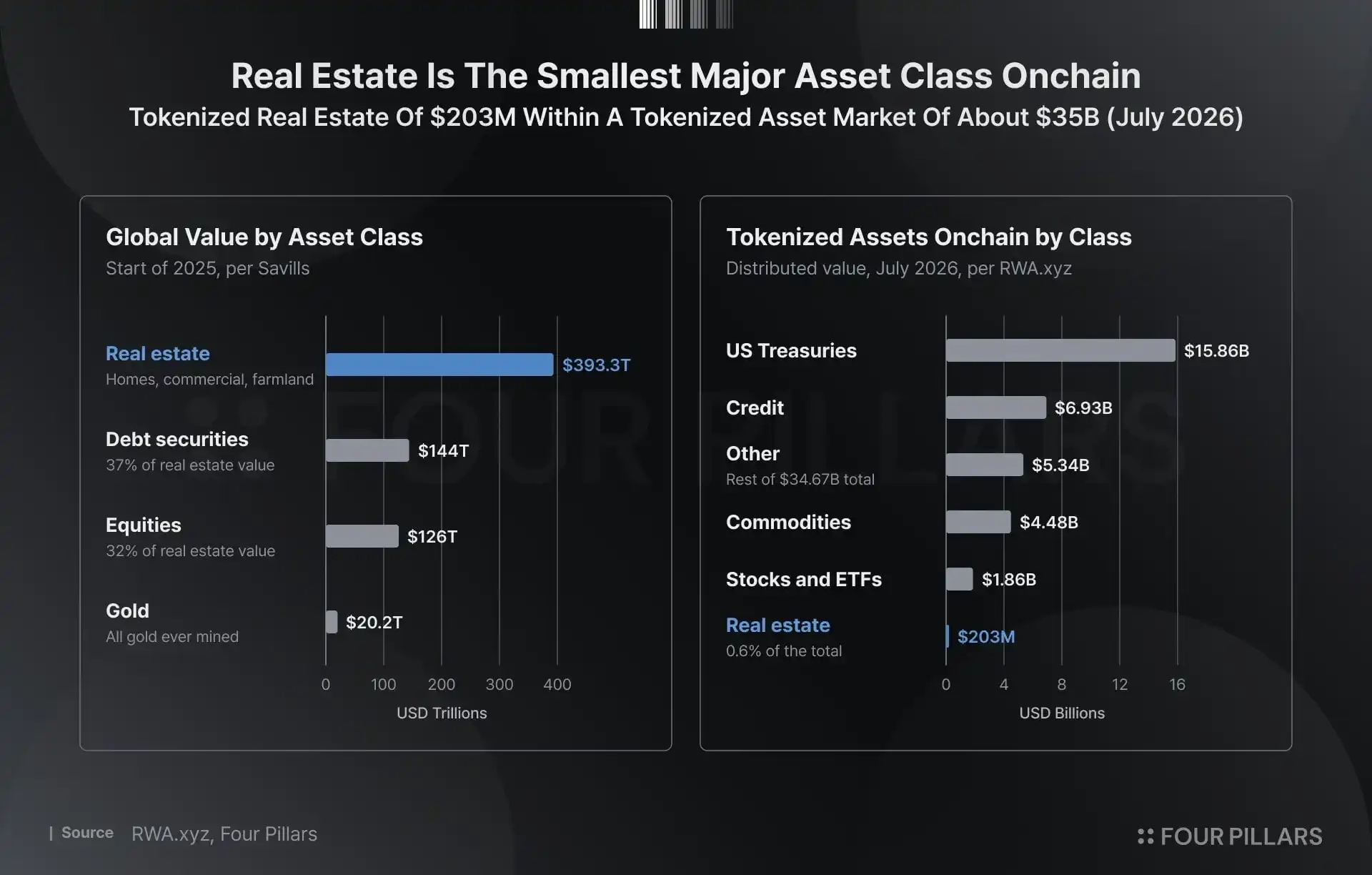
Real estate is the world’s largest physical asset class, but it remains one of the least penetrated sectors in on-chain real-world assets (RWA). Tokenized real estate across distributed networks was worth about $203 million as of July 2026, according to RWA.xyz data cited in the report. That represented only a small share of a tokenized-asset market worth about $35 billion.
The earlier effort to close that gap focused on splitting ownership of individual buildings into blockchain-based fractions. The model has repeatedly struggled. Property maintenance remains an off-chain burden, platform operating costs are high, and secondary-market liquidity is thin.
A different direction is now taking shape. Rather than placing an entire building on-chain, new products are turning real-estate debt and price exposure into standardized financial assets. Figure has built a large on-chain housing-credit business, with its assets connected to composable DeFi markets such as Solana. At the same time, leveraged trading and macro-hedging products based on recognized home-price indexes are attracting institutional capital.
Five businesses share the real-estate label
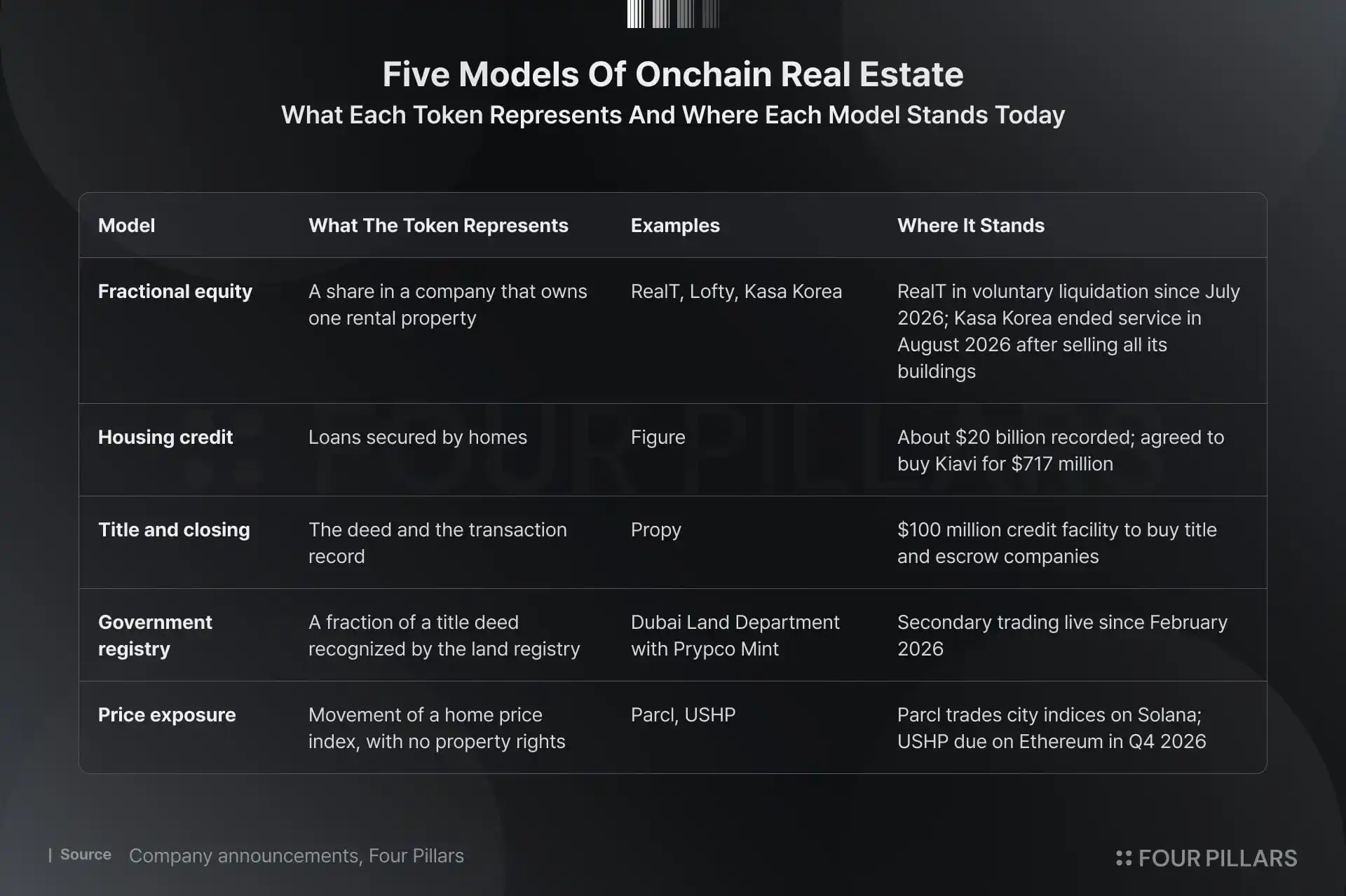
On-chain real estate covers five business models with very different underlying rights. The rights attached to a token shape its revenue model, cost structure and chances of surviving at scale.
Fractional equity
Fractional-equity platforms sell investors shares in a company or trust that owns a single physical property. Token holders receive periodic rental distributions and wait for a future sale of the asset. The platform earns listing and management fees.
Those fees often fail to cover day-to-day operating costs. The model is therefore the most fragile of the five. RealT, Kasa Korea and Funble have all shut down and entered liquidation.
Housing credit
Housing-credit products record home loans on a distributed ledger. Investors hold the debt and receive the mortgage interest paid by borrowers. The platform earns from the spread and service fees generated through loan origination and servicing.
Figure reported $393 million in net revenue and $132 million in net income in the first half of 2026. The business model has been tested in the market, but it depends heavily on asset scale. Pineapple Financial, by comparison, has placed more than $1 billion in mortgages on-chain, yet reported only $2.1 million in revenue over nine months.
Title and closing
This category covers title checks, third-party escrow and transfer registration. It helps move property from seller to buyer but does not offer an investment product.
Propy records the title and closing process on-chain and charges a fee for each closing. The company is using a $100 million credit facility to acquire traditional title companies. The business has steady cash flow, but expansion depends on buying licensed firms one by one, which limits the pace of growth.
Government registries
Government registry models involve a public authority directly in fractional ownership. An official land registry records token holders as legal owners, giving them the clearest form of legal title among the models described here.
Dubai-based Prypco Mint earns fees from token issuance and transfers. It is currently open only to residents of the United Arab Emirates. Its authority comes from the official registration framework, while its expansion depends on the approval process of a single regulatory entity.
Pure price exposure
Price-exposure products remove the physical property from the structure. Parcl offers leveraged derivative contracts linked to home-price indexes for major cities. USHP, built around an Index Industries home-price index, plans to launch a collateral-backed spot index token in the fourth quarter of 2026.
The model relies on assets gathered into the index and fees generated by secondary-market trading. A frequently updated daily index could also become the underlying asset for perpetual contracts, in a structure comparable to Hyperliquid’s HIP-3 products linked to traditional stock indexes.
The report’s comparison points to a clear divide. Models built on existing cash flows, such as mortgage interest or closing fees, have expanded more successfully. Products that ask investors to back a single building must deal with tenant defaults, repairs and local legal issues for each property.
Why on-chain real estate has not taken off
Investors generally buy real estate for two reasons: recurring cash distributions and long-term capital appreciation. Tokenization was initially presented as a way to lower the entry barrier, much as U.S. real estate investment trusts made expensive, illiquid property exposure easier to hold and transfer.
Existing on-chain property products have struggled to deliver on that promise. The report identifies four problems: advertised yields are difficult to sustain, platform economics can fail to cover operating costs, secondary-market liquidity is extremely limited, and unlevered property appreciation is too slow to attract on-chain capital.
Advertised yields are not always delivered
Advertised or distributed annual yields for on-chain real-estate products generally range from 3.4% to 16%. Many of these figures have not been subject to rigorous independent third-party audits. The basis used to calculate a yield matters more than the headline number.
RealT once advertised annual rental returns of 6% to 16%. By the end of 2025, it had stopped paying most of the amounts due. The company formally halted dividend distributions in February 2026 and announced a voluntary liquidation in July 2026.
Some of the higher yields still advertised in the market are stated expectations or estimates based on averages. Prypco Mint markets a net annual return of 8% to 12%, but that projection combines current rent with expected future appreciation in property prices. Lofty stated that its 111 properties generated an average rental yield of 9.2% as of May 2026, without publishing the underlying calculation formula.
Credit products have a different source of return: actual interest paid by borrowers. Figure disclosed a 9% realized yield for its home-equity-backed pool in February 2026. PRIME, a token issued by Hastra and backed by that pool, showed a native annual yield of 6.01% on DefiLlama.
More restrained figures appear in products backed by licensing, actual account payments or third-party tracking. Before Lucentblock sold its property in Daejeon, South Korea, in October 2025, the actual annual dividend paid to investors was about 5%. Mitsui’s land token tied to the AEON Omiya shopping center, issued under Japan’s Financial Instruments and Exchange Act, carried an expected pretax yield of 3.4%.
Across these examples, yields backed by formal licensing, actual payments or independent tracking generally fall in the 3% to 6% range.
Japan issues the most, but trades the least
Japan is currently the world’s largest regulated market for real-estate security tokens. During fiscal 2025, issuance of Japanese real-estate security tokens reached 140.8 billion yen, about 85% of total security-token issuance in Japan. BOOSTRY expects cumulative public issuance to reach 530 billion yen in fiscal 2026.
The Japanese market has expanded through its close integration with traditional finance. Trust banks hold the underlying real estate, while large brokerages such as SBI and Nomura distribute the tokens directly to retail and high-net-worth clients. Blockchain is used mainly to replace back-office recordkeeping and settlement between institutions.
That compliant, closed structure also helps explain why Japan has not developed an open market with deep secondary liquidity.
- Secondary-market liquidity is close to zero. As of March 2026, the Osaka Digital Exchange, or ODX, listed only eight token products with a combined market value of 33.6 billion yen. Settlement still required two business days, or T+2.
- The underlying networks are largely closed. Most tokens run on private consortium chains assembled by licensed institutions, leaving them disconnected from offshore capital and open DeFi liquidity. Progmat only recently began testing bridges for some tokens to the Avalanche public blockchain.
- The products function mainly as savings substitutes. An annual return of about 3.4% can appeal to risk-averse Japanese savers, but it has limited appeal for global crypto capital. Low turnover suggests that most buyers treat the tokens as fixed-income instruments to hold until maturity.
Japan shows that a mature licensing and distribution network can quickly increase tokenized-asset issuance. Issuance alone, though, does not automatically create a deep secondary market.
Property appreciation is too slow for on-chain capital
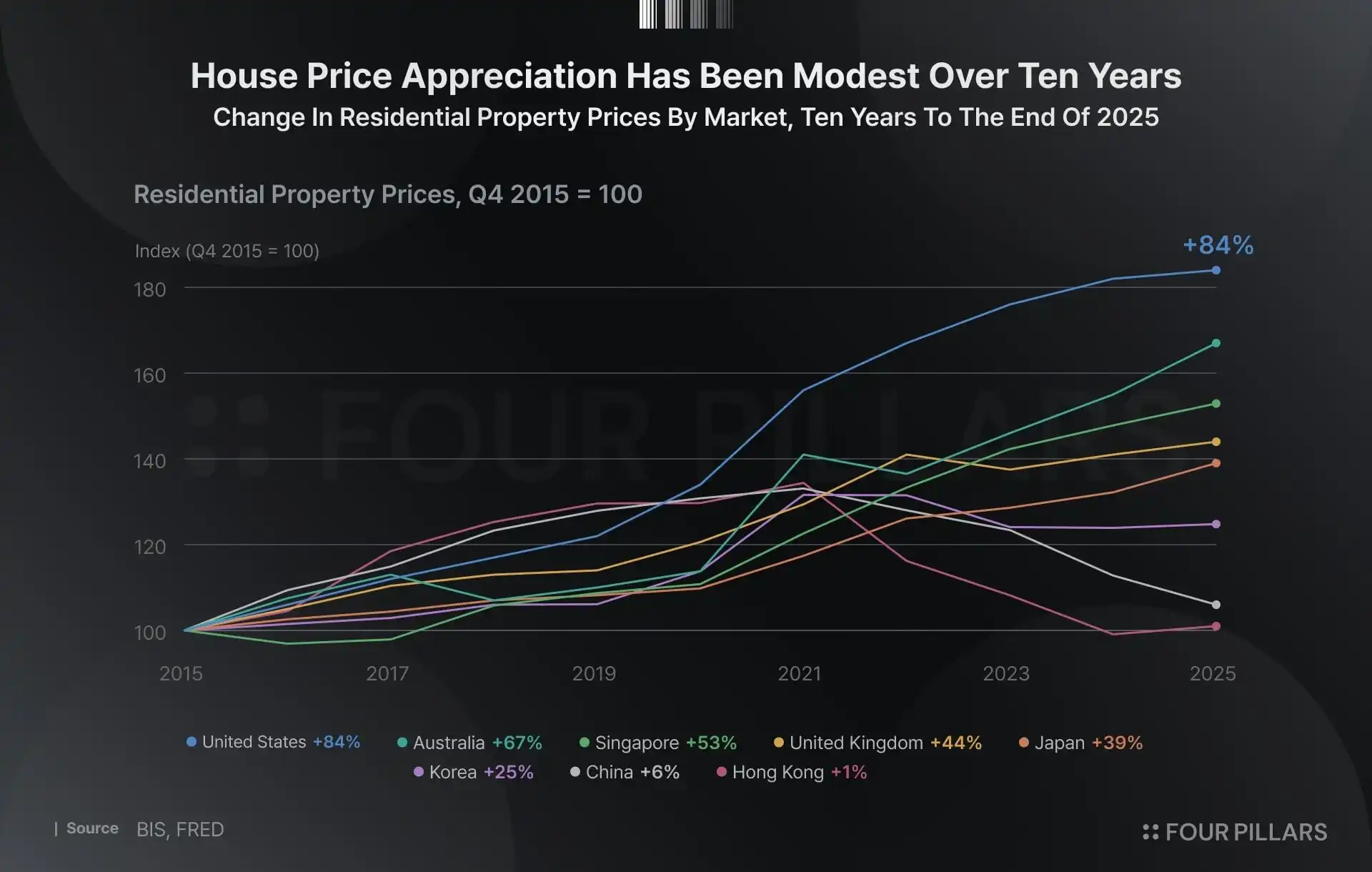
Physical real estate generally appreciates too slowly to attract large pools of native on-chain capital. Data from the Bank for International Settlements, as cited in the report, shows that U.S. real estate had the strongest performance over the 10 years through the end of 2025, with an aggregate gain of 84%, or about 6% annualized.
Singapore recorded annualized growth of about 4% over the same period, Japan about 3%, and South Korea about 2%. China and Hong Kong’s home-price indexes had almost returned to their starting points at the end of the decade.
For investors used to faster on-chain turnover, those compound returns appear modest. On-chain mortgage credit can provide fixed returns of 6% to 9% without direct exposure to falling home prices. Tokenized U.S. Treasuries have grown to $15.9 billion, while narrowly defined on-chain real estate remains at about $203 million.
Homebuyers in the physical market can build wealth partly because they borrow mortgage leverage from banks and receive the practical benefit of living in the property. A token holder generally has only unlevered price exposure. To compete with larger asset classes, on-chain real estate would need to add leverage or a yield-bearing structure to that exposure.
Putting price and debt on-chain
Many early projects tried to move concrete buildings onto the blockchain without changing the underlying operating burden. Rental management, narrow exit channels and maintenance costs eventually weighed on the model.
The report identifies two approaches with a different structure. Both leave the physical building in the offline world and put only price exposure or debt on-chain.
A leveraged trading and hedging venue for home prices
Demand for pure real-estate price exposure exists, but it has been difficult to create an effective market with broadly accepted pricing. The problem resembles the pre-IPO equity market: limited liquidity makes it difficult to establish a widely recognized fair value. The report says Parcl had not fully solved this problem.
Real estate does have a useful source of reference pricing. Authoritative institutions publish standardized home-price indexes at regular intervals. Derivatives venues can use them to offer leverage to traders who view a 6% annual increase as too slow, while also giving homeowners, property developers and lenders a tool to hedge downside exposure.
Composable private credit on-chain
Mortgage lending comes with recurring cash flow from household repayments. Figure has recorded about $20 billion in these loans on-chain. Once standardized and tokenized, the underlying loans can be resold, used as collateral in repeated lending transactions and split into smaller positions.
Figure Connect can distribute mortgage receivables directly to eligible buyers outside the chain. PRIME, issued against Figure’s home-equity-backed pool, is already used as a core form of collateral in Solana lending markets.
Neither model requires a platform to handle tenant collections, water leaks, repairs or local litigation. Those operational obligations were among the burdens that individual-property tokenization platforms struggled to carry.
Real estate can still become the next major RWA growth engine, but the expansion is more likely to come from financial products built around credit and home-price indexes than from individual buildings themselves.
On-chain housing credit alone has already accumulated about $20 billion in assets. RWA.xyz classifies that activity as private credit rather than including it in the $203 million figure for narrowly defined tokenized real estate. USHP had secured subscription commitments of up to $100 million before its official launch. Its trading performance will offer the market a direct test of whether index-based exposure can give real estate the liquidity that a single physical building cannot provide.



