
Tokenized assets have become one of the clearest themes in crypto’s latest recovery, especially after the U.S. Securities and Exchange Commission issued related exemptive documents. As more traditional financial products, including U.S. Treasuries, funds, and stocks, move onto blockchain rails, Ondo has emerged as one of the sector’s leading names. But just as that business gained momentum, the company was pulled into a dispute that had nothing to do with product rollout: the sudden death of founder Nathan Allman and the fight over the estate he left behind.

Nathan Allman died in May, and Ian De Bode was named CEO
According to MarsBit, Ondo founder Nathan Allman died unexpectedly in May at the age of 32.
At the time of his death, Allman was Ondo’s founder and CEO, as well as the company’s sole director and controlling shareholder. His death left the company with an immediate question: who would take over.
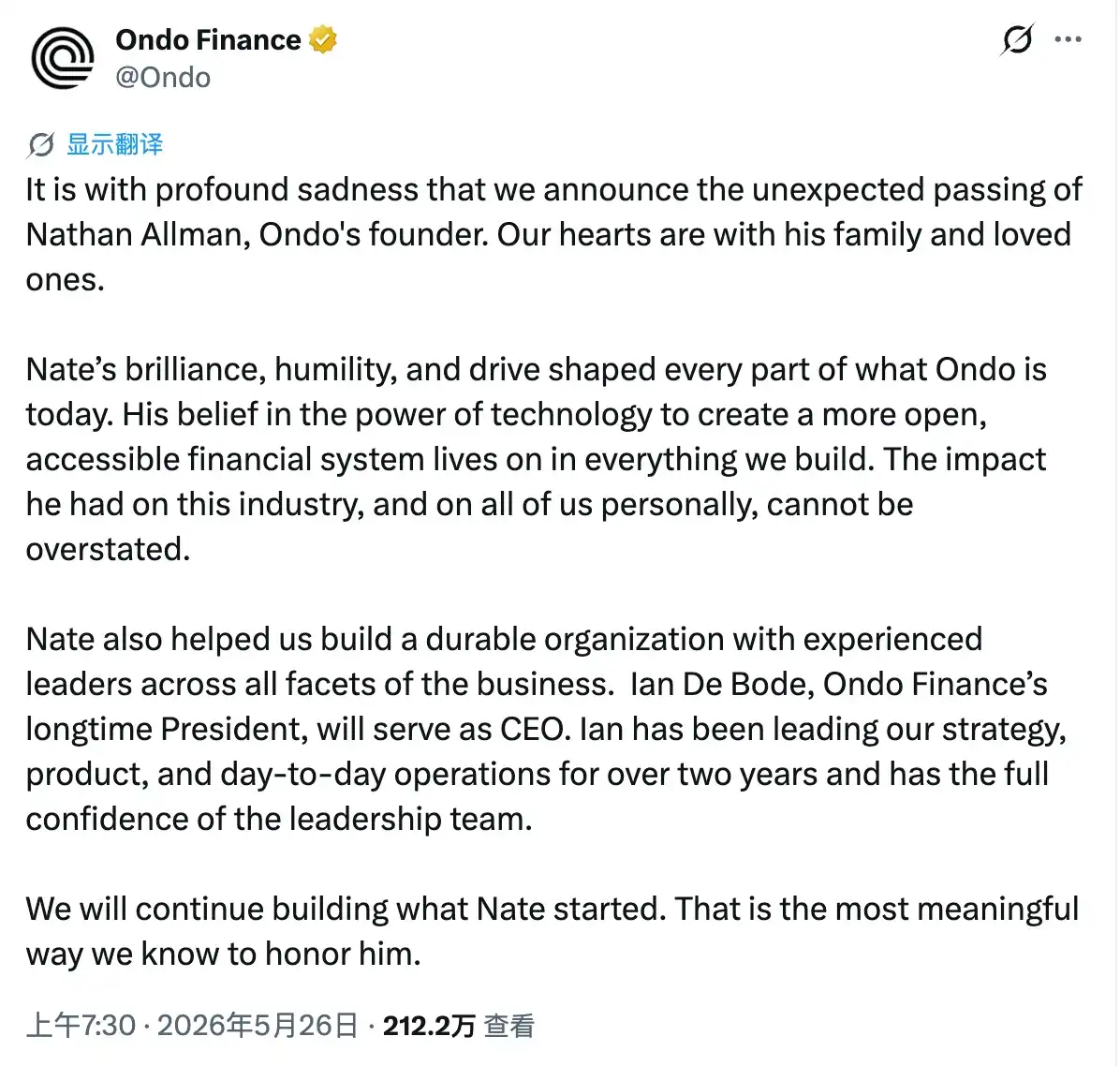
On May 26, Ondo confirmed Allman’s death in a public statement and said longtime president Ian De Bode would become CEO. The company said De Bode had spent the previous two years overseeing strategy, products, and day-to-day operations, and had the full confidence of the management team to continue the work Allman had started.
From an operating standpoint, the handover appeared orderly at first. The harder issue sat elsewhere. A CEO role can be reassigned, but the founder’s equity and control rights cannot be transferred through a company statement alone, and those rights are central to the company’s long-term stability.
The situation was made more difficult by the fact that Allman died without leaving a will, according to the report.
No will left behind, and his parents became legal heirs
After Allman’s death, a court determined that his mother, Kathleen Allman, and his father, Lawrence Allman, were his legal heirs. Later court filings said the estate includes a controlling interest in Ondo and a large amount of ONDO tokens, including tokens that had already unlocked and others scheduled to unlock over the next several years.
In June, a Hawaii court appointed Kathleen as the personal representative of Allman’s estate. She then began to involve herself in Ondo’s corporate governance.
The conflict soon moved into the open. In July, Kathleen said she was reorganizing Ondo’s board in her capacity as a shareholder, appointing herself chair and interim CEO while attempting to remove De Bode from his roles. Nathan’s sister, Tahnee Towill, was also appointed to the board by Kathleen.
Kathleen later filed suit in the Delaware Court of Chancery, alleging that De Bode took over as CEO after Allman’s death without valid board authorization and then tried to strengthen his own control.
One major point of dispute: De Bode’s pay and equity package
A central issue in the case is the compensation and equity package De Bode received after Allman’s death.
According to filings from Kathleen’s side, the package included:
- a $900,000 annual salary and bonus,
- a $1 million signing bonus,
- and 26 million restricted ONDO tokens.
Those filings said the package was worth more than $11 million in total. Kathleen’s side argues the arrangements are invalid and has asked the court to rule that the appointment and awards have no legal effect.
De Bode has denied the allegations, saying Kathleen’s lawsuit lacks merit. He also said the company has support from key stakeholders and investors.
At that point, what had looked like a management transition had become a fight over control of Ondo.
A new filing in September exposed deeper family divisions
The dispute took another turn in September.
On Sept. 16, Nathan’s maternal half-sister, Lani Clinton, and early Ondo investor David Chen jointly asked a Hawaii court to impose a limited conservatorship over the portion of Nathan’s estate inherited by Kathleen. The report said Chen had previously been proposed for the board by De Bode.
In that application, Lani raised a series of allegations about Kathleen’s cognitive capacity, long-term drinking, and financial management, arguing that she might no longer be able to manage the estate properly. In addition to claiming that her mother had a decades-long history of what the filing described as “pathological alcoholism,” Lani asked the court to obtain Kathleen’s medical records and conduct a dementia evaluation.
The filing also described what it called a long pattern of lavish spending, including the purchase or attempted purchase of a Zeelander yacht in Florida worth about $4 million, travel by private jet, a request that Ondo reimburse a six-figure flight bill from Hawaii to California, and stays in luxury accommodations costing about $4,000 per night.
Chen also disclosed a text message he said came from Kathleen. According to the filing, just nine days after her son’s death, she asked the company for money and wrote: 「Hi, I believe everything will work itself out over time, but right now my main concern is cash flow, liquidity! The sooner the better! For example, I currently have a $200,000 bill from a Newport pool builder. I really want to buy that ... yacht and other things.」
Because the estate represented by Kathleen includes a controlling interest in Ondo and a large amount of ONDO tokens, those allegations go directly to the question of who controls the company.
The allegations remain one-sided claims in active litigation
The report stressed that these statements are allegations made by one side in ongoing litigation, not facts established by a court.
Kathleen’s side has denied the claims and said they have no factual basis. She has also argued that the case is another move by the De Bode camp in the broader control fight, and that De Bode and Chen are acting together in an attempt to replace her with a trustee more willing to follow their wishes.
The result is a two-track legal battle. One front is in Delaware, where the fight centers on control of Ondo itself. The other is in Hawaii, where the dispute focuses on who should manage Nathan Allman’s estate. In practical terms, both cases revolve around the same core asset: the Ondo equity and token interests Allman left behind.
The fight is still unresolved
As of now, the dispute remains unresolved. Under a court order issued in early September, De Bode continues to serve as Ondo’s acting CEO and retains his board seat. The new September filing has pushed internal divisions within the Allman family further into public view.
Ondo, meanwhile, is still advancing its tokenized asset business. U.S. Treasuries, funds, and stocks continue moving on-chain, and the sector itself is still expanding quickly.
For a company at the front of that market, though, the founder’s sudden death has created consequences that go well beyond an executive transition. Corporate control, inheritance rights, and family conflict are now tied together, and the final outcome remains unsettled.