

ONDO has climbed from about $0.31 in early July to around $0.40, up nearly 30% in three weeks. The move has come while Bitcoin has hovered near $63,000 for almost a month and much of the altcoin market has stayed subdued, putting extra attention on the few tokens still showing momentum.

In the original article by Kuli, published by TechFlow and carried by Odaily, that strength is framed within a broader rotation toward real-world assets, or RWA. Meme trading on Robinhood is described as one outlet for capital, but with signs of cooling. Tokenized equities are presented as the other high-conviction arena, and Ondo is depicted as one of the busiest names on that front.
Tokenized equities are gaining traction, and Ondo sits upstream
According to Startup Fortune, trading volume in tokenized stocks and commodities on Hyperliquid reached $25.1 billion in the third week of July, the first time it exceeded crypto asset volume on the platform. Trade[XYZ] listed on-chain contracts tied to SpaceX and the latest ChangXin Memory Technologies offering, while tokenized stocks accounted for 23 of the top 30 assets on Hyperliquid. Binance has also moved into the segment and captured 56% of the centralized exchange market for RWA perpetual contracts. The U.S. Securities and Exchange Commission is also discussing an “innovation exemption” route for tokenized stock trading.
Set against that backdrop, the article argues that on-chain trading in U.S. equities has become a central theme in the current market cycle. Ondo, it says, happens to be one of the projects making the most concentrated push along that theme.
Its role is different from Hyperliquid or Binance. Those platforms are fighting for trading volume. Ondo is presented as the supplier behind a meaningful share of the underlying inventory. The article uses a simple comparison: if Hyperliquid and Binance are the restaurants, Ondo is supplying the ingredients.
Citing AInvest, the piece says a large portion of the tokenized stock contracts listed on Trade[XYZ] are backed by assets from Ondo Global Markets. It also says the on-chain tokenized stocks that Hyperliquid connected through Felix Protocol in May this year were issued by Ondo.
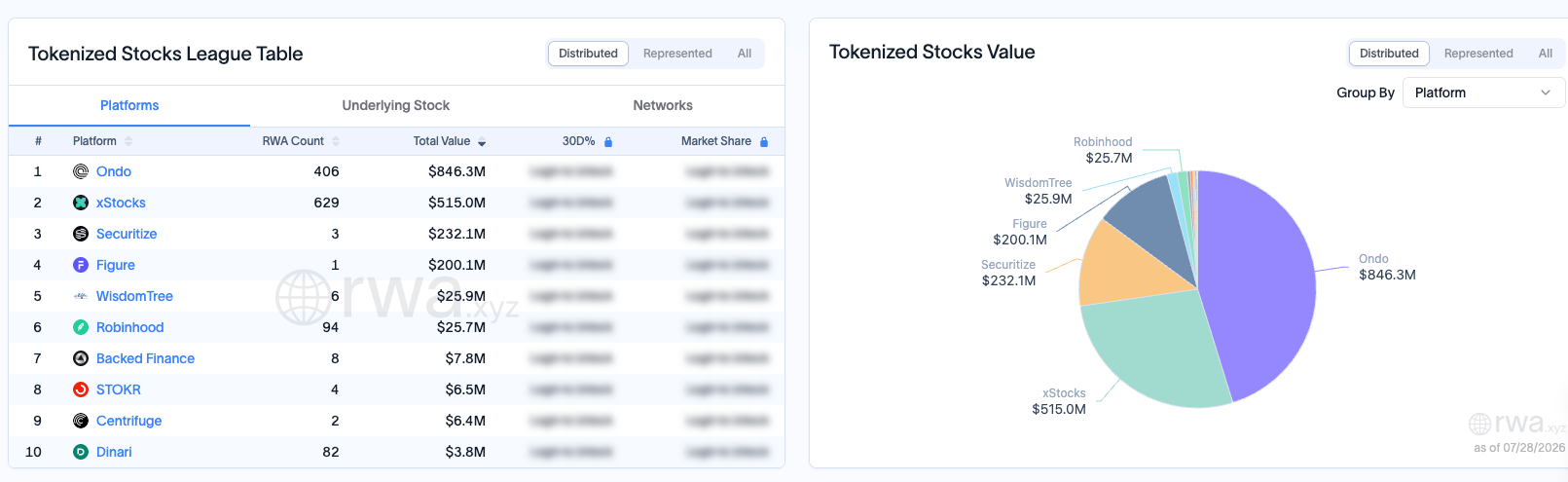
RWA.xyz data cited in the report puts Ondo Global Markets at more than 70% share on the issuance side of tokenized equities, with total value locked above $5 billion and cumulative trading volume above $18 billion. The platform offers more than 260 tokenized U.S. stocks and ETFs across Ethereum, Solana, and BNB Chain, with distribution through Binance, Bitget, MetaMask, and Blockchain.com.
A DTCC-linked update helped drive an 18% one-day jump
The article points to July 15 as a key date. After a DTCC-related update, ONDO rose 18% in a single day. The argument in the piece is that the market response was not about a routine partnership headline. It was about distribution.
DTCC sits at the center of U.S. stock clearing and settlement, and nearly all U.S. equity trades ultimately pass through it. Ondo, through DTCC’s tokenization service, issued on-chain certificates tied to U.S. stocks and appeared on the same participant list as BlackRock, J.P. Morgan, Goldman Sachs, and Nasdaq. In the article’s framing, that put the development on a distribution-channel level rather than in the category of a standard collaboration announcement.
Ondo is also moving downstream with Ondo Perps
After taking more than 70% of issuance share upstream, Ondo has started reaching into trading. Ondo Perps, launched on July 7, is the clearest example cited in the report.
The platform offers perpetual contracts on U.S. stocks, ETFs, and commodities with leverage of up to 20x. What sets it apart, according to the article, is that traders can use tokenized stocks issued by Ondo itself as collateral. If a user holds an on-chain Apple or Nvidia token, that position can be posted directly to open a trade.
That is different from the setup on Hyperliquid or other perpetual venues, where users generally need to convert assets into USDC or USDT first because the exchange and the asset issuer are separate parties. Ondo combines issuance and trading inside one system, cutting out that extra layer of friction.
DefiLlama’s RWA Perps ranking, as cited in the article, showed Ondo Perps at $221 million in 24-hour volume as of July 28, placing it fourth.
The report does not present the numbers as a clean win. Open interest stood at only $49.92 million, or 1.15% of the market. Volume divided by open interest came to 4.4x, which the article reads as a sign that funds are cycling through quickly rather than staying overnight. For comparison, Trade[XYZ] was at 1.6x on the same measure, suggesting deeper capital retention.

Even so, the article says Ondo Perps may not be targeting the exact same users as Hyperliquid. Rather than trying to match Hyperliquid’s scale directly, it may be converting holders from Ondo’s $5 billion-plus asset pool into traders, extending revenue from issuance fees into trading fees. In that logic, open interest matters more than whether daily turnover can catch up.
The piece also flags a data issue. DefiLlama’s overall RWA Perps board and the Ondo Perps protocol page show different figures, with a gap of nearly three times. The protocol page shows $77.53 million in 24-hour volume and $10.3 million in open interest. The article advises sticking to one data set for time-series comparisons rather than mixing sources.
Ondo Chain is out; Ondo Network replaces it with a split architecture
On July 27, Ondo unveiled Ondo Network and replaced the Ondo Chain plan it had been pushing for more than a year.
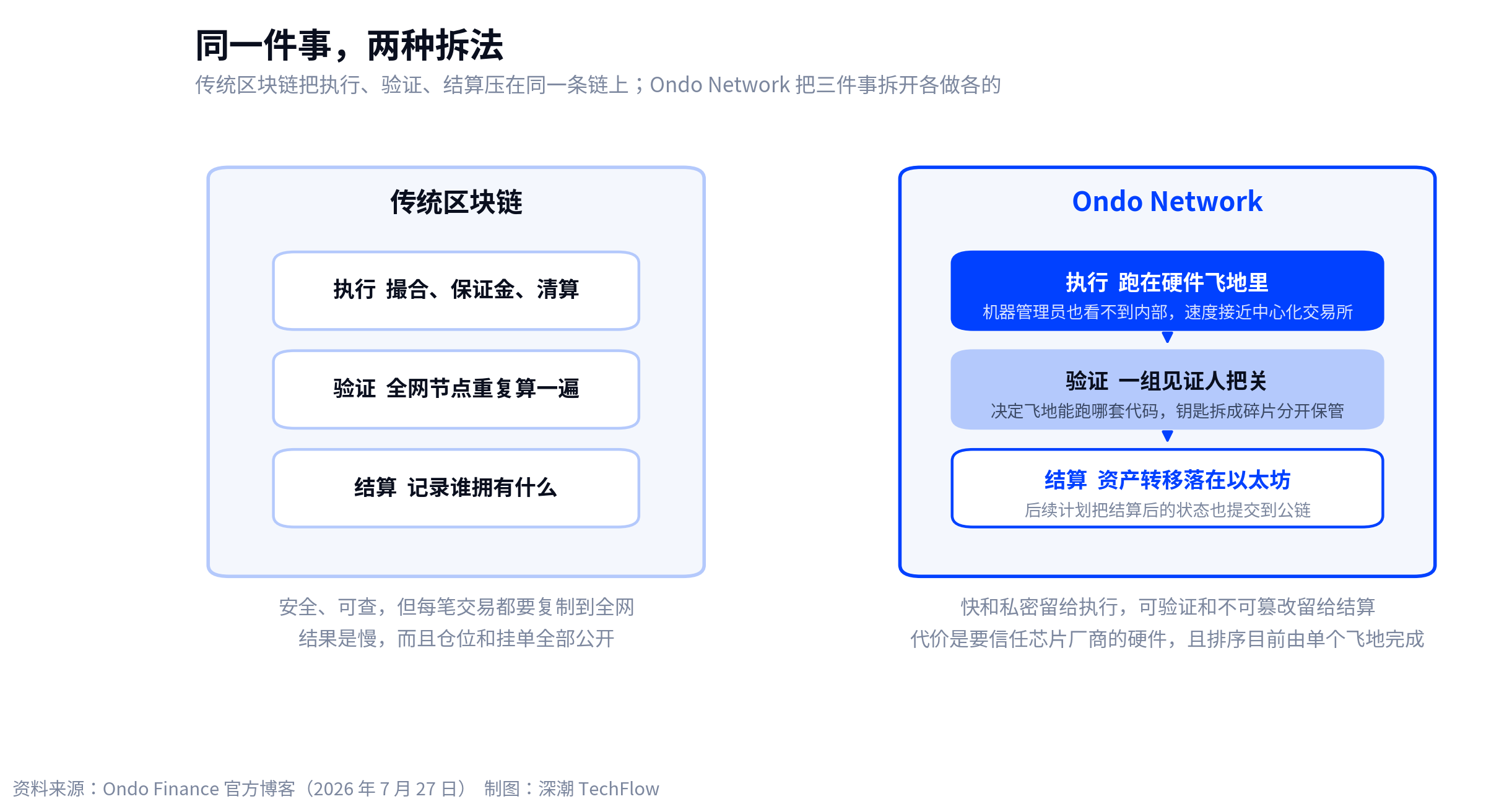
As described in the article, the new design splits trading into two parts. Execution, including matching, margin, and liquidation, runs inside a hardware enclave. Settlement, meaning the final record of ownership, remains on Ethereum. Ondo Perps is already running on that architecture.
The author argues this is more practical than forcing a new Layer 1 chain into existence. Launching a chain means rebuilding liquidity and ecosystem support from scratch, while Ondo’s assets are already spread across Ethereum, Solana, and other networks. Pulling execution into a separate layer is described as a lighter and less risky path.
Still, the report says Ondo has acknowledged two trade-offs. First, execution currently runs inside a single enclave rather than a distributed network. Transaction verification is handled by a group of independent operators called “witnesses,” but the number of witnesses, their identities, and the list of participants have not been disclosed. Second, the security model depends on the chip provider. Ondo has not said which vendor or hardware generation it uses, leaving open questions around the underlying security assumptions.
Those details do not amount to a trading signal in themselves, the article says, but they do suggest that Ondo Network currently looks more like a verifiable centralized execution layer than the decentralized end state described in its white paper.
For ONDO token holders, the more immediate issue is token utility. The article says Ondo’s CEO has stated that ONDO will take on incentive and governance functions as the network decentralizes in the future, but the witness economics and staking revenue-sharing design remain in the category of possible directions, with no timetable attached.
What the market appears to be pricing in
The report breaks the rally into parts. It attributes 18% of the move to the DTCC-related development, saying the market was pricing in an upgrade to Ondo’s distribution reach, especially the significance of appearing on the same participant list as BlackRock and Goldman Sachs.
Another roughly 10% is tied to cooperation with SBI Group, which the article describes as an entry point into the Japanese market, along with the broader beta move in the RWA segment. By contrast, the July 27 architecture update, which shifted Ondo away from building an L1 and toward an execution layer, is said to have had only limited effect on the token price.
On that reading, the main catalyst is not the technical architecture. It is Ondo’s more than 70% issuance-side share in tokenized equities and the strength of its institutional distribution channels.
From an investment perspective, the article lists ONDO at $0.38 with a market capitalization of about $2 billion, down around 65% from its 52-week high of $1.13. If on-chain trading in U.S. stocks turns into a multi-year structural trend, the article says Ondo’s position on the issuance side gives the token a clear underlying logic.
At the same time, it stops short of turning recent catalysts into a long-term conclusion. Ondo may be making a bigger push, and tokenized equities may indeed be one of the strongest themes in this cycle, but with the wider crypto market still weak, the article says the recent move looks more like a response to event-driven catalysts and capital rotation than proof of a lasting structural uptrend.