
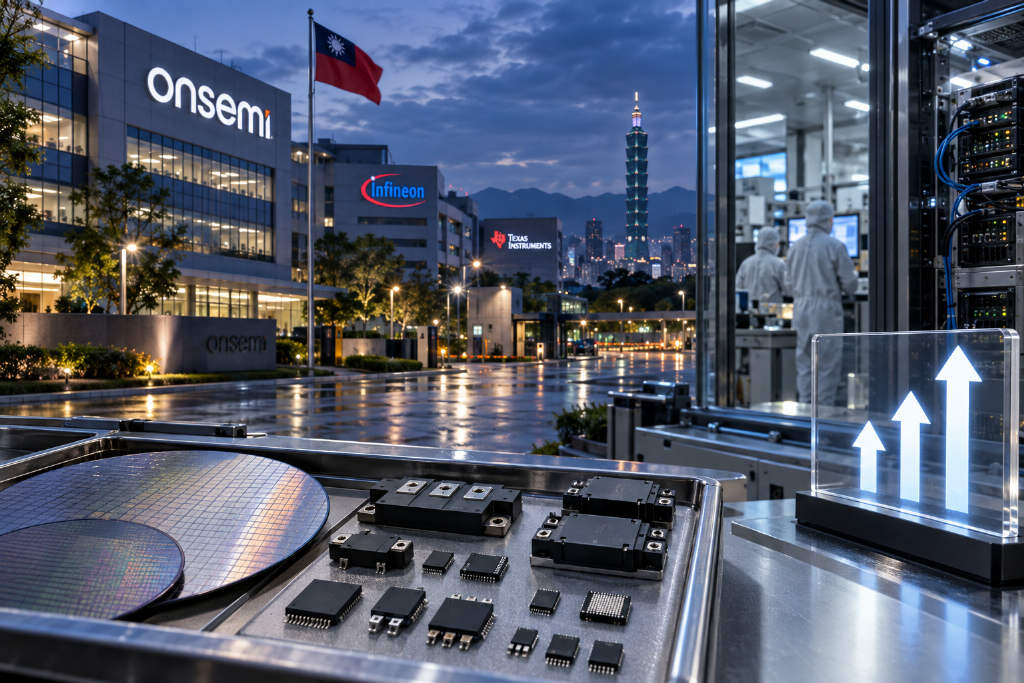
onsemi said it will raise prices on some power semiconductor products starting Oct. 10, becoming the latest major supplier to increase pricing after Infineon and Texas Instruments.
According to Commercial Times, onsemi notified customers on Sept. 21 that some products would see price increases from October. Infineon and Texas Instruments had already announced hikes of 5% to 15%, while Renesas is expected to carry out its next round of increases in early 2027, extending the current sequence of price moves among international power semiconductor makers.
Taiwan suppliers may raise non-contract prices in the fourth quarter
The report said Taiwan power device makers Panjit International, Taiwan Semiconductor and Eris Technology could follow as early as the fourth quarter, lifting prices on non-contract products by about 10% to 15%.
The actual increase would vary by product line, customer profile and contract structure. The article added that repeated pricing moves by large international suppliers have reduced resistance for Taiwan manufacturers in negotiations and made it easier to pass costs on to downstream customers.
AI power architecture changes are expanding demand for power devices
The article tied the latest pricing cycle to structural changes in power demand from AI computing infrastructure. Over the past year, power consumption per AI rack has climbed from the kW range toward several hundred kW and even MW levels. Power architectures have also been moving from traditional 48V systems toward 800V high-voltage direct current, or HVDC, increasing both the specifications and the volume required for power components.
On the high-voltage side, that shift is driving demand for higher-voltage silicon carbide, or SiC, devices. In intermediate conversion stages, it is lifting demand for gallium nitride, or GaN, and high-efficiency MOSFETs. Across the full conversion chain, from high-voltage distribution down to the roughly 1V supply needed by chips, usage is increasing for high-voltage, high-current MOSFETs, IGBTs and PMICs.
As power consumption per GPU and CPU continues to rise, both the specifications and the number of power components required in each machine are increasing, creating conditions for simultaneous gains in volume and pricing.
Panjit, Taiwan Semiconductor and Eris are highlighted as key Taiwan names
The report identified Panjit, Taiwan Semiconductor and Eris Technology as the three Taiwan companies drawing the most attention from institutional investors, while noting that each is entering the AI supply chain in a different way.
Panjit
Panjit was described as one of the earlier Taiwan power component makers to disclose growth in AI-related business. Its AI revenue contribution has continued to rise from about 11% in the first half of the year, according to the article. In the second half, shipments of Power MOSFETs, small-signal devices and TVS products have started to expand, and new customer projects are expected to be introduced in the fourth quarter.
Because the average selling price of Power MOSFETs is significantly higher than that of traditional components, the product line has become Panjit’s main source of AI-related revenue contribution, with the report saying that could strengthen as server specifications continue to upgrade.
Eris Technology
Eris Technology is focusing on opportunities tied to the upgrade toward 800 VDC power architectures. As AI servers and edge AI power systems move toward native multi-phase power delivery and 800 VDC, demand for TVS, ESD and small-package MOSFETs is expected to keep growing.
The article said that under AI workloads requiring high frequency, high power and high stability, the traditional practice of replacing TVS with capacitors is no longer workable. TVS and ESD are shifting from optional components to rigid demand.
Eris subsidiary Asen Technology plans to convert part of its 4-inch capacity to 6-inch lines as early as the third quarter of 2027, which would double monthly capacity from 12,000 wafers. Automotive MOSFET packaging and testing orders are already fully booked through 2027, and the company is also building out 1,000V and 1,200V high-voltage product lines.
Taiwan Semiconductor
The original article listed Taiwan Semiconductor among the three Taiwan companies expected to benefit, but did not provide separate operating details for the company in the body of the report.
Whether spot price gains can reach contract pricing remains the main variable
Even if spot price increases are already widely expected, the report said the bigger question is whether this cycle can produce sustained gains in contract pricing and materially improve gross margins for manufacturers.
One core variable is the bargaining structure downstream. If international suppliers adopt differentiated pricing for contract customers, or if foundries and packaging and testing companies can ease bottlenecks in the short term through capacity expansion or reallocation, spot price increases may not be fully reflected in contract prices, limiting the durability of margin improvement.
The timing of new capacity from South Korean manufacturers and other suppliers is another factor. If supply continues to respond more slowly than AI demand growth, short-term tightness could keep supporting prices. If new capacity is released in large volume in a specific quarter, spot pricing could face reversal risk.
Institutional outlook cited in the report
The article said institutional investors broadly remain positive on the power component sector. It said that from the fourth quarter of 2026 into 2027, the industry is expected to see a combination of higher shipment volumes, firmer product pricing and broad specification upgrades, improving earnings visibility for Panjit, Taiwan Semiconductor and Eris.