


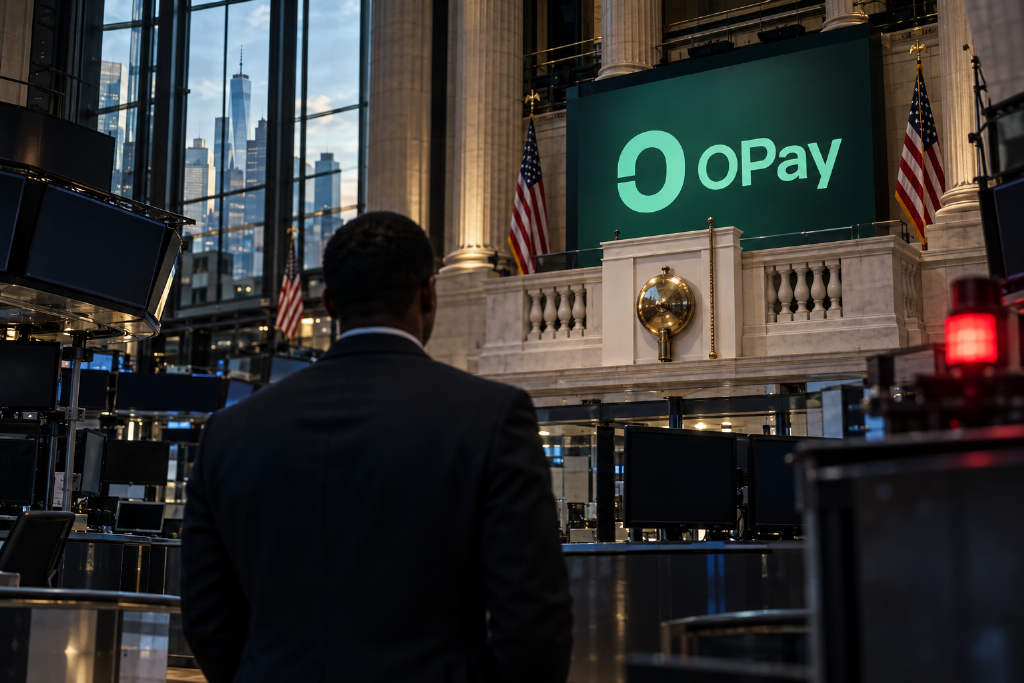
OPay, the Nigeria-based payments company backed by SoftBank, rang the opening bell at the New York Stock Exchange on Oct. 30, Eastern Time, but its stock never opened for trading and did not record a single executed share before the exchange halted it later in the day.
On Oct. 31, OPay said it had terminated its underwriting agreement with its banks because of a regulatory inquiry in a market it described as non-core, stopping the company’s planned $304 million initial public offering.
The IPO was priced, but trading never began
According to Nairametrics, OPay priced its offering on Oct. 29 at $19 per American depositary share, selling 16 million ADSs for total proceeds of $304 million. The $19 price was the bottom of the company’s indicated $19 to $21 range, and the deal valued OPay at about $4 billion. The ticker was set as OPAY.
ADSs are a common structure used by foreign companies listing in the United States, allowing investors to buy depositary receipts that represent the underlying shares.
Nairametrics, citing Bloomberg, said the NYSE’s X account posted a video on Oct. 30 showing OPay executives ringing the opening bell. The post also showed a DJ booth carrying OPay branding, but the post was later no longer visible.
After the ceremony, however, the stock still did not begin trading. By 2 p.m. Eastern Time, the reference opening price was indicated at $16.25 to $16.75, or 11.8% to 14.5% below the $19 IPO price. At that level, investors allocated shares at the offer price would have been facing an immediate paper loss if trading had opened there.
At 3:30 p.m. Eastern Time, NYSE system messages showed the stock had been halted with a pending-news notice and no trade prints.
The same day, U.S. technology stocks were under pressure. The Nasdaq 100 fell 3.5%, its biggest one-day drop since early June.
OPay says the inquiry came from a non-core jurisdiction
OPay issued a statement on Saturday, Oct. 31, and Nigeria tech outlet Techeconomy published the full text. In that statement, the company said a regulator in a jurisdiction that is 「not material to the company’s core business」 had opened an inquiry. OPay said it therefore agreed with the underwriters to terminate the underwriting agreement signed on Oct. 29, and its ADSs would not list on the NYSE as scheduled.
The statement said: 「The Company is confident that the inquiry will be resolved satisfactorily in the near term, but after careful consideration and discussions with the underwriters, the Company believes that not proceeding with the offering at this time is the most prudent course of action.」
OPay did not identify the country or region involved and did not disclose the subject of the inquiry.
The company also said the matter was unrelated to its operating performance, financial condition or regulatory standing. Services in Nigeria, Indonesia, Egypt and Pakistan remain fully operational, it said, and the company will provide updates if there are material developments.
Nairametrics also cited a source saying this was the first time in NYSE history that an IPO had been withdrawn after the bell-ringing ceremony, but that claim currently rests on an anonymous source.
Settlement had been scheduled for Nov. 2, with a Nigeria secondary listing also planned
Bloomberg reported that the IPO was led by Citigroup, Deutsche Bank and South Africa’s Standard Bank. A Reuters report dated Oct. 23 listed China International Capital Corporation, or CICC, among the underwriters as well.
The deal had been scheduled to settle on Nov. 2. Underwriters also held a 30-day option to buy up to 2.4 million additional ADSs.
Reuters reported that OPay was founded in 2018 by Chinese billionaire Zhou Yahui, who also founded the Chinese gaming company Kunlun Tech, a company that once held dating app Grindr. Before the IPO, SoftBank-affiliated entities owned 6.6% of OPay.
OPay had also planned a secondary listing on the Nigerian Exchange, or NGX, after completing its NYSE listing. Nairametrics reported that the plan had already been approved by the board and shareholders, but OPay’s Oct. 31 statement did not mention that plan.
What the company and reports have said
Why was the IPO stopped?
In its Oct. 31 statement, OPay said a regulatory inquiry had been opened in a jurisdiction that is not important to its core business. The company then terminated the underwriting agreement with its banks, and the ADS listing will not proceed as scheduled.
Did OPay trade on the NYSE?
No. According to Bloomberg, by 2 p.m. Eastern Time on Oct. 30 the reference opening price was $16.25 to $16.75, below the $19 offer price. At 3:30 p.m., the NYSE halted the stock, and no trades were recorded.