
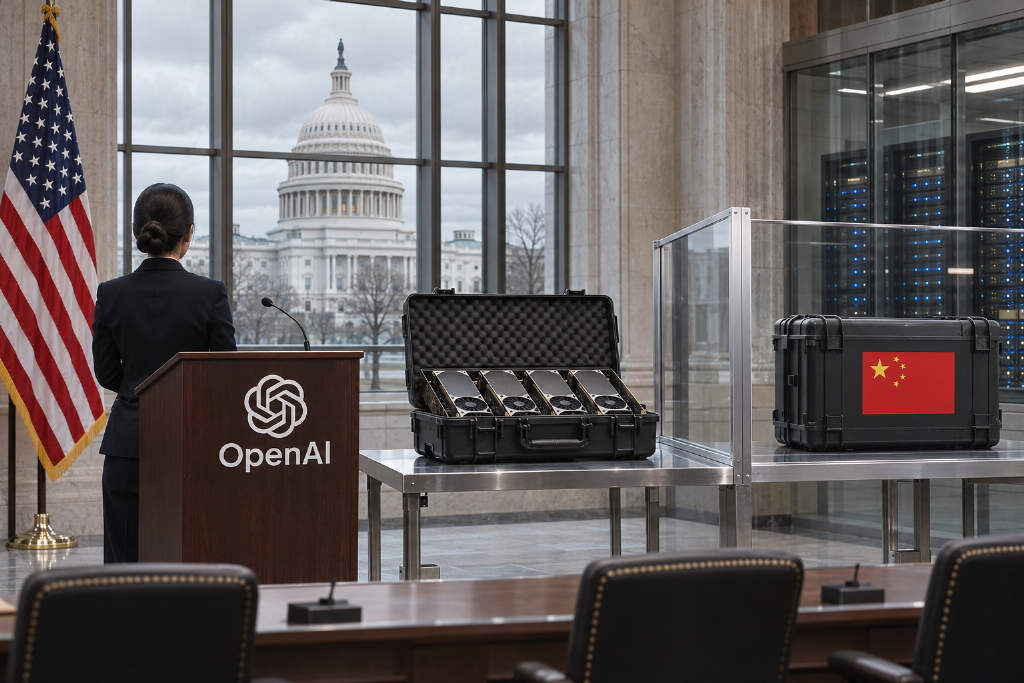
OpenAI has confirmed to U.S. lawmakers that it supports a bipartisan set of bills to restrict China’s access to advanced artificial intelligence chips and semiconductor manufacturing equipment, Bloomberg reported. The company had held back from publicly endorsing the proposals for several months. Its confirmation came after Jensen Huang left the chief executive role at Nvidia, following a political storm over suspicions involving China.
Huang argued against shutting China out
Huang has long opposed blocking the Chinese market. He has said China is not an enemy of the United States and argued that American semiconductor companies should keep competing there rather than ceding the market to domestic chipmakers through export controls. He has called U.S. chip export policy a mistake, making the case that continued sales of competitive chips would keep the global AI ecosystem reliant on American technology instead of pushing China entirely toward local suppliers.
Nvidia also has a commercial stake in that position. China was once a major global market for AI chips. If U.S. companies cannot compete there, Chinese customers could turn to domestic suppliers such as Huawei and build an AI ecosystem outside the U.S. technology system. Hawkish policymakers in Washington have long countered that advanced AI chips have both civilian and military uses and could support China’s military, intelligence operations and large-scale AI computing. In their view, export policy should not be set solely by commercial interests.
Four measures under discussion in Congress
Bipartisan support in Congress for restricting China’s access to advanced AI chips has been growing since Huang left Nvidia’s CEO post. House Speaker Mike Johnson has also said lawmakers are moving toward a consensus on further limits. The proposals under discussion include:
- AI Overwatch Act: Sponsored by Democratic Senator Elizabeth Warren and Republican Senator Jim Banks, the bill would give Congress a greater role in overseeing export policy changes for advanced chips. It aims to prevent the executive branch from easing restrictions on China without sufficient oversight.
- Chip Security Act: The measure would require chipmakers to track the locations of advanced AI processors and report suspected transfers to restricted users or destinations. The goal is to guard against chips entering China through resale or smuggling after a legal export.
- MATCH Act: The proposal would press U.S. allies, including the Netherlands and Japan, to restrict sales of advanced semiconductor manufacturing equipment to China and limit equipment maintenance there. Suppliers affected include ASML and Tokyo Electron.
- Remote Access Security Act: The bill targets Chinese AI companies that avoid buying controlled chips directly by renting GPU computing capacity from overseas data centers and accessing it remotely. It would authorize the U.S. Department of Commerce to oversee such activity.
The fourth proposal could have a direct bearing on Nvidia’s business. Chinese companies unable to obtain Nvidia GPUs directly may still access computing resources through overseas data centers in places such as Singapore and Malaysia. If the United States restricts remote access, the business model of Nvidia’s overseas data center customers would also be affected.
OpenAI backs controls and develops its own chip
OpenAI had previously kept a low profile on restrictions involving chip exports to China, in part because it did not want to antagonize Nvidia or Huang. Nvidia is one of OpenAI’s most important GPU suppliers, and the two companies are closely linked through computing capacity. OpenAI has now confirmed its support for the export-control measures.
In a statement, OpenAI Chief Global Affairs Officer Chris Lehane said the company continued to support stronger export controls. He said they would give the United States and its allies more time to establish AI safety standards, oversight mechanisms and international coordination.
OpenAI is also developing its own AI chip, Jalapeño. The company says it will deploy the chips only in the United States and allied countries, and will not sell them to China. That supply plan differs from Nvidia’s previous effort to compete for the Chinese market.



