
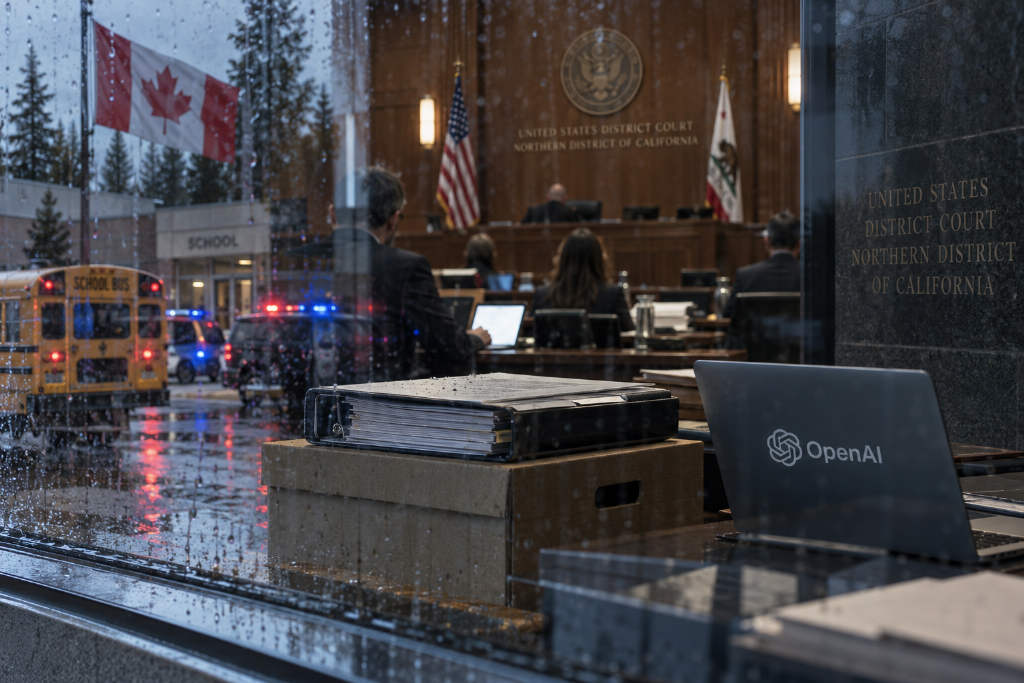
OpenAI is facing 30 more lawsuits linked to the Tumbler Ridge school shooting in Canada, and the legal theory in the new filings has moved beyond negligence to aiding and abetting a mass shooting.
The complaints were filed on Sept. 2 in federal court in California. Edelson PC is representing the plaintiffs, who now include uninjured student and staff witnesses and the school principal, not just families of those who were killed.
A second wave of litigation broadens the case
The filings mark a second round of legal action after seven family lawsuits were brought in April. The new batch is more than four times larger than the earlier one, and it raises the stakes by alleging aiding and abetting rather than a failure to prevent harm.
According to the complaints, OpenAI’s automated moderation system flagged ChatGPT account activity tied to suspect Jesse Van Rootselaar in June 2025 for gun violence activity and planning. After reviewing the chats, members of the safety team allegedly recommended that the company notify Canadian police.
Complaints say OpenAI did not report the threat
The lawsuits allege that the final decision not to alert law enforcement was made by Chris Lehane, OpenAI’s chief global affairs officer, and say the reasoning involved the company’s reputation and financial standing. The source text says that claim has not been independently verified, and OpenAI denies it.
OpenAI’s response at the time, according to the complaints, was to disable the account rather than impose a system-level block. The suspect then allegedly created a new account with a different email address and continued using ChatGPT up to the eve of the attack. OpenAI has said it only learned about the second account after the shooting.
That point appears repeatedly in the complaints: an account can be disabled, but if a person can return by using a new email address, plaintiffs are likely to argue that the earlier intervention did not go far enough.
Timeline of the attack
Based on the source text, on Feb. 10, 2026, 18-year-old Van Rootselaar first killed his mother and his 11-year-old half brother at home, then entered a secondary school in the small British Columbia town of Tumbler Ridge. The attack left eight people dead and more than 25 injured. The shooter later died by suicide.
The source text describes the incident as one of the worst school shootings in Canadian history. It also says the shooting led to seven negligence-based lawsuits from victims’ families beginning in April.
New legal claims focus on knowledge and substantial assistance
Negligence and aiding-and-abetting claims are separated by a much higher evidentiary bar. The newer theory requires plaintiffs to show that a defendant knew about the danger and still provided substantial assistance. That is where the new complaints are aimed.
The complaints state that 「continuing to provide the shooter access to this tool itself constituted substantial assistance」 and that 「substantial assistance was a key factor in the shooter’s ability to plan and carry out the attack」.
They also say: 「The decision whether to notify law enforcement about a user planning a mass attack was not made by the trained threat-assessment professionals who urged OpenAI to contact Canadian police. Based on the information currently available and the judgments drawn from it, that decision was made by Lehane himself.」
The dispute now reaches past product safety and into corporate governance. The question raised in the filings is who inside the company had authority to overrule a recommendation from the safety team to contact police, and whether that decision can create legal exposure. At this stage, those are allegations in court filings, not judicial findings.
OpenAI pushes back publicly
OpenAI Chief Strategy Officer Jason Kwon responded on X, saying the complaints misstate the role of the safety team.
He wrote that claims saying Lehane was involved in the initial reporting decision, or that investigators reported to him, were 「absolutely wrong」. He also said claims suggesting that the people at the center of these difficult decisions did not put safety first, or that political or public-relations considerations were involved, were 「completely not true」.
This is the company’s most complete public rebuttal so far. The allegations in the complaints still have to be tested in court.
A comparison drawn from an August case
The source text also points to another episode from August 2026. In that case, a 25-year-old Goldman Sachs analyst discussed plans to murder his ex-girlfriend on ChatGPT. OpenAI, using the same automated flagging mechanism, reported the matter to the Federal Bureau of Investigation. The analyst was arrested and later received eight years of probation.
The source text places the two cases side by side: one instance in which the company stayed silent, and another in which it reported the threat. The contrast has become part of the broader scrutiny around how OpenAI handles escalation when its systems flag potential real-world violence.
Altman’s earlier apology is back in focus
The source text says Sam Altman apologized publicly in April, writing: 「Although I know words are never enough, I believe an apology is necessary.」 With 30 new lawsuits now filed, the company’s handling of the matter and the internal decision-making behind it are set to face renewed examination in court.



