

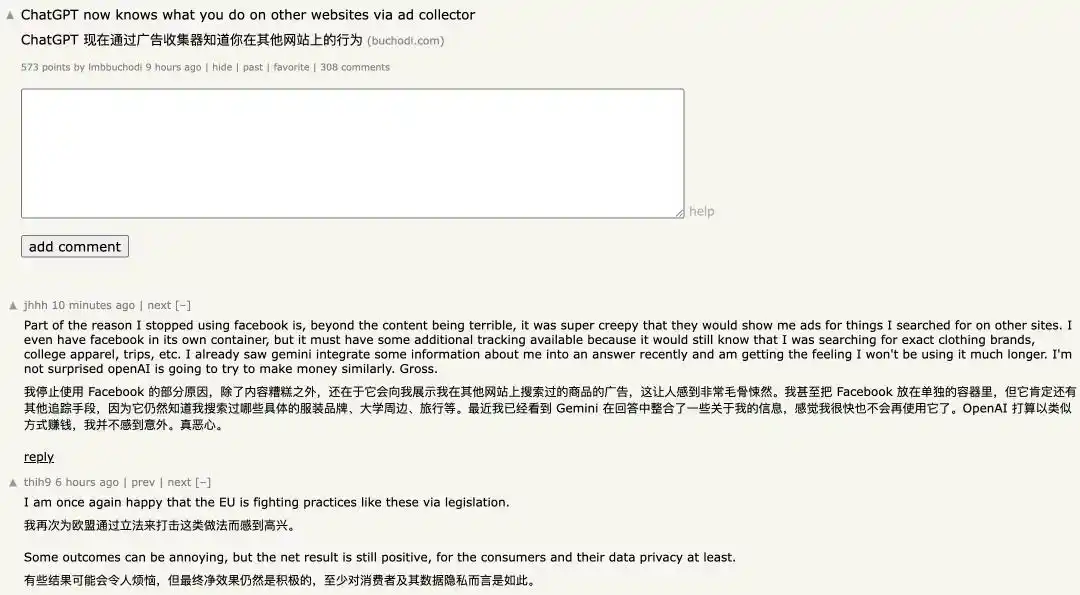
An investigation by independent researcher Buchodi claims OpenAI’s ad tracking setup may allow browsing and shopping activity from other websites to be tied back to a ChatGPT account through a cookie named __obi. The post gained traction on Hacker News, where it reached 573 points and 308 comments.
Buchodi said he ran the test on his own Android phone, captured traffic between the device and multiple websites, and then verified the results with a second collection method. He said the broader review covered several months of real browsing history, spanning thousands of websites and nearly a thousand ad trackers.
His core finding was direct: what a user searches for, views, and buys on merchant sites can travel back along the same cookie to a ChatGPT account. That cookie is called __obi.
How the __obi cookie is created and sent across sites
The report breaks the process into three steps.
First, when a user opens chatgpt.com, the browser generates a random value in the background and sends it to OpenAI’s servers. The server returns a digital token that binds the ChatGPT account to that random value. The token expires after 60 seconds.
Second, the browser uses that token in a cross-site request to bzr.openai.com. The server then sets a long-lived __obi cookie on the .openai.com domain with a one-year lifetime.
Buchodi said the key setting is SameSite=none, which allows the cookie to be sent with cross-site requests. In his account, when the browser made that batch of requests, other OpenAI cookies were blocked while __obi was allowed through.
Third, companies that buy ads on ChatGPT place a small piece of OpenAI tracking code on their own websites, similar in function to Meta Pixel or Google Tag. Once that code loads, the __obi cookie is sent back to OpenAI together with the page being viewed, the product being searched, and the order that was just submitted.
The report says the browser attaches the cookie to the script-loading request before OpenAI’s code even starts running. In practice, that means the identifier is already sent as soon as the page opens, with no extra click required.
The returned data goes beyond the cookie itself
In tests on Buchodi’s own phone, the same __obi identifier was sent to OpenAI from 12 commercial websites, including Chewy, Wayfair, HelloFresh, and Coursera, and was accepted each time.
Looking across a longer period, he said it was common to see the same user identifier repeatedly returned to OpenAI by different merchant sites. In one case, a single identifier appeared in return logs from 10 different merchants at the same time.
According to the report, OpenAI’s code does more than receive data that merchants intentionally submit. It also extracts information from form fields a user is filling out and from text displayed on the page. Buchodi said some of that collection went beyond what merchants themselves appeared to provide.
Email addresses, phone numbers, and names were encrypted before transmission, he wrote, but country, city, and ZIP code were sent in plain text. ZIP code was one of the most frequently captured fields, appearing 100 times across 28 websites.
The visited URL was also returned. Search terms were stripped, but the page path remained. Buchodi said the paths received by the collector included a disease-related page, a debt repayment plan page, and a litigation registration form.
Merchants may not know the data can be tied to a ChatGPT account
The report says merchants typically installed the script because OpenAI required a small code snippet to measure ad performance. In Buchodi’s telling, those merchants may not have known that customer browsing records could be linked quietly to a ChatGPT account.
He also said logging out of ChatGPT does not necessarily stop the tracking. After examining nearly a thousand identity credentials, he found that the system still assigned an anonymous identifier to a device even when the user was not logged in. He said that identifier stayed with one device for at least 27 days.
In that setup, logging out changes the label, not the tracking itself.
A dispute over how the cookie is classified in privacy settings
Buchodi also pointed to OpenAI’s privacy controls, where “data analytics” and “advertising marketing” appear as separate switches and can be managed independently.
He said the __obi cookie was classified under “data analytics.” If that is correct, a user who explicitly turned off advertising marketing could still receive the cookie.
On Sept. 14, Buchodi sent OpenAI his findings along with two questions: why the mechanism was treated as analytics rather than marketing, and whether users who disabled marketing were still affected. He said customer support acknowledged receipt and said the matter would be reviewed internally, but did not directly answer either question.
Scope and limits of the findings
The report does not say every user is affected in the same way.
First, Buchodi said the mechanism worked on Chrome for Android. Safari on Apple devices blocks this class of cross-site cookie by default, and Chrome on iOS follows the same restriction, so iPhone and iPad users were not affected in his tests. He said desktop Chrome had not yet been tested.
Second, the identifier was not created every time ChatGPT was opened. By his estimate, it appeared about once in every five sessions, while the mobile web version did not trigger it at all.
He also drew a clear line around what he could prove. He said he could confirm that the data was sent to OpenAI’s servers, but he could not confirm whether OpenAI actually matched that data to a specific account on the server side because he had no visibility into internal processing.
An old ad technique in a new AI setting
Buchodi said the underlying method is not unique to OpenAI. Similar tracking has existed for years in ad systems such as Facebook’s, where browsing activity from shopping sites is sent back through embedded tracking code while a user is logged in.
The article says the advertising industry has used this kind of technology for more than a decade.
ChatGPT formally began selling ad placements in February this year, and by late April marketing tracking was enabled by default for free users. At the time, much of the concern centered on data flowing out of ChatGPT. This investigation points in the other direction: browsing records from outside websites may be flowing into a ChatGPT-linked identity.
The report’s broader point is that the ad technology is old, but the context is different. Conversations people have with AI, along with what they browse and buy elsewhere, may now be converging under one account.



