
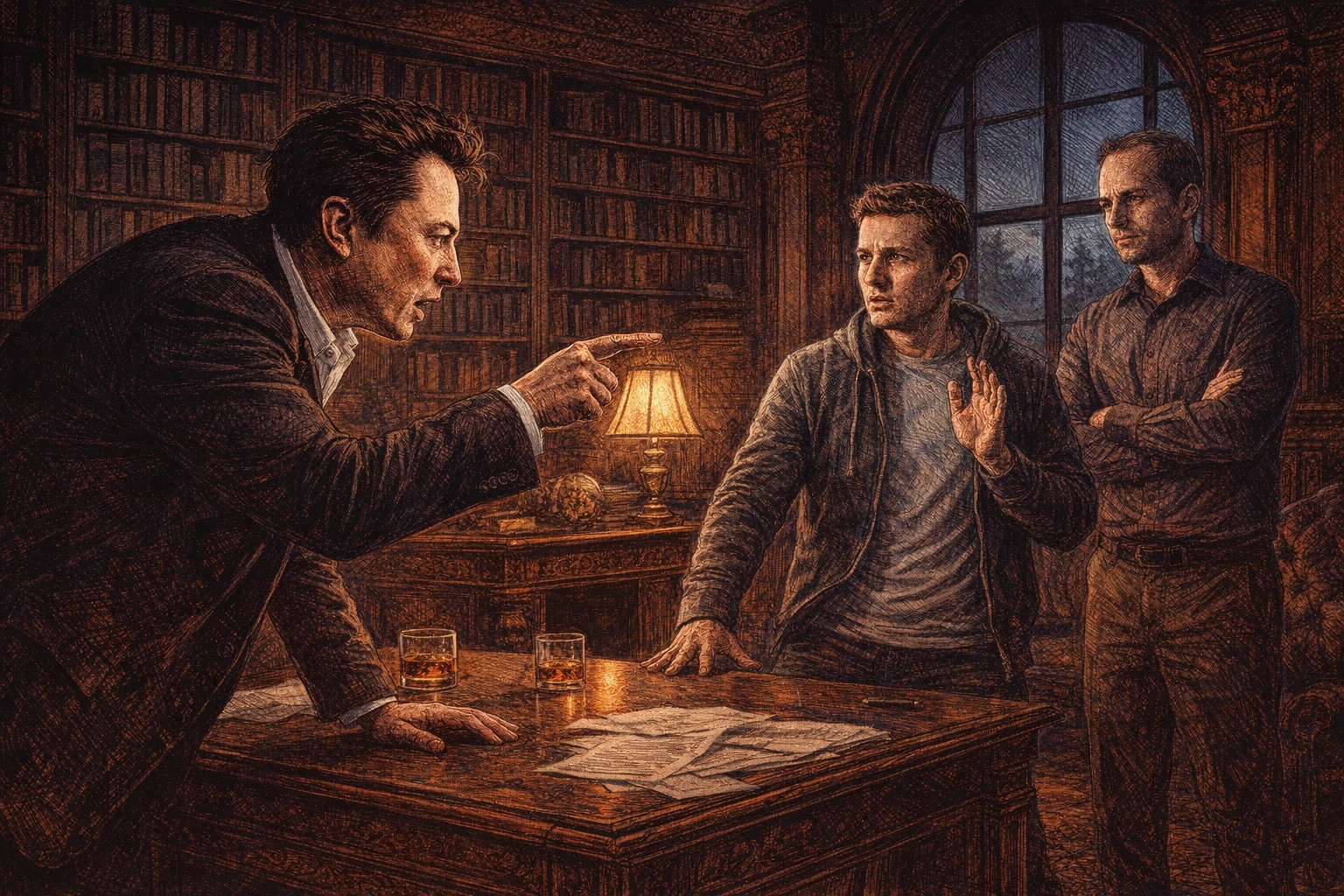
In August 2017, OpenAI co-founders Greg Brockman and Ilya Sutskever drove to Elon Musk's 47-acre Hillsborough estate — a property Musk himself called a "haunted mansion." Brockman recounted the meeting this week in federal court, summing up the atmosphere with a blunt line: "I really thought he was going to hit me."
The testimony is part of Musk's lawsuit accusing Brockman, Sam Altman, and others of misusing roughly $38 million in donations to transform a nonprofit AI research lab into a for-profit empire now valued at $852 billion, home to ChatGPT and Codex.
The Mansion Negotiation: Tesla as a Favor, a Painting as a Prop
Before the meeting, Musk had gifted both Brockman and Sutskever a Tesla Model 3 each. Brockman stated bluntly in court: "He wanted us to feel indebted." Sutskever reciprocated with an oil painting he had made of a Tesla — a painting that would become the final prop in their fallout. Musk proposed creating a for-profit arm to raise "billions of dollars" for computing power, but with a non-negotiable condition: total control of the company. Brockman and Sutskever called it a dictatorship and suggested shared control. Musk refused after a few minutes of discussion.
What followed, Brockman described: Musk stood up, walked around the table toward him — "I really thought he was going to hit me." Instead, Musk grabbed the Tesla painting, announced he would cut off funding to the nonprofit until they resigned, and left. Later that night, Musk's chief of staff Shivon Zilis called Brockman and Sutskever, saying the situation wasn't over and that there was still a place for them in future discussions.
Dismissing the Early ChatGPT Prototype: A Question of Judgment
The mansion night was not the only time Brockman questioned Musk's judgment. Researcher Alec Radford once demoed an early AI chatbot to Musk, who dismissed it: "This system is stupid. Any kid on the internet could do better." Radford was devastated and almost quit AI research. Brockman and Sutskever spent considerable time rebuilding his confidence. That early system later became the technical foundation of ChatGPT. Brockman's verdict: "You need to be willing to dream. Musk didn't show that at the time, and therefore he wasn't fit to steer OpenAI.
Board Purges and the Woman Who Was 'Musk's Proxy'
Courtroom disclosures also detailed internal politics. Brockman testified that he, Sutskever, and Altman considered voting Musk off OpenAI's nonprofit board, but ultimately decided it was "wrong" and dropped the plan. Musk left on his own in early 2018 after writing that OpenAI was on a "path to inevitable failure." Zilis's role was complicated: after leaving, she continued to brief Musk on OpenAI's progress — "in a sense, she was Musk's proxy." She joined OpenAI's board in 2020; in 2021 she had twins with Musk, but only told Brockman she had children — he learned the father's identity from the news. When confronted, Zilis claimed it was IVF and a purely platonic relationship. Some directors wanted her off the board, but Brockman and Sutskever convinced them to keep her, arguing she could help manage Musk's displeasure — "we actually held a board vote." Zilis left the board in 2023 after Musk founded xAI, and is scheduled to testify on Wednesday.