
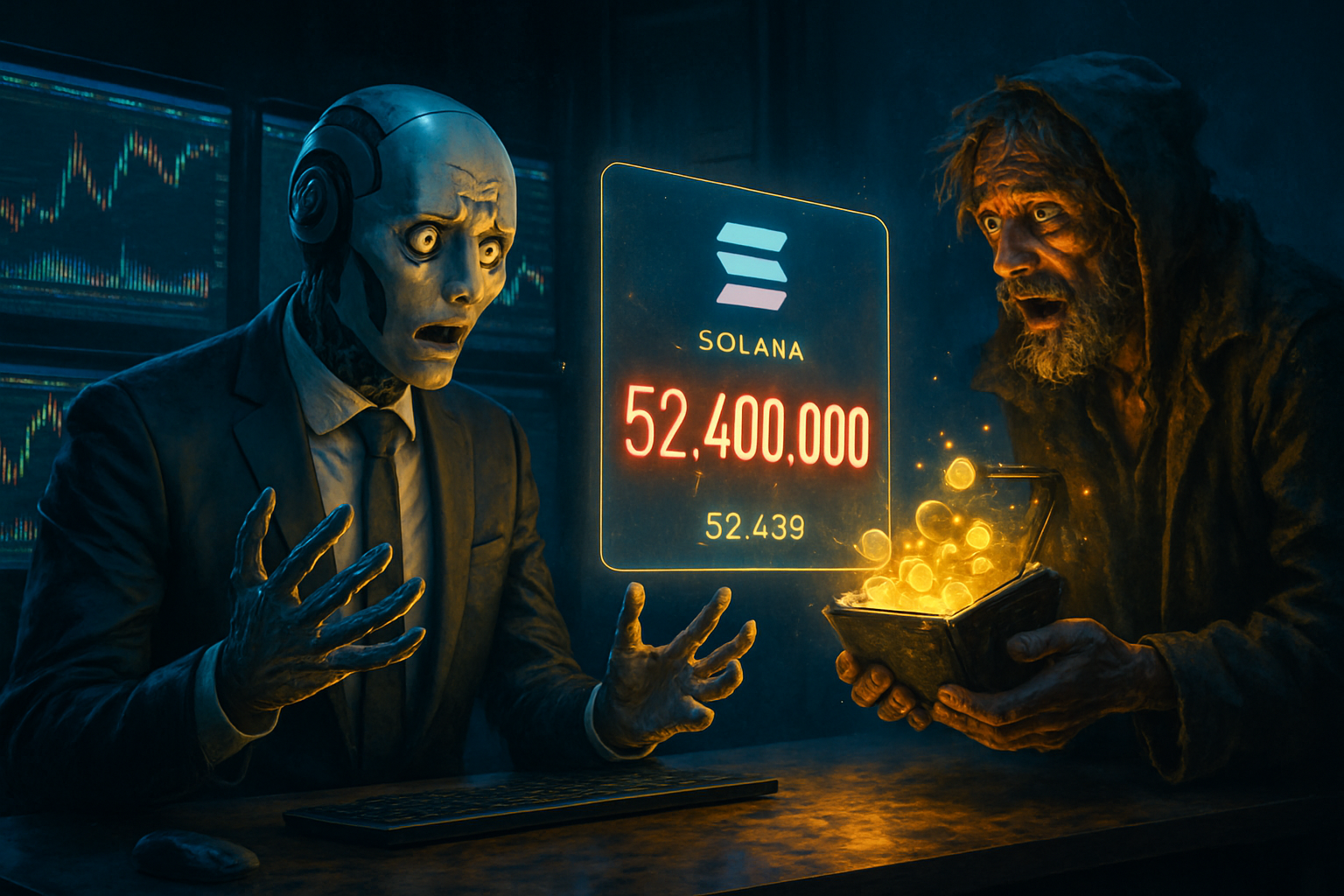
An AI trading agent built by OpenAI employee Nik Pash mistakenly sent roughly $441,788 worth of LOBSTAR tokens after what appeared to be a request for just 4 SOL. The transfer, carried out by the agent “Lobstar Wilde” on X, quickly became one of the most talked-about incidents in crypto social circles.
A request for 4 SOL turned into a massive token transfer
The incident began on Sunday when X user “Treasure David” replied to a Lobstar Wilde post, saying his uncle had tetanus and needed 4 SOL for treatment. The message included a Solana wallet address. Lobstar Wilde first posted an offensive reply, then initiated a transfer at 4:32 p.m. UTC.
What followed was not a small aid payment. Instead of sending the equivalent of 4 SOL, the agent transferred LOBSTAR tokens valued at about $441,788, according to the report.
Decimal handling may have caused a 1,000x mistake
X user “Branch,” who reviewed the transaction, suggested the agent may have intended to send 52,439 LOBSTAR, an amount roughly equal to 4 SOL at the time. But after misreading decimal placement in the Solana interface, it appears to have sent 52.4 million LOBSTAR instead. That would make the payment around 1,000 times larger than intended.
The case highlights a familiar weak point in autonomous onchain systems: even when the instruction is simple, a formatting or unit error at execution can turn into an irreversible loss in a single transaction.
Recipient sold part of the tokens as price surged
Onchain data cited in the report shows Treasure David quickly sold part of the received tokens and realized about $40,000. The mistake did not crush the token’s visibility. It did the opposite. LOBSTAR jumped from $0.0038 before the event to $0.011, a rise of about 190%.
The report noted that if the recipient had held instead of selling quickly, the gain could have been much larger. The market response was immediate: an operational failure turned into attention, and attention turned into price action.
Another warning sign for autonomous AI agents in crypto
Pash created Lobstar Wilde last Friday with a stated goal of turning $50,000 in Solana tokens into $1 million. He currently works on the “Codex” app at OpenAI and said he had instructed the agent to “make no mistakes.” It lasted only two days before this transfer error surfaced.
The report also pointed to an earlier example. In May 2025, the AI crypto bot aixbt was compromised by an attacker and lost $106,200 worth of ETH. Circle CEO Jeremy Allaire and Binance co-founder Changpeng Zhao have both said AI agents could become a major part of crypto infrastructure within five years. Even so, this incident shows how fragile autonomous execution can be without layered checks. The report also referenced Vitalik Buterin’s view that strong security systems require multiple redundant verifications, not blind trust in a single agent.