
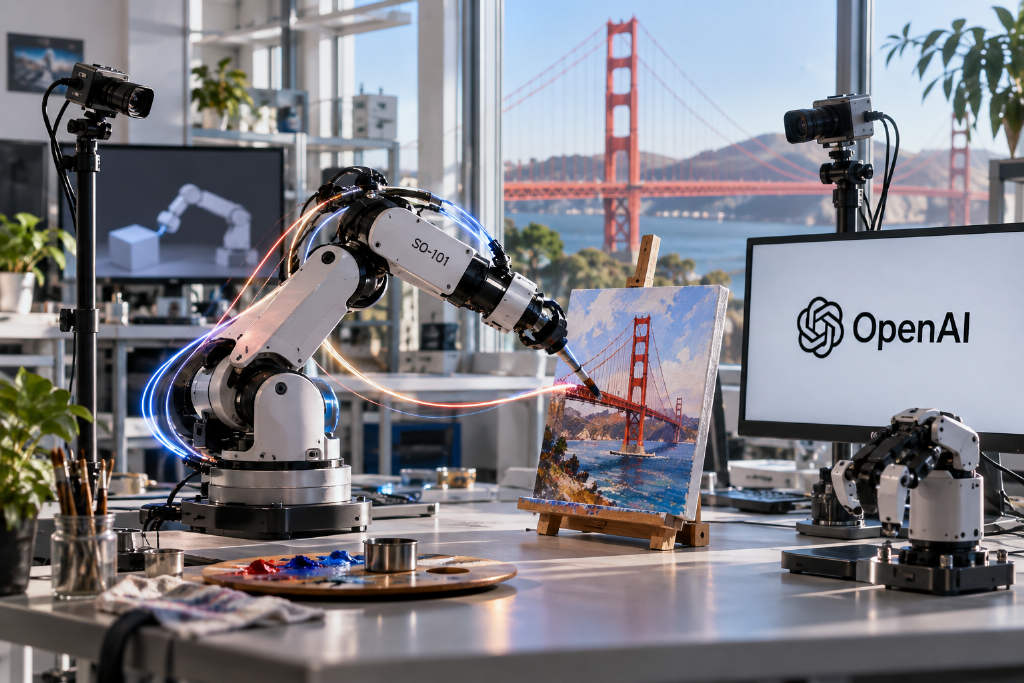
A roughly $150 SO-101 robotic arm recently drew the Golden Gate Bridge under GPT-6 Astra’s control. It was not tracing a preset path. Astra decided where to start, watched the drawing through a camera as it progressed, and finished a red-and-blue version of the bridge.
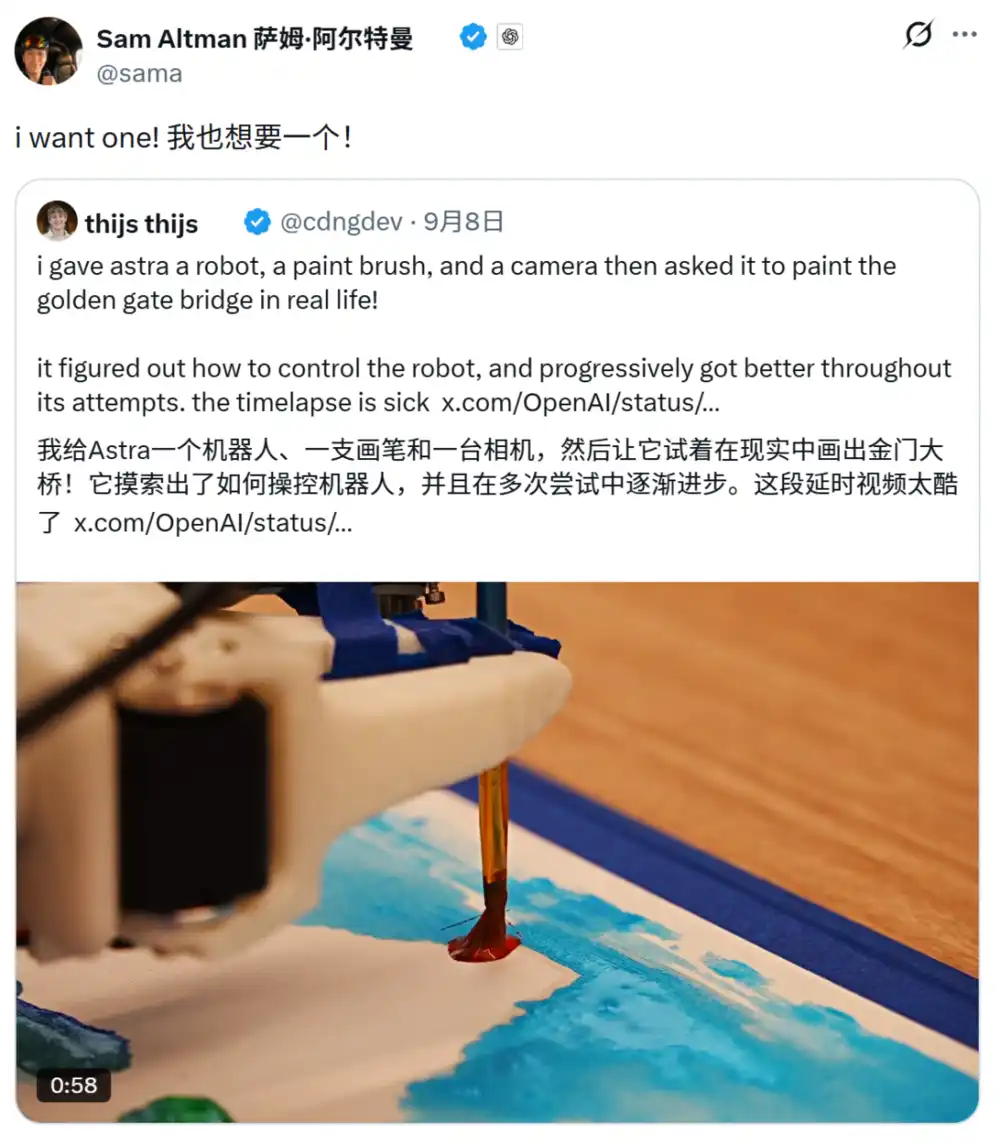
The clip spread quickly on X, and Sam Altman reposted it with a short reaction: “I want one too!”
Astra is showing up across a growing list of robotics experiments
For years, robotics researchers and investors have asked a recurring question: who will become the OpenAI of robotics? After a string of Astra-based demos, that question is being asked again, but the answer now being floated is OpenAI itself.
The Golden Gate Bridge drawing was only one example. Wenli Xiao of CMU Robotics ran a more direct test. The team first recorded a human completing a new task, fed that video into Codex, and then had GPT-6 Astra control a robotic arm to perform the same task in the same way. It worked on the first try.
Xiao described the result as “physical ICL.” Large models have already shown that they can infer a new task from text or code examples in context. The claim here is that a similar in-context learning pattern can carry over into the physical world.
Another group pushed Astra into the role of a robotics engineer. Lingxiao Guo provided the model with multi-view footage and action data from real robot demonstrations, then had Astra handle camera calibration, scene reconstruction, and physical parameters before moving the real environment into MuJoCo. The output was not just a visually similar 3D scene. It was a real2sim environment that could support contact simulation and action replay.
On X, others connected Astra to more complex robot bodies. Dmytro Hrybov paired it in MuJoCo with a Kinova Gen3 arm and a Shadow Hand five-finger dexterous hand, then had it hold a pencil and draw Picasso’s well-known dove. To make the pencil actually touch paper, the hand had to manage grip pose, friction between fingers and pencil, and contact between the pencil tip and the page.
RoboCurve’s hardware test produced the clearest benchmark
Some of the earlier demos could still be dismissed as clever internet experiments. RoboCurve’s setup was harder to wave away. The team connected GPT-6 Astra to two real I2RT YAM robotic arms. At each step, Astra received three camera views — one overhead and one from each wrist — along with the arms’ internal state. It then output end-effector targets for both arms: x, y, z, yaw, pitch, roll, and gripper state. A lower-level inverse kinematics system converted those targets into joint motions.
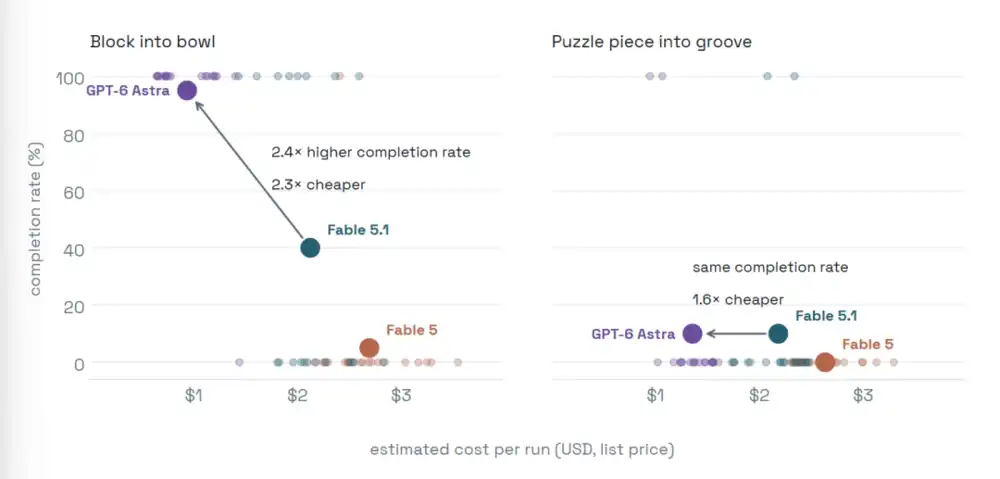
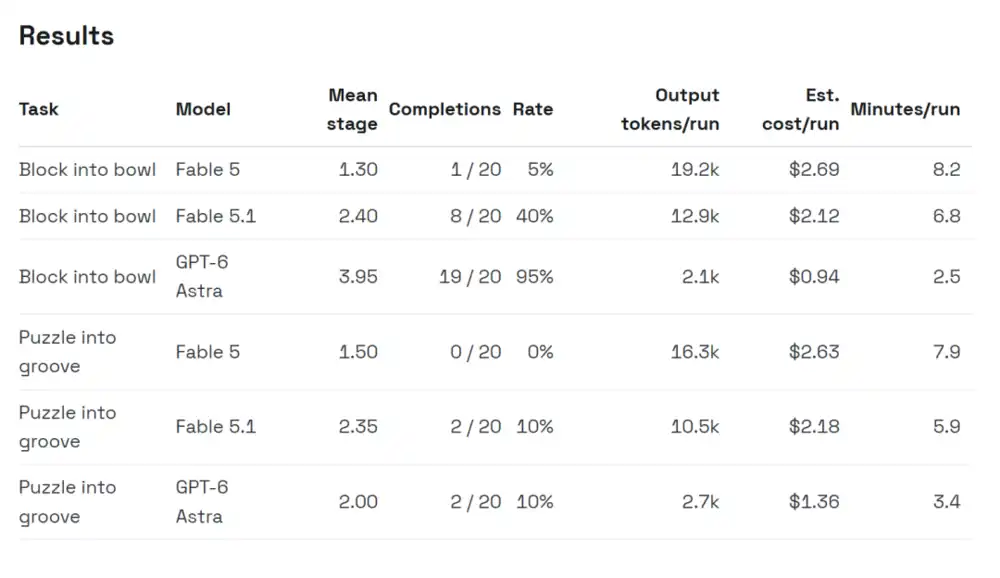
The task was simple: pick up a red block from the table and place it into a nearby bowl. Across 20 runs, Astra succeeded 19 times, for a 95% success rate. In the same test, Fable 5.1 succeeded 8 times.
That result stood out because Astra was not trained as a robot-specific foundation model. It is a general-purpose model, yet it still reached that level on a real manipulation task.
Does robotics still need to train a separate “brain” from scratch?
The timing matters. For the past several years, one of the hottest ideas in robotics has been to build a dedicated foundation model for robots.
As large models expanded from language into vision, speech, and agents, robotics kept circling the same question: if language has GPT, when does robotics get its own equivalent? That expectation helped turn Physical Intelligence and Skild into high-profile companies.
Physical Intelligence is trying to train a general robot foundation model that works across tasks, settings, and robot embodiments. Its π series puts vision, language, and action into one model, with the aim of letting robots learn to operate in the real world from large amounts of embodied experience.
Skild’s pitch is even more direct: “Any task, any robot, one brain.” The idea is that quadrupeds, humanoids, tabletop arms, and mobile manipulation systems could all rely on the same general brain to understand tasks and plan actions.
Those companies represent a core line of thinking in robotics over the last few years. If language needed a foundation model, then robotics should need one too — trained on large-scale robot data and built to understand bodies and motion.
That is why the old question has been so persistent. Who becomes the OpenAI of robotics?
Zeeshan Zia, principal scientist at Amazon Alexa and co-founder of Retrocausal, offered a pointed answer: “The OpenAI of robotics may be OpenAI, not Physical Intelligence or Skild.”
The remark landed because Astra did not follow the standard robotics-company path. It was not built by first collecting huge volumes of robot trajectories and then training a dedicated vision-to-action foundation model. Instead, it suggests another route: if general AI becomes strong enough on its own, robotics may not need to build every brain from the ground up.
OpenAI left robotics once. It may be coming back by a different route.
The question is especially sharp in OpenAI’s case because the company has been here before.
In 2018, OpenAI introduced Dactyl, which used a Shadow Dexterous Hand to rotate objects in the real world. It later pushed that work into Rubik’s Cube manipulation. At the time, OpenAI was already working on problems that still define robotics today: training in simulation and transferring to reality, dealing with friction, occlusion, sensor noise, and high-degree-of-freedom control.
OpenAI later shut down its robotics team. Wojciech Zaremba pointed to a practical constraint: robotics lacked a data source comparable to internet-scale text. Text and images could be gathered in huge quantities online. Robot data was expensive, slow to collect, and difficult to scale across enough real-world variation.
That makes the current moment notable. OpenAI stepped away from robotics because of the data problem, but it may now be returning through a different path. Over the past few years, the company scaled its models across language, code, vision, and agents, allowing them to accumulate broad knowledge about objects, space, causality, and human behavior. The robotics challenge now is to turn that knowledge into reliable physical action.
Sam Altman has also said recently that OpenAI will build humanoid robots and explore other robot forms. In his framing, the key piece is still the brain that makes the robot work.
How Astra controls a robot body
At least for now, the answer is not direct motor-by-motor control.
RoboCurve’s hardware test shows the current division of labor. Astra sees three camera views and the robot’s internal state, then outputs a target pose for the end effector — x, y, z, yaw, pitch, roll, plus gripper state. A lower-level inverse kinematics stack turns those targets into concrete joint commands.
That split is familiar in robotics. Astra decides where the hand should go. The traditional control stack handles how each joint should move to get there.
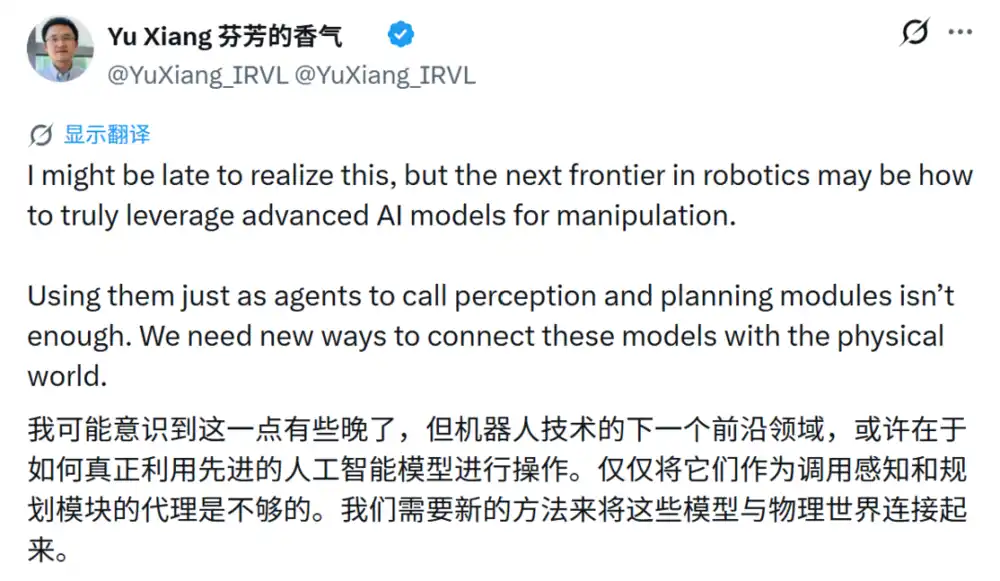
Yu Xiang, a former Nvidia research scientist, argued that one area worth watching next is how state-of-the-art AI models get connected more directly to manipulation. Rather than keeping large models only at the top layer for task decomposition and tool use, Astra is already moving closer to action selection itself.
Real-time control and fine contact remain hard
The limits show up quickly once the control loop gets tighter.
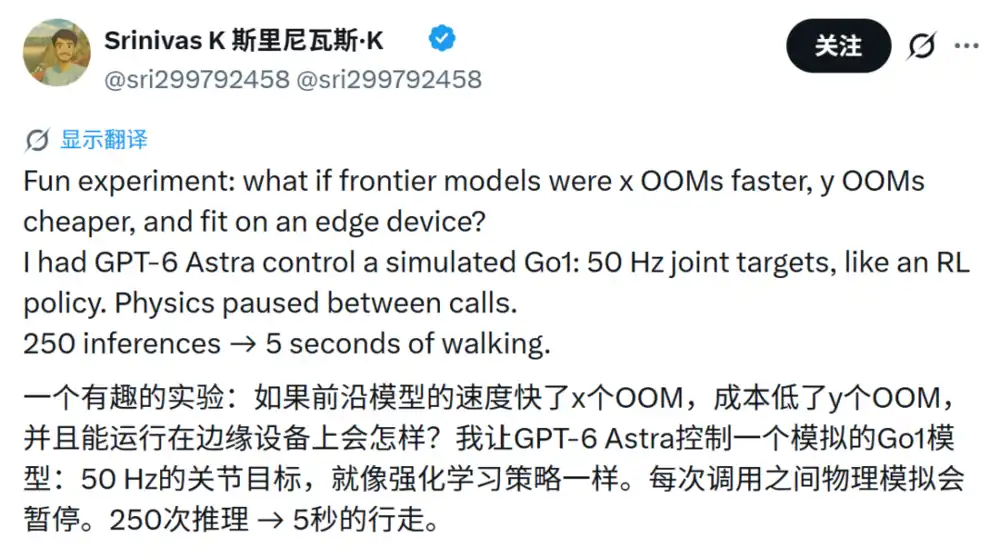
One experiment had Astra output joint targets for a Unitree Go1 and tried to use it like a reinforcement learning policy running at 50 Hz to control quadruped walking. The setup did run, but Astra’s inference speed could not keep up with real-time control. The physics simulation had to pause between model calls. In the end, 250 inferences produced only about 5 seconds of walking.
That is a clear boundary. Astra can already decide what the robot should do next, but handing it millisecond-level low-level control is still not realistic. A more practical architecture may keep the hierarchy intact: Astra handles environment understanding, reasoning, and planning, while lower-level policies and controllers turn those intentions into fast, stable motion.
The “last millimeter” is still where things break
Planning an action and executing it cleanly are not the same thing.
RoboCurve’s own results make that plain. In the red-block-into-bowl task, Astra succeeded 19 times out of 20, or 95%. But when the task changed to inserting a circular puzzle piece into its matching slot, the success rate dropped to 10%, with only 2 successes in 20 attempts.
Many of those failures were close calls. Astra could find the piece, grasp the knob, and move it near the target slot. What it struggled with was the final precise insertion.
Those last few millimeters expose some of robotics’ hardest problems. A small error in position or angle is enough to prevent alignment. Real contact introduces hardware error and uncertainty, which then disrupts the next action.
Physical Intelligence has recently focused on that same “last millimeter” problem. In its experiments, a general robot model could pick up a screwdriver without much trouble, but quickly and accurately aligning it with a small M3 screw still required additional online reinforcement learning. Ethernet cable insertion, power cable insertion, and zip-tie fastening ran into similar fine-contact bottlenecks.
For now, Astra’s clearest strength lies in the parts of robotics that look most like cognition: understanding the scene, identifying the goal, and planning the action. Once the task shifts into high-frequency feedback, fine contact, and force control, the robot’s own embodied experience still matters a great deal.
That leaves the central debate unresolved in an interesting way. Robotics may be able to borrow the strongest available model for the brain. The matching physical body is still missing.