
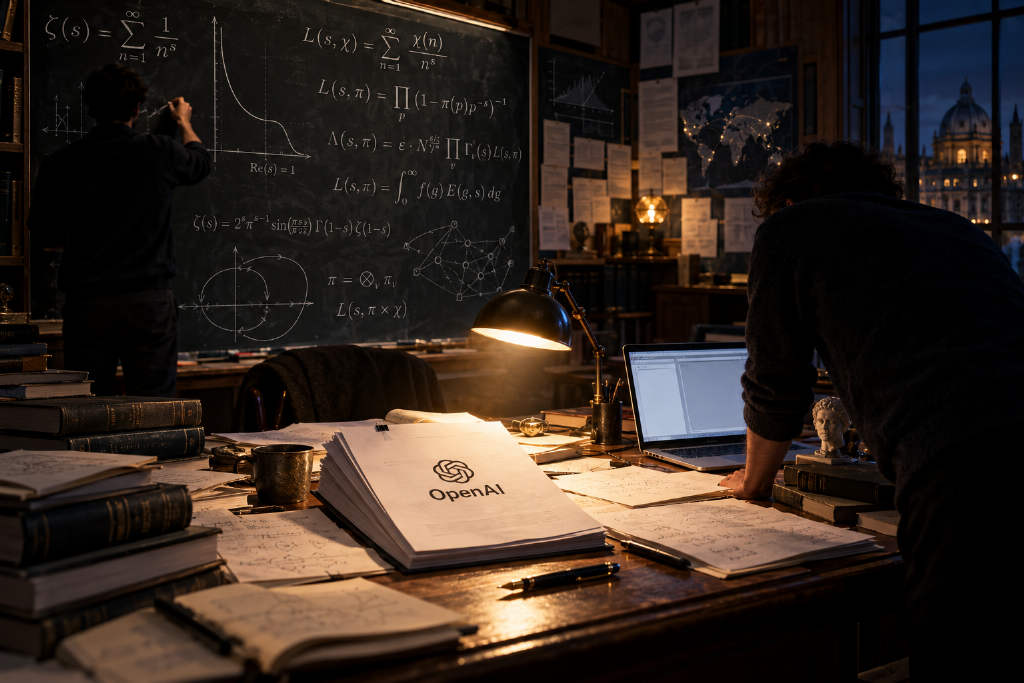
A burst of activity around the Riemann hypothesis and related problems unfolded over just a few days in October. On Oct. 6, OpenAI said its AI had proved a quasi-Riemann hypothesis result. The source article says mathematician Alex Kontororvin reacted by saying that if someone had achieved that result, 「he would immediately get a Fields Medal, without suspense」, and later added that eliminating Siegel zeros could count as 「two Fields Medals」. Number theorist Hector Pasten was also cited as expressing surprise at OpenAI’s result on ruling out Landau-Siegel zeros, stressing that it was a solution to the problem rather than mere progress.

The article also says a user asked Claude Fable 5.5 to explain OpenAI’s 199-page proof of the quasi-Riemann hypothesis and gave it a strong assessment, calling it 「the first fixed interval in history with no zeros」. The piece adds that this is not the Riemann hypothesis itself, but if the claim holds, it would be among the closest results yet.
Cureton and Thorner extend the method to Hecke L-functions
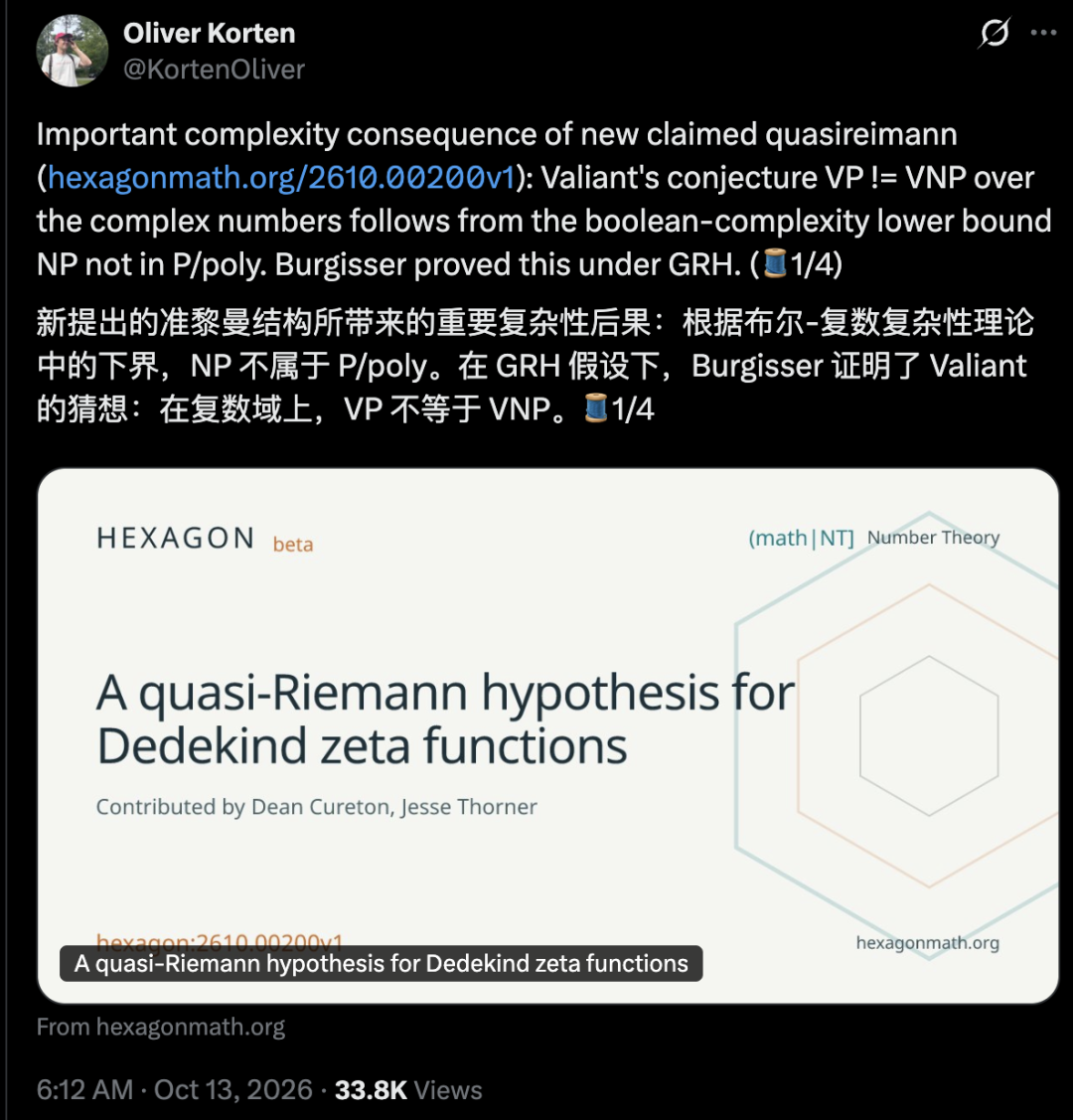
Six days later, on Oct. 12, a new paper appeared on the preprint platform Hexagon, authored by Cureton and Thorner: https://hexagonmath.org/2610.00200v1 .

According to the source, the two mathematicians took the tools sharpened by the OpenAI result and applied them to a broader and more complex object: finite-order Hecke L-functions. The article describes L-functions as an advanced generalization of the Riemann zeta function and says they sit near the center of modern number theory, including major proofs such as Fermat’s Last Theorem.
Their main conclusion was that all finite-order Hecke L-functions have no zeros to the right of 1-1/6000. The PDF cited in the source is https://hexagonmath.org/pdf/2610.00200v1 . The article explains the result with a metaphor: zeros are like hidden reefs, and the new theorem carves out a clearly navigable safe zone.

The community pushes the boundary from 1/6000 to 1/32
Once the 1/6000 result appeared, the source says the global math community quickly began trying to improve the constant. As arguments were tightened and error terms reduced, the zero-free boundary moved through 1/1000, 1/500, and 1/100 before landing at 1/32.
In the article’s framing, that expanded the safe zone by more than a hundred times. To reduce the risk of human error, the open-source community also used the Lean theorem prover for formal verification. The piece describes Lean as a formal language that accepts only strict logic, where even a tiny gap can cause the proof to fail.

The formal Lean proof was generated by the mathematical agent AxiomProver and published on GitHub at https://github.com/AxiomMath/DedekindZetaZeroFree . In the source’s account, the 1/32 boundary was not only derived by humans but also established through machine-checked logic.
An arXiv paper removes a 19-year assumption
The next major step came in a paper on arXiv co-authored by Frei, Somos, and Widmer: https://arxiv.org/abs/2610.18491 . The source presents it as the point where the chain of advances hit a longstanding target.
That target was the 2007 Ellenberg-Venkatesh bound on class group ℓ-torsion in number fields. The article says the bound was highly significant but conditional, because it relied on the generalized Riemann hypothesis, or GRH. For 19 years, researchers had tried to remove that assumption and failed.
Using the newly established 1/32 zero-free region as a foundation, Frei, Somos, and Widmer plugged the updated result into the older framework. The conclusion, as stated in the source, is that the 2007 Ellenberg-Venkatesh bound on class group ℓ-torsion has now been proved unconditionally, with no GRH assumption required.

A closing line drew extra attention
The source article highlights one sentence at the end of the paper: 「We declare that no artificial intelligence tools were used in this work.」 It also reproduces the English line as 「No artificial intelligence tools were used in this work.」
On the source’s telling, the episode became more than a single theorem. It turned into a relay: OpenAI’s claimed result, a human extension on Hexagon, community optimization of the constant, machine-checked verification in Lean, and then an arXiv paper that removed a 19-year-old condition from a major theorem in algebraic number theory.

References cited in the source
- Hexagon paper v1: https://hexagonmath.org/2610.00200v1
- Hexagon PDF v1: https://hexagonmath.org/pdf/2610.00200v1
- Hexagon PDF v2: https://hexagonmath.org/pdf/2610.00200v2
- GitHub repository: https://github.com/AxiomMath/DedekindZetaZeroFree
- arXiv paper: https://arxiv.org/abs/2610.18491
- X post: https://x.com/KortenOliver/status/2109995579275362643
- X post: https://x.com/imjustnewatai/status/2107615459822453187?s=20
The article was edited by David and credited to the WeChat account Xinzhiyuan (ID: AI_era), with ASI Apocalypse listed as the author.



