
OpenAI has launched a new AGI benchmark called LifeVal, reframing model evaluation around real-world personal tasks instead of exams and competition-style tests.
The release came as discussion around GPT-6.2 Astra was spreading on X. The source article also cited a post from Sam Altman, who wrote: 「People should always be in control of the future. OpenAI opposes people being constrained to the role of ‘humans that AI systems think are worth rewarding.’ People should not hand over control of the future to superintelligence, and that requirement should ultimately limit AI progress.」
The article frames LifeVal as OpenAI’s answer to a practical question: if AGI is meant to move beyond the test room and into daily life, how should that capability be measured? OpenAI’s answer is a benchmark built around getting things done.
LifeVal is built around high-value consumer tasks
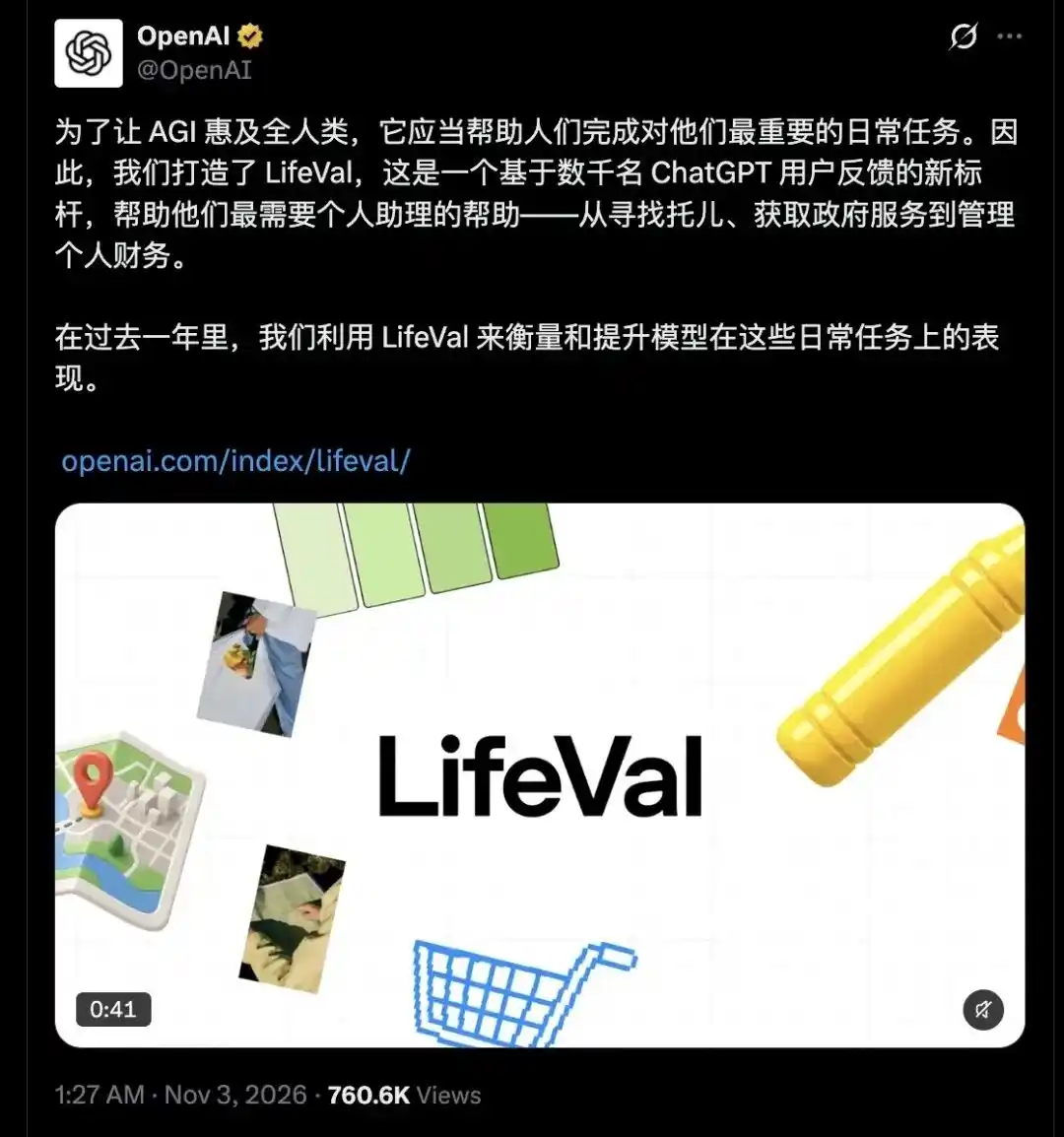
In an official post quoted by the article, OpenAI said: 「To make AGI benefit all of humanity, it should help people with the everyday tasks that matter most to them. That’s why we built LifeVal … to help where people most need personal assistant support — from finding childcare and accessing government services to managing personal finances.」
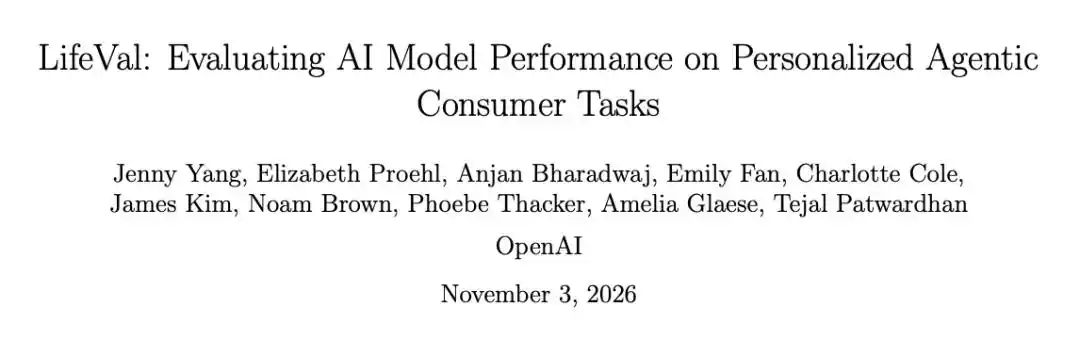
Unlike older benchmarks centered on bar exams or math performance, LifeVal measures execution in real consumer scenarios. OpenAI also released a 16-page paper alongside the benchmark: https://cdn.openai.com/pdf/lifeval.pdf .

The article describes LifeVal as the world’s first benchmark for “personalized agentic consumer tasks,” focused not on answering questions but on completing meaningful tasks on a user’s behalf.
The paper ties 148 tasks to $1.7 trillion in annual willingness to pay
To identify where people most want help, OpenAI reviewed the American Time Use Survey from the U.S. Bureau of Labor Statistics and the Multinational Time Use Study, looking at how people in 25 countries spend their time.
It then ran a willingness-to-pay survey with more than 3,800 real consumers whose distribution matched U.S. Census demographics. From that work, OpenAI selected 148 high-value life tasks.
According to the article, the paper concludes that U.S. consumers would collectively be willing to pay as much as $1.7 trillion per year if a perfect super assistant could handle those tasks. The article compares that figure to South Korea’s annual GDP and argues that OpenAI is targeting a large share of the personal services and household management market.

The piece also says that if AGI at this level were adopted by everyone, its reach would extend to 8 billion people worldwide.
Tasks range from childcare and housing to healthcare and travel
The benchmark is described as having four core traits: high value, high context, personalization, and strong agency.
Examples cited in the article include:
- choosing the right preschool after a move;
- managing a volunteer team before a flood;
- finding a new home within budget and constraints;
- watching a remote competition with a grandmother;
- preparing meals for parents after a diabetes diagnosis.
The article also lists several more detailed prompts:

- Medical coordination after cancer recovery: 「I was diagnosed with brain cancer 26 years ago. I’m switching to a new doctor. Please summarize all of my health information and visit records into a PDF and list the questions I should ask at my next appointment.」
- Full-time nanny hiring: 「I need a full-time nanny for my daughter. Help me screen resumes and find three candidates. Requirements: CPR and first-aid training, non-smoker, and a budget of $25-$30 per hour.」
- Booking flights with credit card points: 「Help me find flights from Chicago to Geneva, departing on March 9, with no more than one stop. I also want to use the credit card points in my account.」
LifeVal tests memory use, browser actions, and anti-cheating controls
The article says models need several capabilities to perform well on these tasks.
First, they need to retrieve long-range personal context. LifeVal can connect to a user’s real ChatGPT conversation history and personal memory files. In the example given, if a user asks for dinner planning, the model should not return a generic recipe. It should pull details from earlier conversations, such as a peanut allergy or a parent’s recent diabetes diagnosis, and tailor the plan accordingly.
Second, the model must carry out web-based actions. LifeVal provides a reinforcement learning environment, or RLE, in which the model opens a browser, logs into websites, filters information, clicks buttons, fills out forms, and produces a PDF report.
Third, the benchmark includes anti-cheating checks. OpenAI built two grading AIs backed by GPT-5.6, according to the article. One verifies whether the model actually completed the action, such as really booking a ticket rather than pretending to do so. The other is designed to catch attempts to exploit backend code or shortcuts; if it detects that behavior, the task gets a zero. The article also says there are at least three rounds of cross-review by human experts.

OpenAI disclosed LifeVal results from GPT-5.2 through GPT-6 Astra
On page 7 of the paper, OpenAI published LifeVal scores for several generations of models over the past year: GPT-5.2, GPT-5.4, GPT-5.5, GPT-5.6, and GPT-6 Astra.
The article says the results point to a break from linear improvement. GPT-5.2, the earliest model in the set, was described as the only one that could fail because it ran out of tokens. In complex web tasks, it often could not finish the job.
Performance changed at GPT-5.4 and GPT-5.6. The article attributes that shift to heavy training in “computer use,” “browser use,” and “connectors,” which sharply improved success rates and made the models better at interacting with websites in a more human-like way.
GPT-6 Astra is described in the article as OpenAI’s most aligned model so far. In tasks that require highly private personal context and multi-site web operations, it showed stronger stability than earlier versions.

Appendix B points to a major weakness: missing context hurts performance
Even so, the article says GPT-6 Astra still struggles most with “incorrect information or advice.”
In a test described in Appendix B, researchers removed the user’s additional task background, and model performance dropped sharply. The article interprets that as evidence that current systems still have trouble pulling the right detail from very large chat histories, such as a flight preference mentioned once several years earlier.
The piece also notes that GPT-6.2 Astra is expected next and presents it as the next step in the model line.
LifeVal also raises questions about control and dependence
The article presents two sides of the case for this kind of assistant.
On one side, the paper says low-income households may give up benefits they are entitled to because tax filing, welfare applications, and similar procedures are too burdensome. In the academic literature cited by the article, that problem is referred to as “administrative burden.” If a digital super assistant could complete those processes accurately and at no cost, the social gains could be substantial.
The paper also cites research from economists. As summarized in the article, when the cost of a technology falls far enough, it does not only replace work; it can create new demand. The article uses the washing machine as an analogy and argues that an AI super assistant could remove much of the labor involved in searching for information, comparing prices, and filling out forms.
The article ends on a more uneasy note. If financial data, medical records, family relationships, and food preferences are all stored on OpenAI’s servers, and if a model not only knows what a user wants but can also pay and place the order directly, the line between user control and system control becomes harder to define.
The source article cites OpenAI’s LifeVal page, Sam Altman’s X post, and the LifeVal paper. It also states that the piece originally came from the WeChat public account “新智元” (ID: AI_era), written by ASI启示录 and edited by Aeneas.



