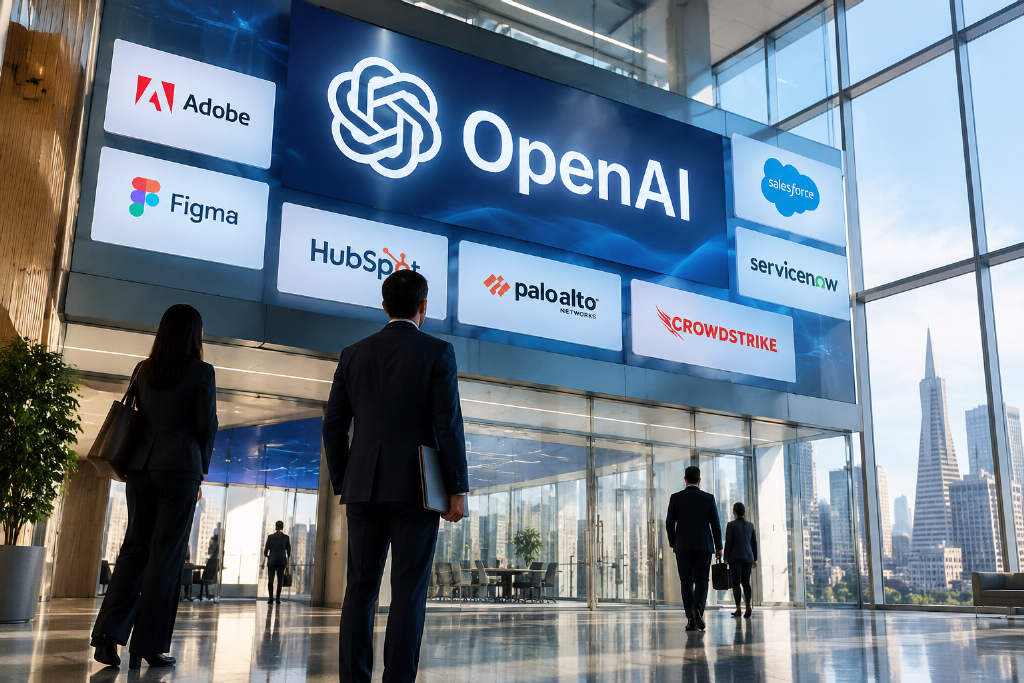
OpenAI introduced OpenAI Marketplace at DevDay, adding a software marketplace layer to its enterprise sales strategy. Under the model, eligible customers that sign large enterprise contracts with OpenAI can count part of their spending on third-party software toward the minimum consumption commitments in those agreements, rather than using the full amount on OpenAI’s own products.
The first group includes 32 partners. Names disclosed in the report include Adobe, Figma, Salesforce, ServiceNow, HubSpot, Harvey, Palo Alto Networks, and CrowdStrike. For now, customers can browse products in the Marketplace, but they cannot place orders directly through OpenAI.
The purchasing process still happens between the customer and the partner. The partner signs the deal and issues the invoice, after which OpenAI credits eligible spending against the customer’s contractual commitment. The setup is described as similar to the cloud marketplace model used by Amazon Web Services and Microsoft Azure. According to the report, the arrangement gives OpenAI a way to direct existing enterprise customers to partners, while partners gain another distribution channel. Sam Altman has also framed the Marketplace as part of OpenAI’s enterprise strategy, with the company looking to use ChatGPT’s user and customer base to distribute software.
OpenAI unveiled OpenAI Marketplace at DevDay, adding third-party software to its enterprise sales motion.
Under the setup, enterprise customers that sign large contracts with OpenAI typically agree to spend a certain amount during the contract term. Eligible customers can now count part of their spending on third-party software toward that commitment, instead of using the entire amount on OpenAI products.
First batch includes 32 partners
The initial partner roster includes 32 companies. Names disclosed in the report include Adobe, Figma, Salesforce, ServiceNow, HubSpot, Harvey, Palo Alto Networks, and CrowdStrike.
Browsing is live, direct ordering is not
Customers can use the Marketplace to find products, but they cannot place orders there yet. The actual procurement process still takes place between the customer and the partner. Partners sign the contracts and issue invoices, and OpenAI then counts eligible amounts toward the customer’s spending commitment.
Model resembles AWS and Azure marketplaces
The structure is described as similar to the marketplace model used by AWS and Azure. For OpenAI, it creates a way to route enterprise customers it has already signed to partners. For those partners, it opens another sales channel.
Sam Altman has also identified the Marketplace as part of OpenAI’s enterprise strategy, with the company aiming to use ChatGPT’s user and customer scale for software distribution.
This article was originally published by Bit.Fan. For more cryptocurrency news and market insights, visit www.bit.fan. Disclaimer:
The market information, project data, and third-party content displayed on this platform are for industry information sharing only and do not constitute any form of investment advice or return commitment.
Cryptocurrency trading carries high risks. Users should fully assess their risk tolerance and make independent decisions. All profits, losses, and legal responsibilities are borne by the users themselves.