
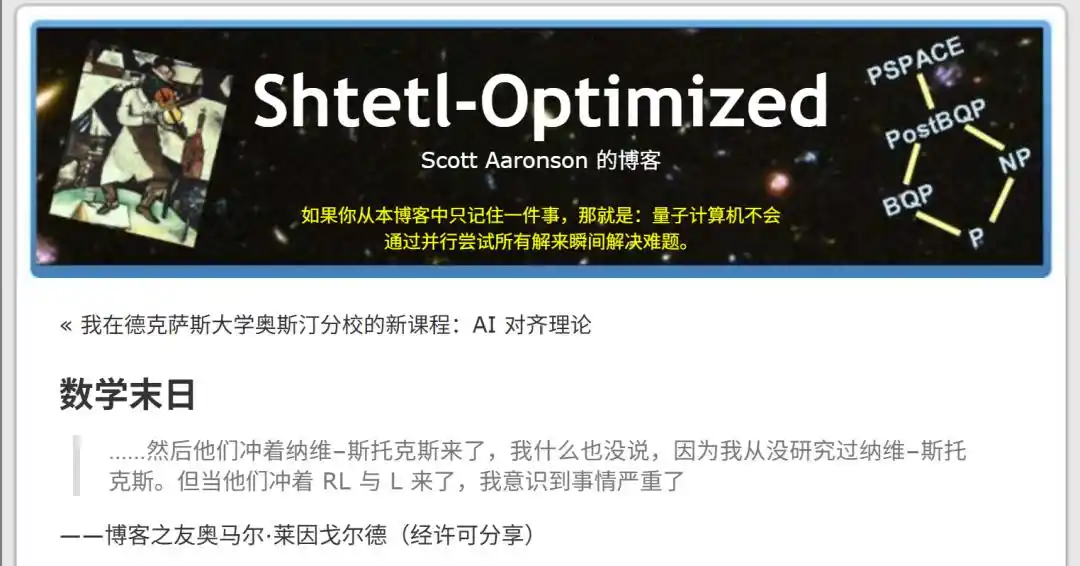
OpenAI’s release of 722 mathematical manuscripts on October 6 has set off a sharp backlash from mathematicians and theoretical computer scientists. Scott Aaronson, a professor at the University of Texas at Austin and an ACM Fellow, called it a "mathematical apocalypse" in a long post reacting to the drop.

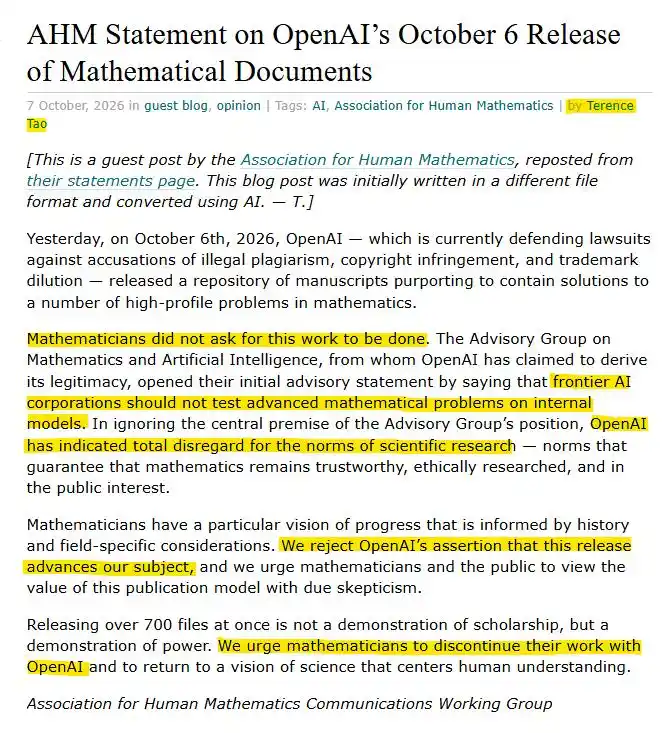
The dispute quickly moved beyond technical debate. Terence Tao reposted a joint statement led by AHM that directly targeted OpenAI. The statement referred to the company as one "currently facing lawsuits over allegations including illegal copying, copyright infringement, and trademark dilution" and said the release amounted to "naked compute hegemony."
Aaronson says the shock hit the field all at once
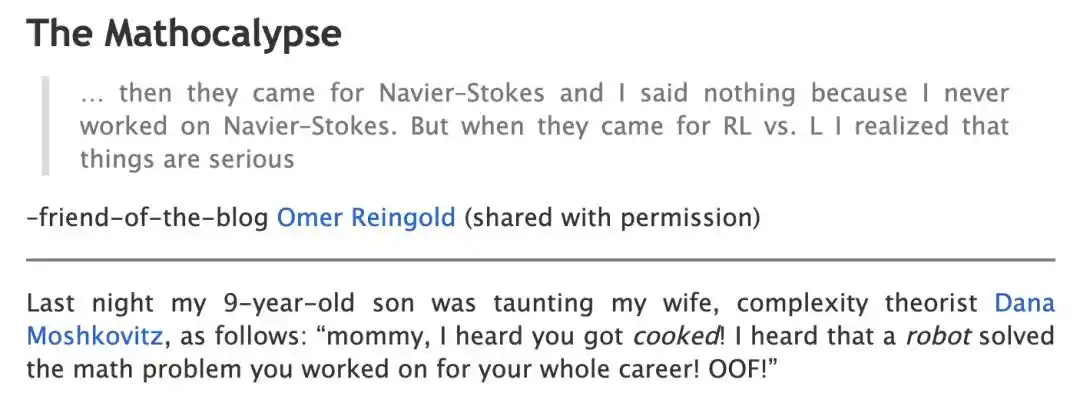
Aaronson opened his essay with a scene involving his 9-year-old son and his wife, complexity theorist Dana Moshkovitz. He wrote that the child mocked his mother by saying, "Mom, I heard you got crushed! I heard a robot solved a math problem you worked on your whole career!"
Among the papers released by OpenAI, Aaronson said, was a full proof of Subhash Khot’s Unique Games Conjecture, or UGC. He described the conjecture as a decades-old problem and said it had been the central target of Moshkovitz’s career. In his telling, she was far from alone. He argued that many mathematicians and computer scientists woke up to a screen full of AI-generated documents that upended years of work.
He listed several results that, in his view, would each have been major events on their own:
- derandomization showing L=BPL, equating probabilistic logspace with deterministic logspace;
- a new matrix multiplication bound with time complexity of O(n^(9/4));
- a Fourier transform breakthrough that pushed integer multiplication below O(n log n), breaking through a barrier he traced back to the 1960s.
Aaronson also focused on the cost of producing those results. According to his account, the work came from a new internal model slated for paid users, at a GPT-Pro level, and each top problem took about three hours of compute on average. He framed that as AI solving 5% of humanity’s top problem set in the time it takes a person to drink two cups of coffee.
The proofs may exist, but humans may not understand them
One of the deepest complaints in Aaronson’s post was not simply that AI solved hard problems, but that the resulting proofs were hard for humans to read. After going through the UGC proof, he wrote that Moshkovitz was left disoriented. He quoted her as saying it felt like something written by "a person on hallucinogens," full of unclear and illogical moves.
He said the proof introduced a new and highly strange coding method with noise testing. In his description, it was "not a long code, not a short code," but something closer to an alien construction. He also said the paper was badly written, with chaotic citations and leaps that human readers could not follow.
That led to what he presented as the most absurd part of the episode: mathematicians turning to another AI system, such as Astra, to translate and organize a paper written by AI. In that picture, human scholars are no longer the primary creators of knowledge. They become archaeologists and translators working through the ruins of an alien civilization.
Aaronson also cited a metaphor from Quanta Magazine writer Jordana Cepelewicz. It was like being teleported to the top of a mountain, surrounded by fog, without ever making the climb. The truth may be there, but the process of reaching it, and the understanding built along the way, is gone.
Why mathematicians turned on OpenAI
In Aaronson’s account, the anger is not only about capability. It is also about the way OpenAI chose to release the work. He wrote that OpenAI had earlier claimed to have solved a Millennium Prize problem, and that Tao had already seen danger in the pace of events. Tao then joined 25 Fields Medalists in a public appeal asking commercial AI companies to slow down.
The article quoted that appeal in blunt terms: "This is insane. AI companies are accelerating without limit and have no idea what happens after that. They need to slow down. There is absolutely no reason to move this fast. None."
OpenAI then followed with 722 machine-generated proof documents. Aaronson’s framing was that many mathematicians saw this not as ordinary research, but as a display of raw computational power.
The article described AHM as a line of defense built by top mathematicians to protect human understanding of mathematics and prevent academic norms from being overwhelmed by unrestricted compute. In the joint statement reposted by Tao, the signatories wrote: "Nobody asked you to do this work. Nobody asked you to solve these proofs."
The statement continued: "Releasing more than 700 files at once is not research. It is pure compute hegemony. We strongly urge all mathematicians to stop collaborating with OpenAI and return to a scientific vision centered on human understanding."
Not everyone agrees that mathematics is dying
The reaction has not been uniform. The article said Florent Krzakala, a professor at EPFL, stated that some parts of mathematics are already dead.
Yann LeCun, by contrast, offered the opposite view. The Turing Award winner said mathematics is not dying and may instead be entering an unprecedented new era. In his view, formal proof will be heavily automated, but that does not erase the value of human researchers. He argued that mathematical work would shift toward new concepts, abstractions, definitions, and conjectures.
LeCun used a simple analogy: the invention of ships made swimming less central, but ships also allowed people to discover new continents.
The split also appeared in comments on Tao’s blog. A scholar identified as Jörg Neunhäuserer said that after AI solved three problems he had spent a great deal of time on, he did not feel robbed. He felt relieved, because he no longer had to do that labor and the machine confirmed that his intuition had been right. The article also noted that a PhD student in algebraic geometry disagreed.
The missing field: cryptography
Aaronson pointed to another detail that he found unsettling. He said the released papers covered number theory, combinatorics, quantum complexity, and many other areas, but not cryptography.
He wrote that AI companies are already investigating whether their latest internal models can break the world’s most important cryptographic protocols. From there, the article raised a broader concern: if AI can crack highly complex theoretical structures and invent coding schemes that even top human researchers cannot parse, then systems tied to bank encryption, cybersecurity, and state secrets, including RSA and AES, may also come under pressure.
The article said that if those systems have already been broken, major firms may now be working behind closed doors to prepare before the rest of the world finds out.
Aaronson included a line in his essay that echoed that anxiety: "Then they came for Navier-Stokes, and I said nothing, because I never worked on Navier-Stokes. But when they came for RL vs. L, I realized this was serious."
He ended the night by watching Terminator 2
After the shock of that night, Aaronson did not keep grinding through what he described as hundreds of alien papers. He shut his computer and watched a movie with his children instead.
He said it might offer the most practical survival advice for them. The movie was Terminator 2.
Sources cited in the article
The article listed Tao’s blog post, "AHM statement on OpenAI’s October 6 release of mathematical documents," and a post from Scott Aaronson’s blog as reference materials.
It was originally published via the WeChat public account Xinzhiyuan, credited to ASI Qishilu with editing by Aeneas, and later republished by MarsBit.