
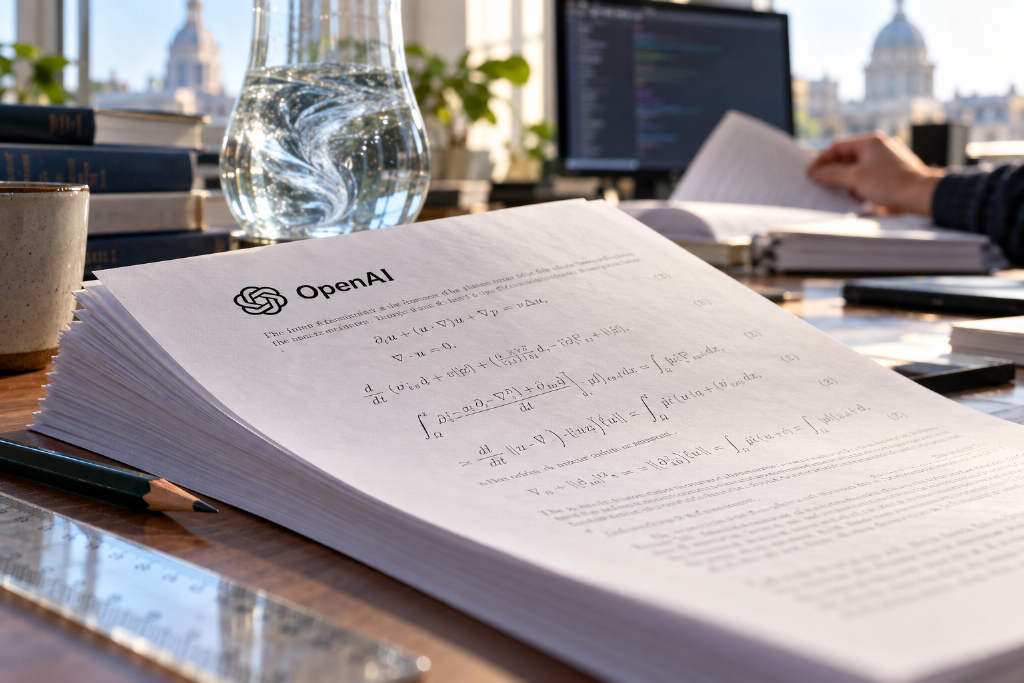
OpenAI’s claimed breakthrough on the Navier-Stokes Millennium Prize problem is starting to become legible to specialists, though not yet settled. On Oct. 26, mathematician Scott Armstrong wrote on X that several groups of partial differential equations experts studying the 166-page proof had, in his retelling, largely understood the main idea behind it.
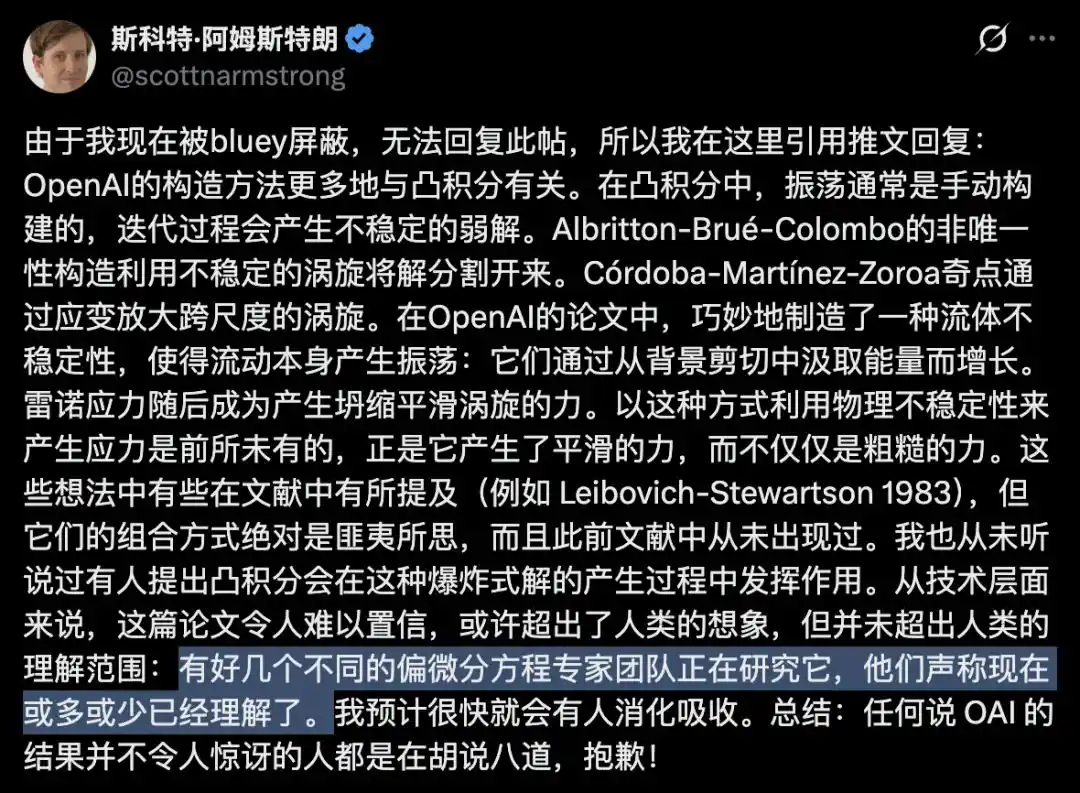
Armstrong described the work this way: 「It may have gone beyond what humans would have originally thought of, but it has not gone beyond human understanding.」 He is research director at the French National Centre for Scientific Research and a mathematics professor at the Courant Institute at New York University, with research that includes fluid turbulence.
That distinction matters. Understanding the strategy is not the same as confirming that every part of the proof is correct, and the second task is still underway.
OpenAI produced the proof in 88 hours, but people needed weeks to begin unpacking it
According to the source material, OpenAI used an unreleased model and deployed about 10,000 agents on the problem at the same time. Over 88 hours, those agents exchanged roughly 2.7 million messages and generated about 130 billion tokens.
After that, GPT-6 Astra spent another 17 hours translating the proof into Lean, a formal language used for machine checking. The report says the compute bill alone ran into the millions of dollars.
The immediate shock was not only that a proof had been produced, but that almost nobody could read it fluently. On Oct. 14, an editorial in Communications Physics, a Nature journal, ran under the headline “The equations blew up, and the planes kept flying.” The editorial said experts believed the result was correct, but nobody had truly understood it yet.
That quickly turned the discussion toward a harder question: did the system contribute a genuinely new idea, or did it only rearrange material already present in the literature?
A user identified as Joel Fish argued that the outcome was “reasonable.” In his view, the model had already absorbed a vast body of papers. He also estimated that OpenAI spent about $15 million on compute, and suggested that the same money, if directed toward mathematicians working full time, might also have produced results.
Armstrong pushed back publicly. After finding himself blocked in the thread, he quote-posted a long response and ended with a blunt line saying that anyone claiming the result was unsurprising was talking nonsense, then added “sorry!” The disagreement was really about whether AI had found a path that people had not.
The mathematical question: can a fluid blow up in finite time?
The Navier-Stokes equations describe fluid motion. One of the central questions around them is whether stretching can overpower viscosity strongly enough for velocity to become infinite in finite time, producing what mathematicians call a singularity.
The source explains this with a cup of coffee. As a vortex is stretched, it spins faster and narrows, much like a figure skater pulling in their arms. Viscosity works in the opposite direction, steadily dissipating energy like a brake.
For decades, mathematicians have asked whether the “accelerator” can beat the “brake.” OpenAI says it constructed a scenario in which a smooth external force gently drives an initially still body of water, the central vortex shrinks, the speed rises, and the velocity eventually diverges to infinity.
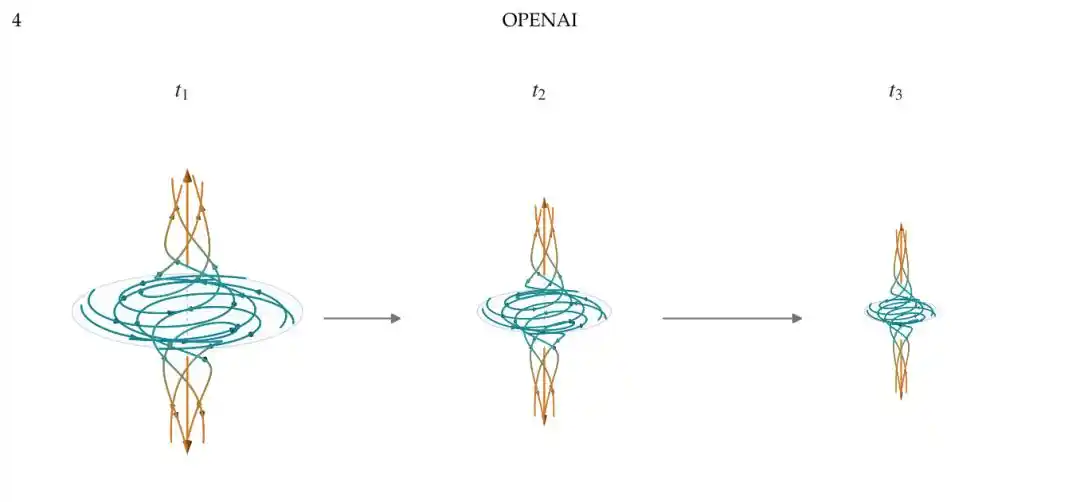
That does not mean the total kinetic energy of the whole fluid becomes infinite. The fastest-spinning region is also shrinking at the same time. The report compares it to a tiny droplet on the tip of a needle: it may spin extremely fast, but it occupies very little volume, so the total energy remains finite.
The hard part is that the external force must stay smooth throughout. If the forcing term itself blows up, then the construction would not show that the fluid dynamics generated the singularity in the required way.
The reported idea: let the fluid generate its own oscillations
As described in the article, simply drawing a shrinking vortex and plugging it into the equations does not work, because the force needed to sustain it also tends toward infinity. The paper’s answer is to add a sequence of rhythmic small oscillations, or oscillatory pulses.
Those oscillations transport momentum in a way that cancels the force that is about to run out of control. What remains is then corrected step by step. That leads to the next question: where do the oscillations come from?
The source lays out three earlier lines of work. One is convex integration, where mathematicians manually build layers of fine oscillations to produce unusual solutions, including flows in which energy appears from nowhere. A second comes from Albritton, Brué and Colombo, who used an unstable vortex to show that a fluid can evolve into two different outcomes from the same starting point. A third comes from the Spanish mathematicians Córdoba and Martínez-Zoroa, who amplified rotation level by level through repeated stretching.

At first, some observers thought OpenAI had followed the third route. But, according to the source, several experts interviewed by Scientific American said the method was different on closer inspection. Armstrong’s view is that the proof is closest to convex integration, with one major twist: instead of having a mathematician handcraft the oscillations, the construction lets the fluid produce them itself.
It does that by designing a fluid instability. When adjacent layers move at different speeds, small waves can arise spontaneously, much like ripples on water under wind or wave-like patterns in clouds when air layers shear past each other.
The force generated by those small oscillations then feeds back into the central vortex and drives it to contract further. The article sums it up in simple terms: earlier work had mathematicians stirring the water by hand; this time, the water is made to stir itself.
Armstrong said that using the fluid’s own instability to generate force had no precedent, in his view. He also said some of the ingredients appeared in papers from 1983, but that combining them in this way was “absolutely crazy” and not something he had seen in the literature. He added that he had never heard of anyone using convex integration to build this kind of blow-up solution.
On that reading, AI did not invent new tools. It used old human tools to travel along a route humans had not taken.
Interpretation papers are appearing, but verification is still incomplete
Researchers have already started producing public explanations. In late September, Fudan University mathematician Lei Zhen and co-author Xiao Ren released an interpretive preprint that rewrote the part of OpenAI’s manuscript dealing with the construction of the flow profile, with the aim of making it easier for peers to follow. They described OpenAI’s work as a major advance on the Navier-Stokes Millennium Prize problem.

But understanding the idea is only one part of the job. Another is checking whether the prose manuscript and the Lean version actually say the same thing.
Lean is a proof assistant. Once mathematical statements and derivations are written in a formal language, it can verify whether each step follows. What it cannot do on its own is decide whether the formalized text preserves the full meaning of the original manuscript.
On Oct. 6, Bastounis, Circelli and Hansen posted a preprint saying that some statements and derivations differ between the original manuscript and the Lean version. They also said they were not judging whether OpenAI’s prose proof was correct.
That is why the criticism cannot be reduced to “the proof has been overturned.” The narrower issue is what, exactly, the machine-checked material guarantees about the claims made in the original text. A machine can confirm that each formal step is valid. It cannot by itself guarantee that the problem statement was transcribed without change.
Clay still lists the problem as active, and OpenAI does not plan to claim the prize
As of now, the Clay institute still lists the problem as “Active.” OpenAI has also said it does not plan to claim the $1 million prize.
The article notes another question that has come up repeatedly: can this method be extended to the case with no external force? It presents that as a new target rather than an unfinished half of the current result. Under the Clay framework described in the source, proving any one of the four listed formulations counts as a solution. OpenAI says it completed the two formulations that allow smooth external forcing.
For the no-force case, the report cites analysis in a new paper by Constantin and others saying that the present construction does not transfer directly. Reaching that setting may require a different idea.
The next stage belongs to human researchers
The source breaks the remaining work into three tasks. First, produce a full and readable explanation so that specialists do not have to infer the intent behind every step from scratch. Second, carry out a line-by-line comparison and state clearly which parts have already been checked and which still need explanation. Third, extract methods from the proof and apply them to other problems.
From OpenAI’s Sept. 8 announcement to Armstrong’s Oct. 26 post, the field moved in seven weeks from “almost nobody can read this” to “some experts now largely understand the idea.” That is progress, but it is not the finish line. Whether the proof is fully correct, how the Lean formalization maps onto the original manuscript, and whether the methods can become usable knowledge for later researchers are all still open matters.
One side of the ledger is easy to state: 88 hours, 10,000 agents, and a compute bill in the millions. The human side is harder to count. Reading, checking and explaining all take expert time. Without that stage, the AI output remains a document that nobody can safely use.



