

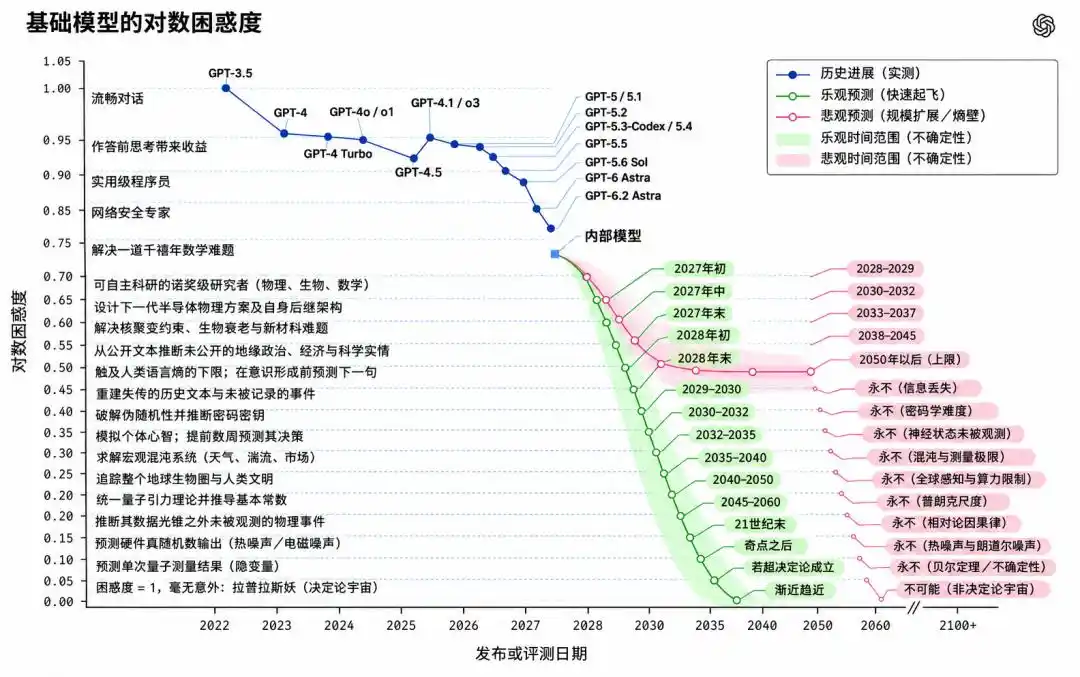
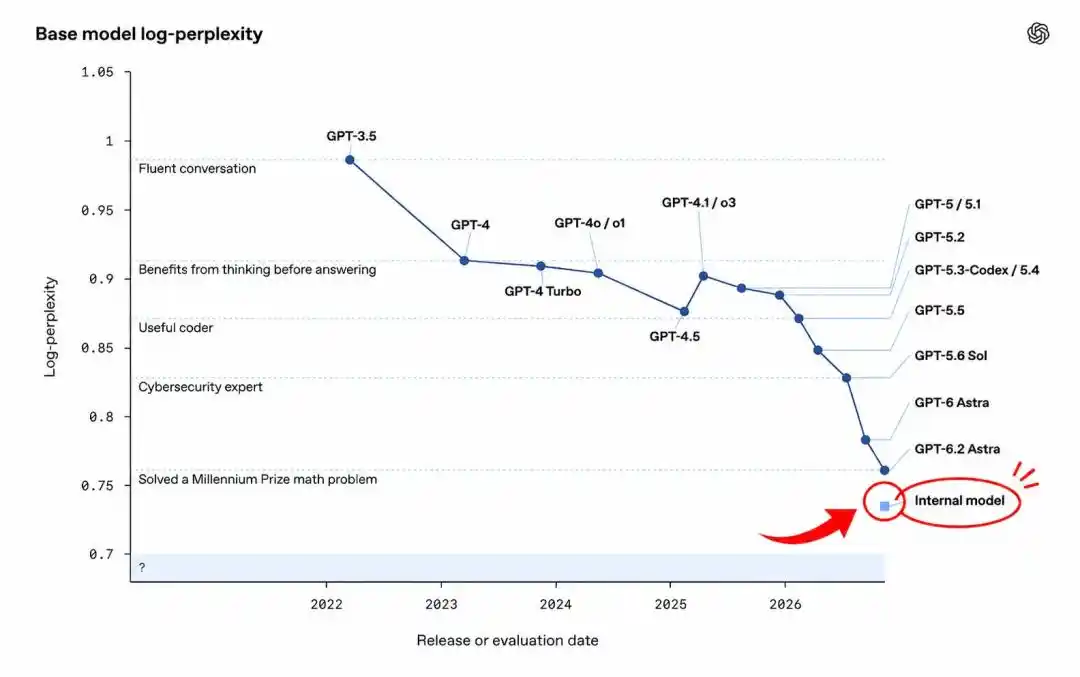
OpenAI chief scientist Jakub Pachocki has disclosed details of the company’s pretraining progress and urged frontier AI developers to consider a shared safety metric. A chart he discussed puts an internal OpenAI model’s log-perplexity at about 0.73. Pachocki described the 0.68-to-0.70 range as a point where the capabilities that might emerge remain unknown.
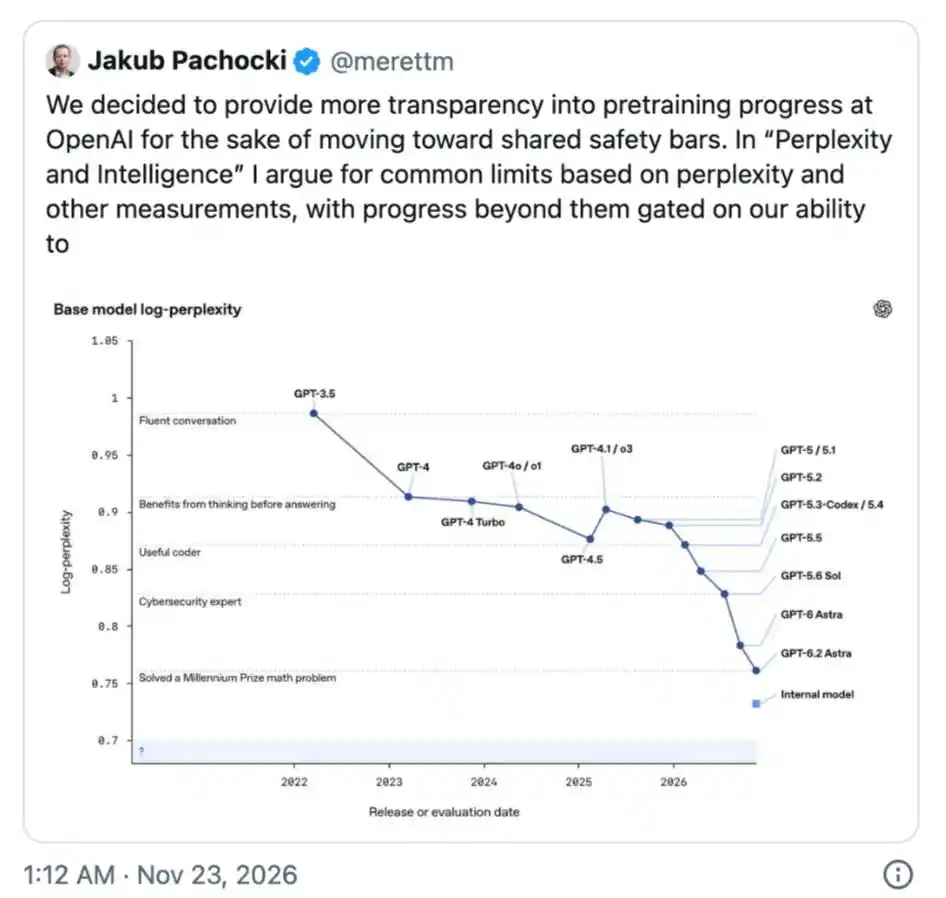
He also said models began solving open mathematical problems when their log-perplexity reached roughly 0.76. Pachocki argued that if AI can make advances in mathematics, it may also be capable of helping research how to train the next generation of AI systems. He forecast that foundational pretraining could see what he called an avalanche of progress as early as 2027. These are OpenAI executives’ assessments of the metric and possible future developments.
Why OpenAI is publishing pretraining metrics
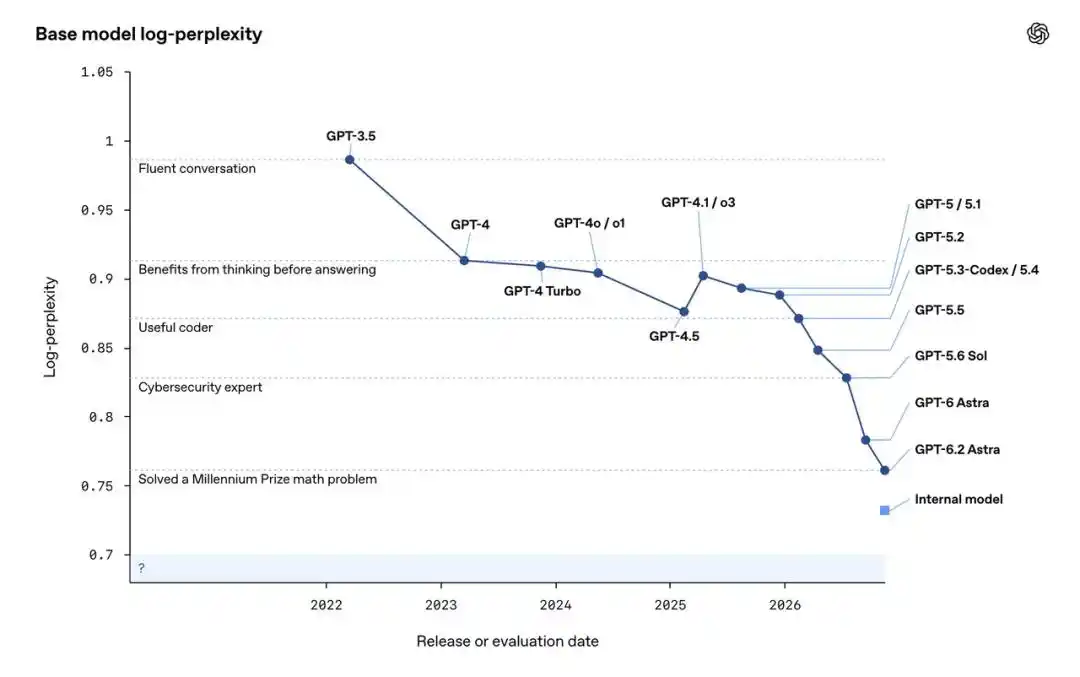
OpenAI CEO Sam Altman called the release one of the company’s most important in some time. He said OpenAI had decided to publish a substantial amount of pretraining progress data in the hope that the industry could agree on common limits and keep AI development safe and controllable.
Co-founder Greg Brockman cautioned that AI may help people with alignment and monitoring, but safety progress is unlikely to keep pace with accelerating pretraining. Pachocki acknowledged that publishing the figures gives competitors a clearer view of OpenAI’s progress. He said, however, that the urgency of establishing a shared safety baseline outweighed the commercial case for keeping the data confidential.
The report says no frontier lab had previously published its own pretraining loss curve. Such figures are considered a key signal of model capability and can give competitors an indication of how close a lab may be to its next-generation model. OpenAI’s proposal is to use perplexity as a common reference point and discuss pausing capability advances at a defined threshold.
How perplexity relates to model capability
Perplexity measures a model’s performance at predicting the next word. In the account of Pachocki’s explanation, a lower number means the model makes more accurate predictions about the data. OpenAI published perplexity figures for models ranging from GPT-3.5 to its internal systems, using the values to describe changes in capability.
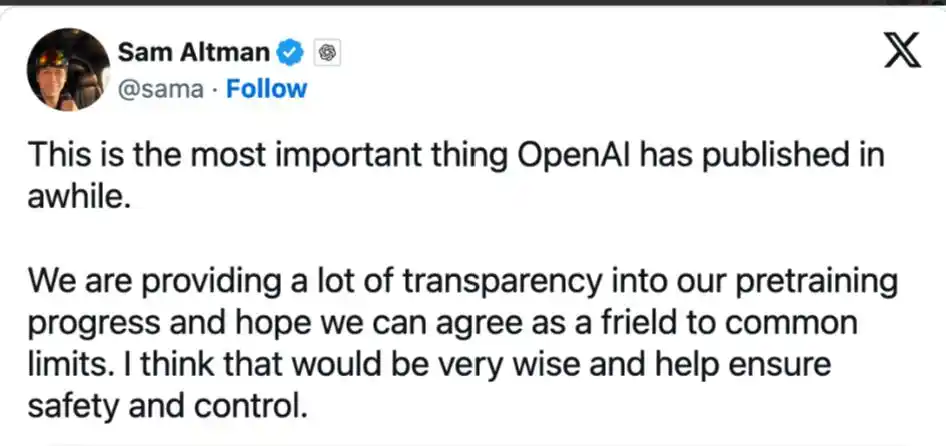
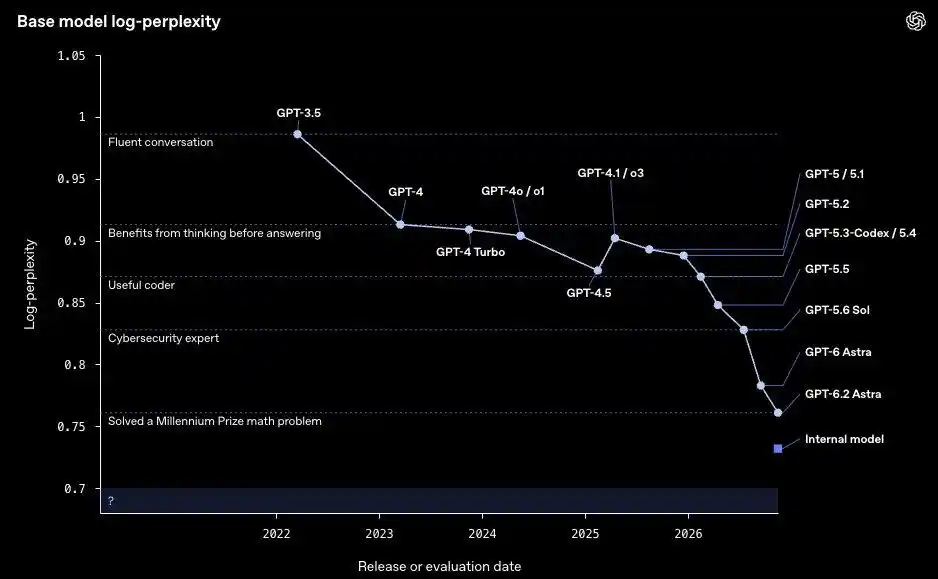
The article identifies several past thresholds. GPT-3.5 fell below 0.99 as it developed fluent conversational ability, while GPT-4 fell below 0.91 as models began showing chain-of-thought (CoT) reasoning. It also says that below 0.80, AI began to affect the fields of cybersecurity and mathematics. These are the article’s descriptions of capability shifts; perplexity does not directly measure performance on every task.
Pachocki said OpenAI had spent more than a year testing models on open mathematical problems that had not been solved. When an internal model’s log-perplexity compressed to around 0.76, the team began seeing new results. He recalled models answering, in a Slack group chat, mathematical questions that researchers had spent years considering, describing the experience as surreal.
In Pachocki’s view, an AI system able to make mathematical breakthroughs could also help develop training methods for future AI models. If AI takes part in research on pretraining algorithms, he said, the traditional pace of human research and development could be disrupted. He forecast that foundational pretraining could accelerate sharply as early as 2027.
The 0.68-to-0.70 range remains difficult to assess
OpenAI’s chart puts an internal model’s log-perplexity at about 0.73. Pachocki identified 0.68 to 0.70 as the next range to watch, but said he did not know what capabilities might appear there. The report attributes to him the view that people have not even invented the tests needed to detect some of those possible abilities.
The article also raises the possibility that existing alignment and monitoring methods may not be adequate for AI at this level. In response to that uncertainty, Pachocki and Altman have advocated a shared perplexity limit for frontier developers. One example is a threshold of 0.68: a lab would stop advancing an internal model once it reached the line, unless people had developed a new generation of monitors capable of understanding and controlling the relevant behavior.
Musk challenges the term pretraining and points to data constraints
OpenAI’s proposal prompted discussion on X. Elon Musk mocked the term “pretraining,” arguing that it should simply be called “training.” He compared the terminology to putting on workout clothes, taking a shower, and never exercising.
Musk also raised the possibility that data depletion could constrain AI development. He asked what might happen if available data were exhausted while computing power continued to grow exponentially. He said people should imagine what superintelligence might look like once computing reaches the scale of 10 quintillion operations, adding that today’s AI would then resemble a caveman playing with a stick.
Four limitations of perplexity as a safety metric
Pachocki also outlined four major challenges in using perplexity as an industry-wide safety measure:
- Comparisons across labs are difficult: Labs use different test sets and training-data recipes. The same value, such as 0.7, may not represent the same level of capability across systems.
- It does not map directly to specific tasks: Perplexity is a basic prediction metric and cannot directly show how well a model writes code or prose. The case for tracking it is that falling perplexity may accompany the emergence of new, hard-to-predict capabilities.
- It misses progress outside pretraining: Chain-of-thought reasoning, for example, can improve a model’s performance without lowering its underlying perplexity.
- Its lower limit is unknown: Loss cannot fall to zero, which would mean perfectly certain memorization of all data, and the inherent entropy of the data is not known. Perplexity declines more slowly as it approaches its limit, but the article says even a 0.01 drop could correspond to a major jump in intelligence.
Despite these drawbacks, Pachocki believes perplexity is currently the only measure that has stood the test of time and can consistently track growth in general intelligence.
Who sets the industry’s safety threshold?
The article links Altman’s repost of the essay to a wider contest over control of future AI and notes that the timing coincided with the days around Anthropic’s listing. It also raises a question: if labs set their own safety limits, decision-making over when to stop remains with the leading AI companies.

The report lists a sequence of declining figures—0.99, 0.91, 0.87, 0.83, 0.76 and 0.73—as a scale for progress toward unknown intelligence. OpenAI says it has already applied part of the brakes. The report gives no answer on whether other labs will join a common commitment.
This article was first published by the WeChat account Xinzhiyuan. Author: ASI Revelation.



