
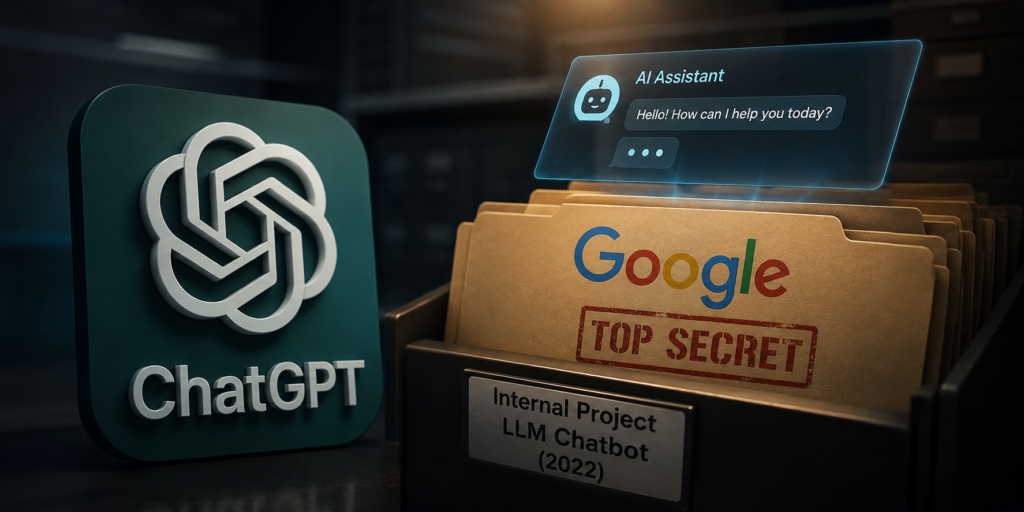
OpenAI product lead Tibo Sottiaux said on X that he once worked on a Google internal project called LMChat, describing it as essentially a ChatGPT-like product that existed a year before ChatGPT was released.
Sottiaux made the remark while replying to a post from former Meta engineer Cheng Lou. Lou had pointed to comments by Google chief scientist Jeff Dean, who said in an interview that Google had internal chatbots before ChatGPT launched, but at the time the company did not believe they were better than using Google Search directly. Sottiaux then said he had been on that team.
He wrote: “I was part of that team. Basically ChatGPT one year before it came out. Called LMChat and then another codename. Google was too nervous to release it and DeepMind was blocked from shipping products that could disrupt Google. I think about this a lot.”
Timeline lines up with Google’s earlier chatbot efforts
The timeline described in the report matches Google’s known work on conversational AI. ChatGPT was released in late November 2022. One year earlier, Google was showcasing its LaMDA conversational model at its 2021 I/O conference.
Before that, Google had introduced the Meena conversational model in 2020. The report says engineers Noam Shazeer and Daniel De Freitas, who helped build Meena, left the company in 2021 after Google did not move ahead with a release and later founded Character.AI.
The issue was not the technology, but the decision to ship
Sottiaux’s explanation was direct: Google was too nervous to release the product, and DeepMind was explicitly blocked from shipping products that could disrupt Google’s main business.
The report also cites Jeff Dean’s later interview with TIME, where he acknowledged a similar concern. Google was highly sensitive to the fact that these models could sometimes be wrong. In search, an incorrect answer can damage trust built over decades. A startup without that same burden could take the risk more easily.
Delay gave way to a rushed response
According to the report, Google’s hesitation for more than a year left it reacting under pressure. In February 2023, the company rolled out Bard after ChatGPT’s rise, but a mistake during the product demo was followed by an about $100 billion one-day drop in Alphabet’s market value.
Two months later, Google merged Brain and DeepMind into Google DeepMind, consolidating its AI efforts around a direction it had already been holding internally a year earlier.
Sottiaux later moved to OpenAI
The report closes with an irony in Sottiaux’s own career path. After working on the project that never shipped at Google, he joined OpenAI in 2024 and first led work on Codex. Following a 2026 reorganization of OpenAI’s product group, he became a core product lead overseeing both ChatGPT and Codex, and is now pushing to combine them into a single super app.
The account adds to the picture of a company that appears to have had a product close to ChatGPT internally, but chose not to bring it to market at the time.