
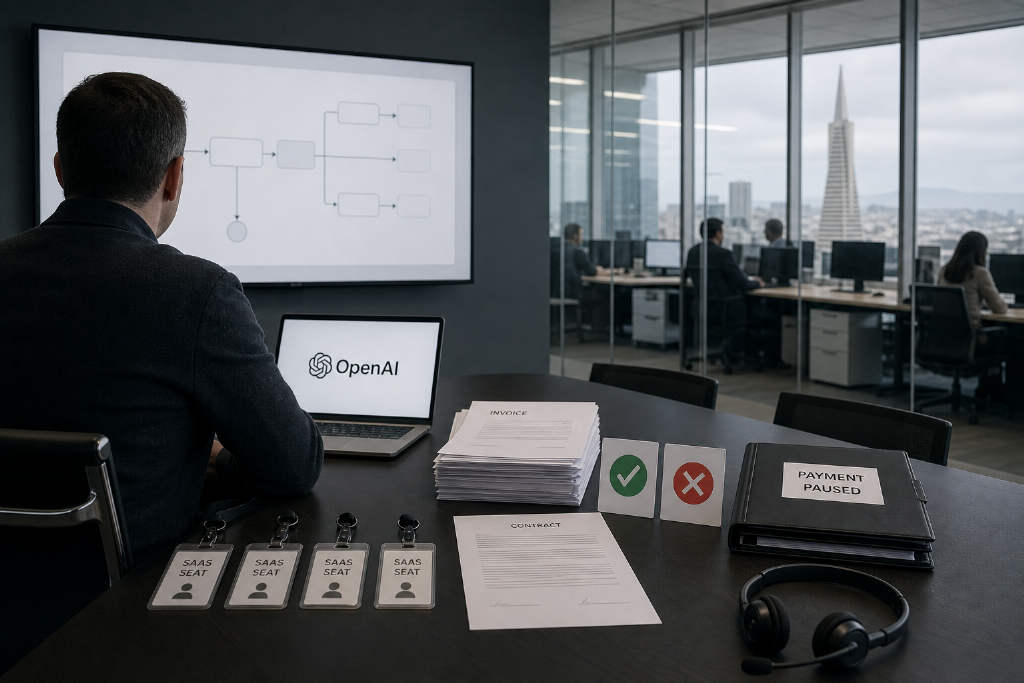
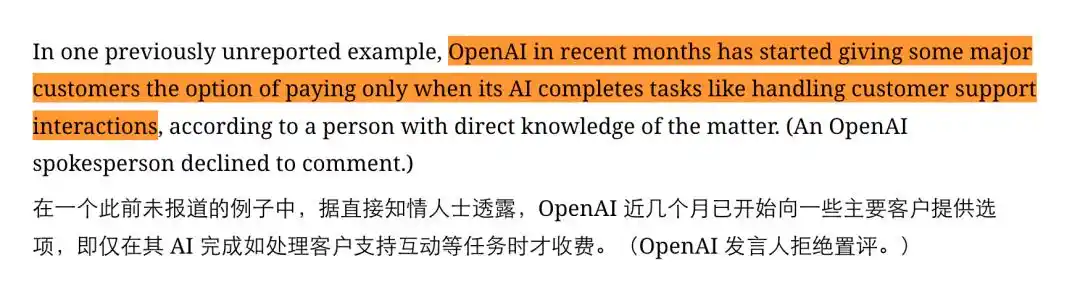
OpenAI has quietly begun offering some of its largest corporate customers a new pricing model: pay only when the AI actually gets the job done. Citing a person with direct knowledge of the matter, The Information reported that the company has floated the arrangement over the past few months, covering tasks such as customer service. An OpenAI spokesperson declined to comment.

On the surface it is a billing tweak. Behind it sits a deeper unease that has been building in the software industry for years. The old math was simple: one employee, one license, one monthly subscription fee. AI agents break that math. An agent might answer a question in a minute or work for hours across a whole workflow; more tokens burned does not automatically mean more value produced. So a growing number of buyers are asking a blunt question: if the AI is supposed to do the work, why not pay after the work is done?
Usage-based pricing gets closer to cost, but not to value
The industry has spent two years circling the problem. The easiest fix was usage-based billing — per token, per call, per completed task. It tracks AI cost structures better than seat-based subscriptions, but it raises a different problem: heavy usage is not the same as high value. An agent that makes 1,000 phone calls tells you nothing about how many sales closed. A team of engineers burning hundreds of millions of tokens a day does not prove those tokens earned the company a single dollar.
That is why outcome-based pricing is moving onto AI companies' price lists. Sierra, a customer management firm, charges clients only when its AI completes a task without human intervention. Fin, the startup Salesforce is acquiring for $3.6 billion, bills for problems it successfully resolves. Coding agent company Cognition goes further, promising enterprise customers up to $10 million in credits if delivered engineering work falls short of the fees paid. Legacy software names like Adobe, HubSpot and Zendesk are already shifting toward the same direction.

OpenAI's entry signals this is no longer just an experiment for AI startups. The same idea is showing up in China. Lingxi Technology, for example, uses a delivery-style model in sales scenarios like insurance and autos. Its AI does not simply act as a Copilot for sales staff; it participates in customer conversations, judges intent, follows up and closes deals. The yardstick is plain: whether real orders, premiums and sales growth materialize.
The pattern points one way: AI vendors are starting to take on risk that used to sit with customers. Software was once sold as a tool; whether anyone used it or it moved revenue was the buyer's problem. Now some vendors are tying their own revenue to customer outcomes. That sounds attractive — and much harder than selling software.
Salesforce's pricing pivot
Salesforce is the most visible large-company example of the shift. It has been making Agentforce pricing more flexible: enterprises can buy by AI usage, or negotiate custom contracts that tie fees to business results, such as how many extra orders Agentforce helped close or how much cost it saved by automating customer service.

CEO Marc Benioff said on the latest earnings call that he feels the change directly: "Customers want to buy differently, and they want to be priced differently." He has moved past pay-per-task. His example is blunt. Early outcome-based pricing might be: "You made these phone calls, so pay me $2." What Salesforce wants eventually is: "We helped you grow revenue this much, so give me $2 out of the $20 or $40 we helped you earn."
If that works, software vendors can charge a lot more. Benioff said providers could get "very high prices" for their products under this model. Salesforce said flexible AI pricing has already helped it sign "very large deals." Last week it disclosed that Agentforce and a data management service grew sales more than threefold year over year. The business has not yet moved Salesforce's overall revenue much, but investors have reacted — the stock is up about 23% since the announcement.
When the user interface disappears
There is also a deeper reason Salesforce is rushing to change how it charges: AI agents are displacing enterprise software from its traditional position. Employees used to open Salesforce, log customer data, track deals and handle service requests. The software itself was the entry point to work, which justified charging per user.

Agents like Claude complicate that. When AI can operate Salesforce directly, employees may stop opening the app themselves. Tell Claude to organize a customer record, amend an order or check inventory, and the agent does the rest in the background. If that becomes the norm, one of the biggest assets of traditional enterprise software — the user entry point — gets eroded.
Salesforce is not blocking it. Last week it launched Claudeforce, which lets customers fetch Salesforce data through Claude and perform tasks involving the app without entering it. People familiar with its sales strategy say Salesforce will likely offer multiple pricing options for Claudeforce, though enterprises first need a higher-tier Salesforce subscription.
Behind that is a bigger plan: even if users stop opening Salesforce directly, as long as other companies' AI needs to call Salesforce data and capabilities, Salesforce wants to get paid. In other words, as the interface hides behind agents, Salesforce is hunting for a new toll booth.

A return to a familiar fight
Charging by the revenue AI creates, or the cost it saves, is not entirely new. Palantir has done it for years, signing highly customized contracts with large enterprises, combining fixed fees, usage and outcome-based charges. Salesforce's AI pricing strategy now looks a lot like that.
The role reversal is striking. Two decades ago, Salesforce redefined how software is sold. Before it came along, companies paid a heavy upfront license fee and handled upgrades themselves. SaaS let them pay per employee, add seats as headcount grew and leave upgrades to the cloud. That model fed the SaaS industry and powered two decades of software prosperity.
Transitions are not always smooth. Splunk, for example, saw revenue dip briefly when it moved from licensed software to subscriptions. Now AI has scrambled the old rules again. This time Salesforce is not the one inventing the new playbook — it is learning from Sierra, Fin and other newcomers how to sell software.
The two hard questions behind "pay for outcomes"
Outcome-based pricing sounds customer-friendly, but it pushes a previously minor question to the front: what exactly counts as a result created by AI? There are at least two hurdles.
The first is reliability. Under usage-based billing, a failed agent run still costs compute and is usually paid for anyway. Under outcome-based billing, the vendor eats that cost. That is a heavy burden for today's agents. Independent tests show OpenAI's Operator still fails at a notable rate on real desktop tasks. A survey of 8,128 users found agents complete roughly three-quarters of assigned work on average. By trying "pay when it works," OpenAI is effectively turning product reliability into a revenue problem: the more often agents fail, the more compute gets wasted for free. Can the math work?
The second hurdle is attribution. Whether a customer-service ticket was resolved independently is fairly easy to judge. But if the fee is tied to "how much more money we made you" or "how much cost we saved," things get murky. Suppose revenue rose 20% within three months of an AI deployment. The agent may deserve some credit, but so might a product launch, a marketing campaign or seasonal swings. Stripe has published an outcome-based pricing guide, urging software vendors to define attribution rules in advance; otherwise customers and suppliers will argue over whether the revenue came from AI or would have happened anyway.

Moving from tokens and seats to results is far more than changing the unit of billing. Software companies that want a share of the value their AI creates must first be willing to pay for failure, then prove the success was actually theirs. From OpenAI and Sierra to Salesforce and Palantir, with a growing pack of similar firms in China, the experiment is getting noisy. Where it ends up, we can only keep watching.
Reference: https://www.theinformation.com/briefings/openai-starts-letting-customers-pay-ai-works?rc=jn0pp4
This article is from the WeChat public account "机器之心" (ID: almosthuman2014), by 机器之心.