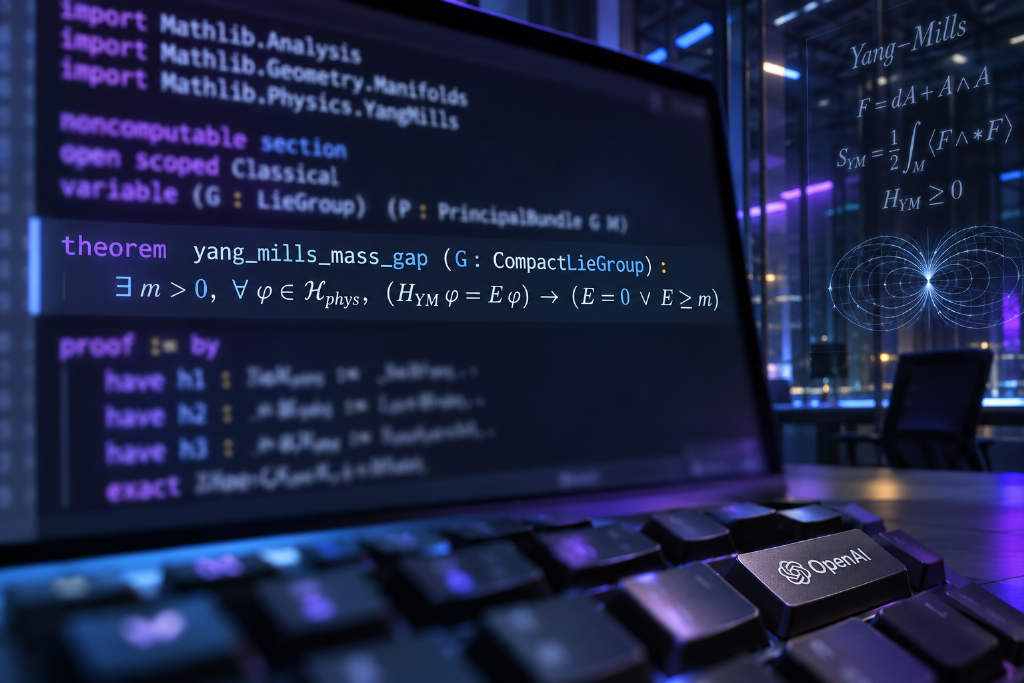
OpenAI’s artificial intelligence model has proved part of the Yang-Mills problem, one of the million-dollar Millennium Prize Problems in physics, according to MTS. The work received support from a review panel chaired by Nobel laureate David Gross. OpenAI first announced the proof on October 26 and said the model had completed the work in September. The proof was formalized in Lean, a computer language that allows each step to be checked. Arthur Jaffe, who helped write the official statement of the Millennium Prize Problem, is also on the panel. The Yang-Mills problem is one of seven challenges established in 2000, each carrying a $1 million prize. The only problem in the series solved so far was completed by Grigori Perelman, who declined the award. MTS said the Yang-Mills prize still requires a proof of the mass gap, publication, and compliance with the Clay Mathematics Institute’s two-year recognition period. X user Theo Jaffee said physicists have handled quantum field theory and quantum Yang-Mills theory empirically, while a mathematical formalization of why the theory works has remained absent.
OpenAI’s artificial intelligence model has proved part of the Yang-Mills problem, a million-dollar Millennium Prize Problem in physics, according to MTS. The work has received support from a review panel led by a Nobel laureate.
OpenAI first announced the proof on October 26 and said its model completed the work in September. Nobel laureate David Gross chairs the panel. Its members include Arthur Jaffe, who co-wrote the official statement of the Millennium Prize Problem. The proof was formalized in Lean, a computer language that allows each step to be checked.
The Yang-Mills problem is one of seven Millennium Prize challenges established in 2000, each carrying a $1 million award. The only one solved so far was completed by Grigori Perelman, who declined the prize. MTS said the Yang-Mills award still requires a proof of the mass gap, along with meeting the Clay Mathematics Institute’s rules on publication and a two-year recognition period.
X user Theo Jaffee said physicists have been able to handle quantum field theory and quantum Yang-Mills theory empirically, but that a mathematical formalization explaining why the theory works has been missing.
This article was originally published by Bit.Fan. For more cryptocurrency news and market insights, visit www.bit.fan. Disclaimer:
The market information, project data, and third-party content displayed on this platform are for industry information sharing only and do not constitute any form of investment advice or return commitment.
Cryptocurrency trading carries high risks. Users should fully assess their risk tolerance and make independent decisions. All profits, losses, and legal responsibilities are borne by the users themselves.