
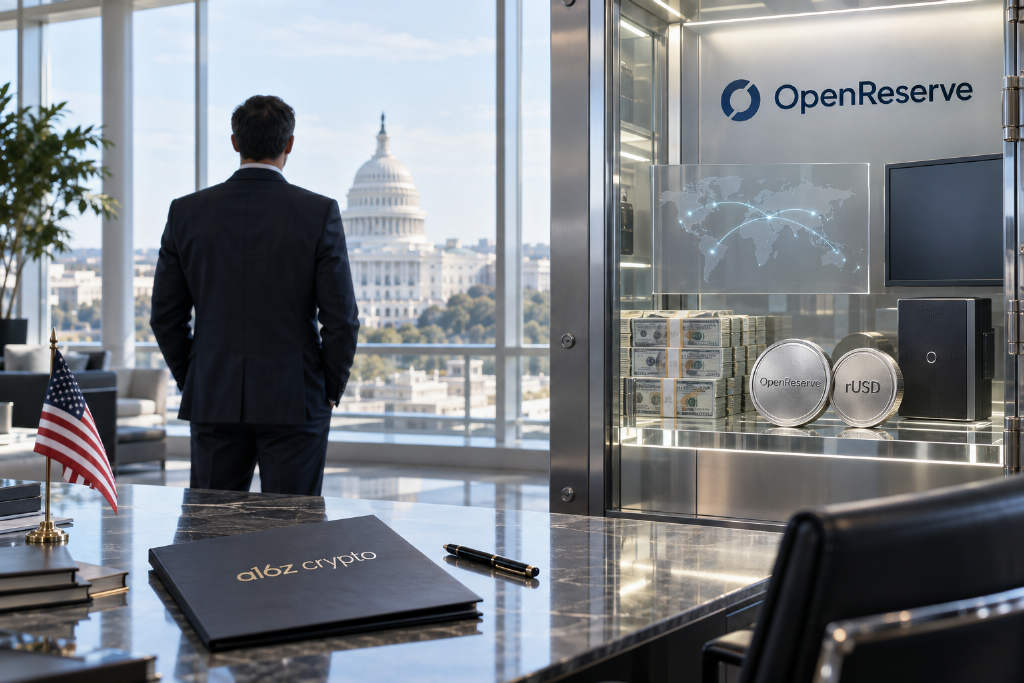
OpenReserve, a company founded roughly a year ago, has raised a $25 million seed round led by a16z crypto and received preliminary conditional approval from the U.S. Office of the Comptroller of the Currency, or OCC, for a national bank charter.

The company, operating as OpenReserve Bank, N.A., is trying to place blockchain settlement inside a full banking license and build what its backers describe as an always-open bank.
A bank model built around institutional clients
OpenReserve’s proposed business includes safeguarded deposits, lending, tokenized deposits, digital asset custody through a subsidiary, and cross-border remittances using stablecoins.
The business list in the OCC approval points to institutional and corporate clients rather than retail users. It covers treasury management, payments and settlement, cross-border correspondent banking, banking-as-a-service platforms, and digital asset custody. On its website, OpenReserve describes its role as connecting institutions with payment rails. The target market is the pool of accounts currently spread across state-chartered banks, trust companies, and offshore entities serving digital asset firms, stablecoin issuers, and trading institutions.
The product drawing the most attention is rUSD, or ReserveUSD, a planned compliant stablecoin to be issued by subsidiary ReserveUSD, LLC. It will run on Open Core, the company’s in-house technology platform. An API example on the company’s website shows a 950-millisecond settlement time for a single transaction, along with ledger hash verification.
Founders come from MoneyLion
OpenReserve founder and CEO Dee Choubey, whose full name is Diwakar Choubey, previously founded consumer fintech company MoneyLion in 2013. MoneyLion went public through a SPAC in 2021 and was acquired by cybersecurity company Gen Digital on April 17, 2025 for $82 a share, or about $1 billion in cash. At the time, the platform had 18 million users.

Explaining why he started a second company, Choubey said: 「We spent twelve years merging banking and payments on infrastructure we did not own while building MoneyLion. We experienced the pain firsthand and came away understanding the obstacles innovators face. In the end, we learned that you cannot fix banking from the top layer. Infrastructure is the product, and that infrastructure must connect America’s real-time payment rails with blockchain ecosystems that operate inside a regulated perimeter.」
OpenReserve’s other co-founder, Richard Correia, was previously MoneyLion’s president and chief financial officer. He now serves as president and chief operating officer at OpenReserve.
Four other organizers and directors named in the OCC filing are John Chrystal, David Schwed, Jame Sloan, and Soumya Basu. Schwed is the chief technology officer and brings security experience from BNY Mellon and Robinhood. Sloan is the chief risk officer and previously spent 21 years at the OCC.
Seed round brought in more than $24 million so far
The $25 million seed round was led by a16z crypto, with participation from Jump Capital, Coinbase Ventures, Wintermute Ventures, Acrew Capital, Clocktower, Quona, AAF Management, and Zero Knowledge Ventures.
An SEC Regulation D filing shows that more than $24 million has already been received.

a16z partner Guy Wuollet framed the bet this way: 「We need a bank that is always online, always open, always available. A bank that never closes.」
Approval came in 4 months and 20 days
OpenReserve filed its application on April 13 and received OCC approval on Sept. 2, a process that took 4 months and 20 days.
That timeline stands out in the context of new full-service national bank approvals. As a comparison, blockchain lending firm Figure applied for a full-service national bank charter in 2020, went through litigation and regulatory scrutiny, and eventually withdrew its application in 2023 without obtaining a charter.
A changing approval window helped shape the outcome. Jonathan Gould became Comptroller of the Currency on July 15, 2025, reopening a new-bank approval pipeline that had been stalled for years. In October that year, the first preliminary conditional approval for a newly established bank under his tenure went to Erebor. Consumer lending platform Upstart received conditional approval on July 23 this year. UK fintech company Revolut and OpenReserve were both approved on Sept. 3.
Since 2025, the OCC has received about 40 new-bank applications and approved 21 of them.

Another factor is that regulators now have a clearer framework. The GENIUS Act limits stablecoin issuance to regulated entities, which means the OCC no longer has to assess these applications without a standard reference point. OpenReserve’s chief risk officer, Jame Sloan, had also just come from the OCC after 21 years there.
$210 million capital requirement remains the key hurdle
The original OCC approval document, Corporate Decision #1389 dated Sept. 2, lays out a firm timetable.
Capital comes first. After deducting organization and pre-opening expenses, OpenReserve must have no less than $210 million in paid-in capital within 12 months. It must open for business within 18 months, or the approval will automatically expire. For its first three years, the bank must maintain a Tier 1 leverage ratio of at least 12%.
The report notes that this condition is not unique to OpenReserve. Erebor received the same requirement, making it a standard term in the current round of new-bank approvals.
Management and operations are also tightly controlled. Executive and director appointments, including the anti-money laundering officer, chief compliance officer, and chief information security officer, require prior OCC approval. Any material deviation from the business plan must be reported 60 days in advance and receive written consent.

The approval also explicitly requires compliance with the GENIUS Act. But the wholly owned stablecoin subsidiary responsible for rUSD had not yet submitted its own application at the time referenced in the report. Beyond that, OpenReserve still faces two separate steps: Federal Deposit Insurance Corporation deposit insurance and stock in a Federal Reserve Bank.
Erebor offers the closest comparison
Erebor received conditional approval on Oct. 15, 2025 and officially opened on Feb. 9, 2026 with $635 million in paid-in capital. It took less than four months from approval to fully capitalized launch.
Its shareholder list included Palmer Luckey and Peter Thiel, the co-founder of PayPal and Palantir.
OpenReserve currently has $25 million on hand. That leaves it $185 million short of the $210 million threshold, with a deadline of September 2027.
