

U.S. companies are directing a far larger share of their AI usage to Chinese models, based on data from OpenRouter cited by CNBC on July 7. The routing platform said the share of tokens used by American firms through Chinese AI models climbed from an average of 4.5% in the first half of 2025 to a peak of 46% in April 2026.
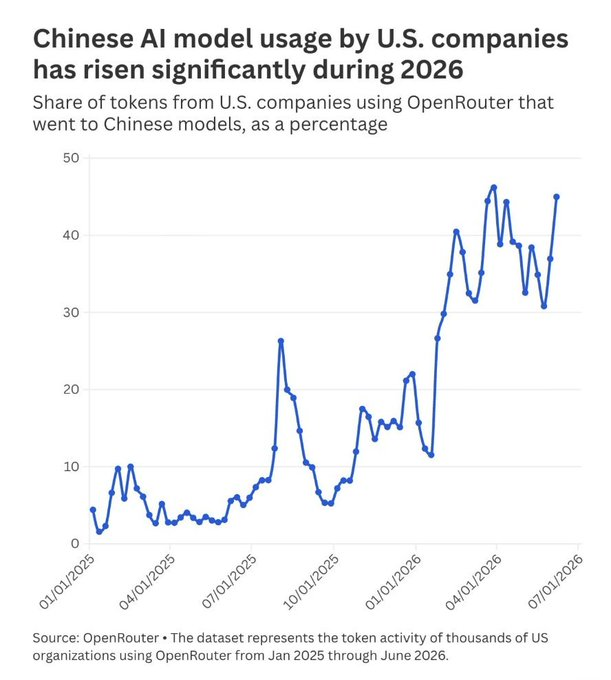
Starting Feb. 8, that share stayed above 30% every week. During roughly the same stretch, the share held by U.S. models fell from about 70% in June 2025 to about 30% in June 2026.
Pricing is driving the shift
Justin Summerville, a data analyst at OpenRouter, told CNBC that Chinese open-source models are 60% to 90% cheaper than leading products from Anthropic and OpenAI.
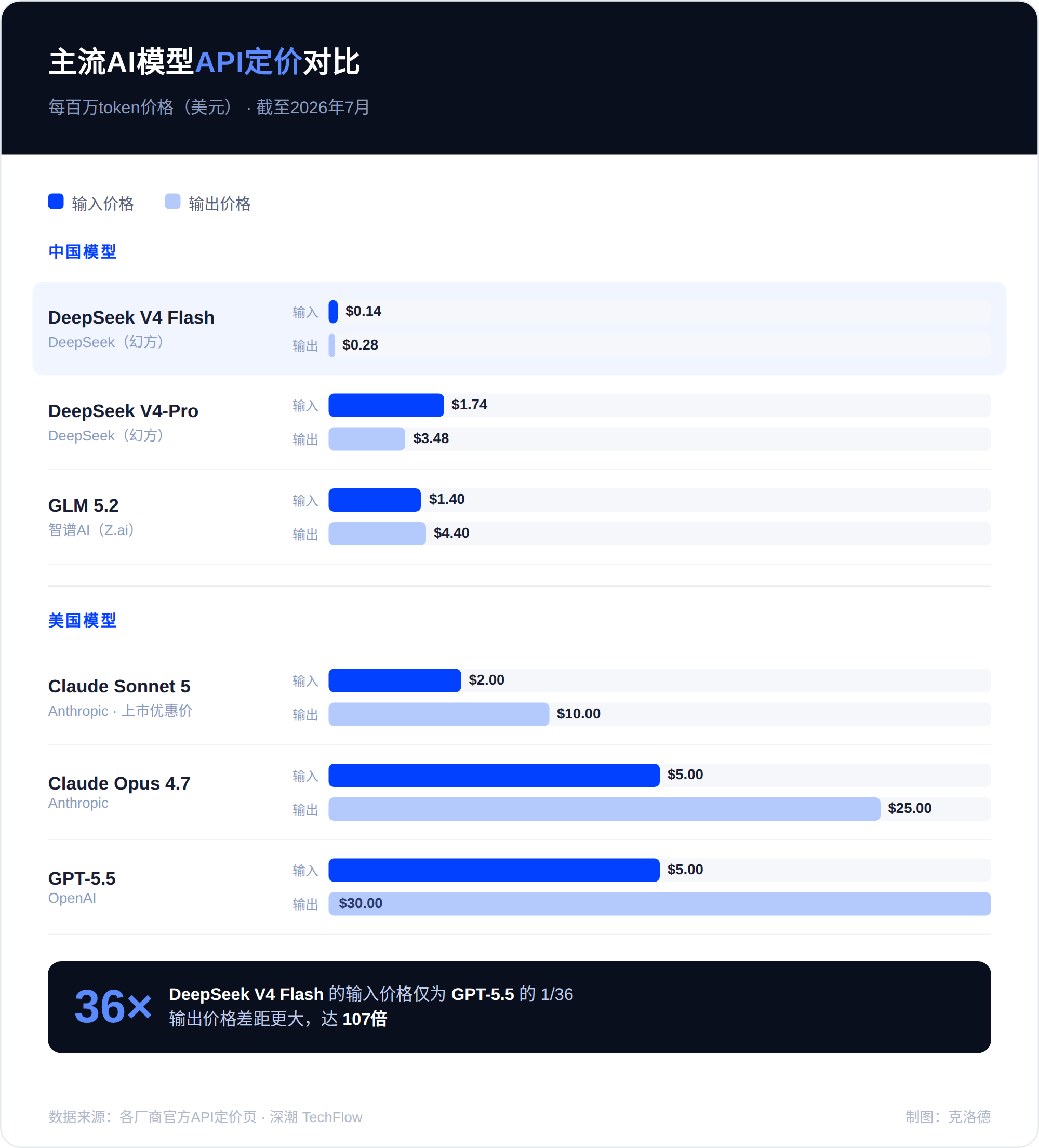
OpenRouter pricing data shows DeepSeek V4 Flash at $0.14 per million input tokens, compared with $5 for GPT-5.5, a gap of roughly 36x. On the output side, DeepSeek V4 Flash costs $0.28 per million output tokens, versus $30 for GPT-5.5, more than a 100x difference.
VentureBeat reported that even DeepSeek’s flagship V4-Pro, priced at $1.74 per million input tokens, costs about one-seventh of GPT-5.5 and one-sixth of Claude Opus 4.7. With caching enabled, the cost can fall to one-tenth of GPT-5.5.
Usage growth is showing up in procurement data
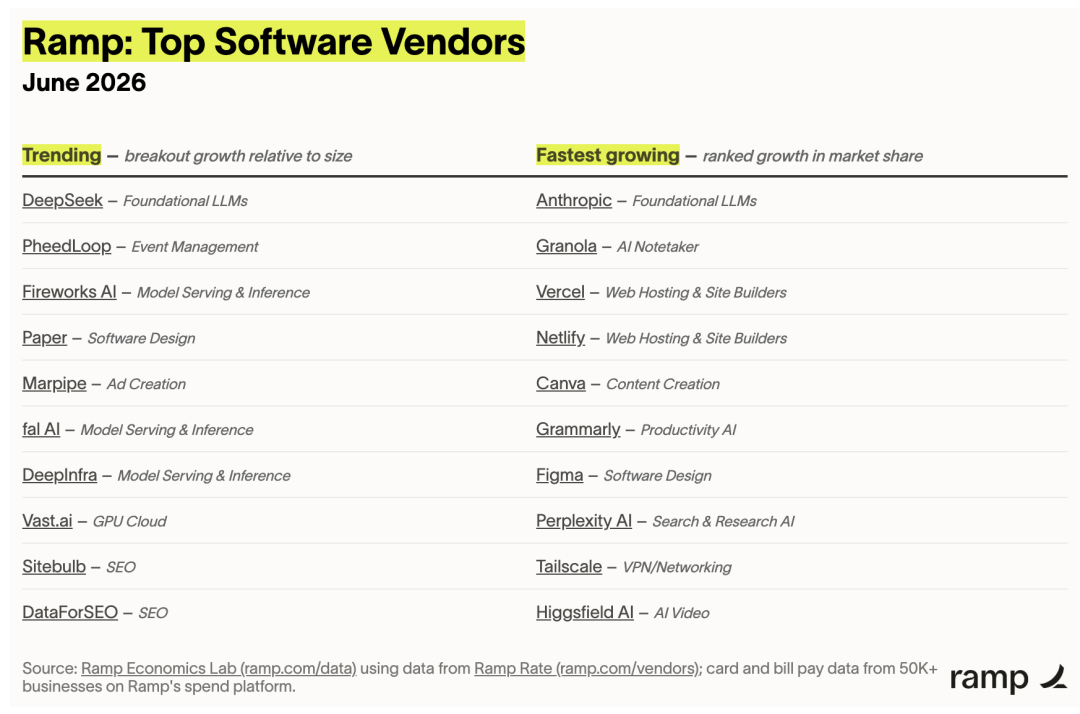
The shift is no longer limited to developer experimentation. Ramp said in its June report that DeepSeek ranked first on its trending software vendors list. The ranking is based on transaction data from more than 50,000 U.S. businesses and measures growth in first-time purchases.
Ara Kharazian, Ramp’s chief economist, said U.S. companies are no longer just downloading DeepSeek’s open-source models for self-hosting. They are also paying DeepSeek directly and sending data through its API.
Kharazian said DeepSeek briefly reached 0.3% enterprise penetration when R1 launched in January 2025, then slipped to 0.1%. The renewed rise came after DeepSeek made V4-Pro discounts permanent in May and lowered cached input pricing to about $0.0035 per million tokens.
Lindy moved all traffic from Claude to DeepSeek
AI agent startup Lindy offers one of the clearest examples. The 25-person company had previously relied fully on Anthropic’s Claude models.
CEO Flo Crivello said on X that Lindy shifted 100% of its traffic to DeepSeek v4, hosted in the U.S. by Atlas Cloud. Crivello told CNBC that the company’s cost curve “fell off a cliff” after the switch, with expected savings in the millions of dollars and inference costs down about 90%.
The New Stack reported that Lindy’s AI inference bill had already exceeded payroll. Crivello said the issue was “existential” for the company, adding that he would switch back if Anthropic cut prices.
CNBC also reported that Uber burned through its full-year AI budget in just four months in 2026, with Claude Code as the main expense. GitHub, facing cost pressure from Copilot’s agent mode, dropped its flat monthly fee and moved to usage-based pricing.
DeepSeek and Qwen are taking a larger share
OfficeChai, citing OpenRouter data, said U.S. models from Google, OpenAI and Anthropic accounted for about 70% of token share on the platform in June 2025. By June 2026, that figure had fallen to about 30%.
DeepSeek became the largest single supplier on the platform with a 17.6% token share. Alibaba’s Qwen ranked second at 13.9%. Chinese models together accounted for about 44% of token traffic among the top 10 models.
Bloomberg cited data showing OpenRouter’s weekly token volume grew from about 5 trillion in April 2025 to more than 20 trillion in April 2026. Programming workloads also rose from 11% at the start of 2025 to more than 50% by mid-2026.
Harpreet Arora, who leads AI infrastructure at Vercel, told CNBC that Zhipu AI’s GLM 5.2 recorded the fastest adoption on Vercel in 2026 after its June release. Average daily token usage in its first week rose about 27x, while the number of customers using it increased about 80x. Arora said, “Price is working. When the task doesn’t need the best model, teams start routing it to the cheapest one that is good enough.”
Executives are openly challenging token pricing
Palantir CEO Alex Karp criticized the token pricing approach used by OpenAI and Anthropic during a July 1 CNBC interview. He said U.S. companies were paying for “tokens that are not producing value,” while intellectual property and competitive advantage were flowing to AI labs.
One day before the interview, Palantir published nine “AI sovereignty” statements and criticized “tokenmaxxing,” saying it leads to “false progress.”
As enterprise AI workflows move from simple chat to agent-based systems, token consumption per task has increased by 10x to 30x. OpenAI CEO Sam Altman recently said AI cost has become a “huge issue” for enterprise customers.
The Linux Foundation has formed the Tokenomics Foundation with support from Google, Microsoft, IBM and Salesforce to build open standards for measuring AI token costs.
Taken together, the OpenRouter traffic data and Ramp spending data show that U.S. use of Chinese AI models has moved beyond experimentation, with pricing now acting as the clearest dividing line.