
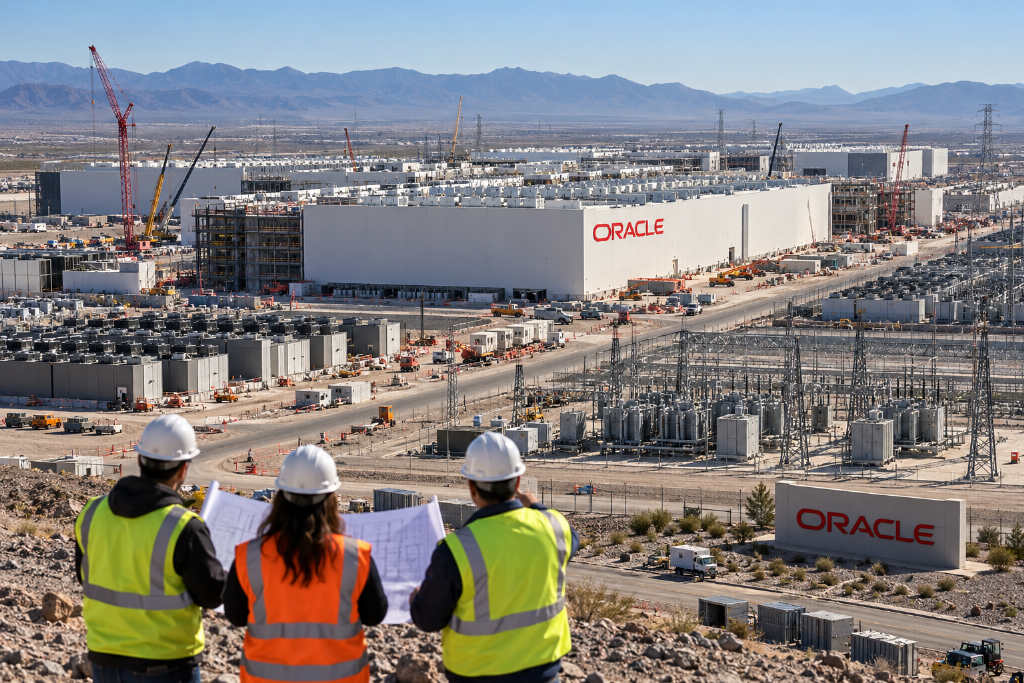
Oracle gave investors a clearer view of how much its artificial intelligence expansion will cost, how it plans to fund it, and when that spending could start to show up in cash flow, according to Morgan Stanley’s Oct. 29, 2026 update. The bank kept its Equal-weight rating on the company and said the market’s focus is moving away from broad worries about capital needs and toward buildout execution.

Morgan Stanley’s central point was straightforward: Oracle’s share performance from here is likely to depend less on whether the company can explain the funding plan and more on whether it can deliver capacity on schedule while protecting margins during the heaviest investment period. Management laid out a fuller financial framework at its analyst day, but that framework still depends on data centers, equipment, customer contracts, and operating efficiency lining up.
Funding mix reduces upfront pressure
Oracle said that from the second quarter of fiscal 2027 through the fourth quarter of fiscal 2028, the remaining roughly 6 gigawatts of construction would require about $220 billion in total capital expenditure. Fiscal 2027 and fiscal 2028 are expected to be the peak investment years. Morgan Stanley said the event gave the market a more concrete answer to earlier concerns about the scale of capital required.
Management said it plans to combine supplier financing, customer prepayments, and bring-your-own-hardware arrangements to lower upfront cash needs. Under the bring-your-own-hardware model, customers provide the relevant equipment while Oracle supplies the supporting infrastructure and services. Based on management’s framework, those structures can cut upfront cash requirements for the related builds by about half.
The company said it still expects to raise another $20 billion, split between $10 billion of equity and $10 billion of debt. Management described that as the final round of incremental financing for this investment cycle and said total debt should remain stable after that. By fiscal 2029, Oracle is targeting net debt to adjusted EBITDA below 3.5x.
For Morgan Stanley, the key issue is how the funding structure changes the pace of expansion. Equipment and data centers have to be funded before contract revenue is recognized. If suppliers and customers take part in the early-stage funding setup, Oracle can ease cash pressure during the concentrated build phase and get through the peak investment period with less strain.
1-gigawatt project economics show the return profile
Management also updated the contract model for a 1-gigawatt project. Under that framework, the project would carry about $80 billion in remaining performance obligations, an average contract term of about five years, and roughly $37 billion in capital expenditure. Once ramped, it would generate about $16 billion in annualized revenue, with gross margin of about 35% and operating margin of about 34%. Morgan Stanley used that model to frame the unit economics of Oracle’s compute service business.
In that setup, free cash flow conversion reaches 100% once the project matures, and return on investment is about 28%. Management said large AI contracts are generally structured on a cost-plus basis. Changes in equipment costs can affect both revenue and capital intensity, but the contract design is meant to preserve margins and returns.
The financing structure materially changes the early cash burden. Oracle showed that with 70% supplier financing, cash outlays in the first two years of a 1-gigawatt project could fall from about $37 billion to about $18 billion, while gross margin would remain near 35%.
Under a bring-your-own-hardware structure, project capital expenditure would drop to about $6 billion, with about $11 billion in revenue and gross margin above 35%. Morgan Stanley said different combinations will affect revenue per unit of capacity, leverage, and cash flow, which is why Oracle’s funding path has to be read together with its business model.
Cash flow improvement still depends on construction
Oracle said free cash flow should turn positive in the second half of fiscal 2028 and exceed $30 billion in fiscal 2029. Morgan Stanley said that is materially better than the market’s earlier consensus, which had pointed to roughly negative $1 billion in the later year. For investors, the timeline for when heavy spending starts to convert into cash returns is now more clearly defined.
That path assumes a rapid increase in capacity. Oracle ended fiscal 2026 with about 3 gigawatts of capacity and is targeting about 10 gigawatts by the end of fiscal 2028. It had already delivered 850 megawatts in the first quarter of fiscal 2027, but a large amount of additional construction still has to be completed.
Morgan Stanley sees capacity execution as a major constraint on the stock. Four of the company’s five large campuses are not expected to begin providing initial service until calendar 2027. The timing of those sites matters directly for revenue ramp and for the point at which free cash flow turns positive.
Management also outlined how it plans to handle delays. Guidance already assumes that large sites could slip by as much as several quarters, and construction costs are incurred progressively as data halls are built out. Racks, networking gear, and cooling equipment can also be shifted between sites, which may reduce the effect of delays at any single project.
Margins will shape the quality of expansion
Looking out to fiscal 2030, Oracle set floor targets of more than $225 billion in revenue and more than $21 in adjusted earnings per share, while adding a target of more than 40% adjusted operating margin. Management also said margins during the peak expansion period should remain close to that level. In other words, scale and profitability are being presented within the same long-term framework.
Morgan Stanley said hitting that margin target will require clear operating leverage on the cost side. As infrastructure becomes a larger share of the business, the profit mix changes with it. Growth in applications and database operations will need to stay aligned with expense discipline if Oracle is to support group-level returns.
The company also pointed to signs of AI adoption in its core applications business. Customers using the Fusion enterprise application suite made more than 150 million embedded AI calls in the first quarter of fiscal 2027, while the number of active AI agents rose from 1,000 in May to 3,500. Management said it wants to use new configuration capabilities to reduce implementation work and support enterprise cloud migration.
Morgan Stanley keeps its target, but execution remains the swing factor
Morgan Stanley maintained its $210 price target on Oracle, saying the opportunity in AI compute services is real but so are the execution risks tied to construction, financing, and cost control. The bank’s view is that Oracle has now provided a relatively clear framework for funding and returns. What comes next is whether operating results can validate that framework.
The analyst day moved the discussion beyond large revenue ambitions and into project spending, financing arrangements, and cash recovery. By Morgan Stanley’s reading, Oracle’s vision and funding path are now largely in place. The unresolved question is capacity delivery.
Note
This article is a整理 and interpretation by Chaoxiang Research of a third-party brokerage report from Morgan Stanley dated Oct. 29, 2026, combined with public market information. The ratings, price target, earnings forecasts, and related judgments cited in the article are the views of the brokerage analyst and represent only the position of that institution. They do not represent the views of Chaoxiang Research and do not constitute investment advice.
Markets carry risk, and decisions should be made independently. This article should not be used as a basis for buying or selling any security.



