

Paul Veradittakit, a partner at Pantera Capital, says the intersection of AI and blockchain is moving from broad discussion to concrete infrastructure. In his framework, that buildout sits across four layers: money and machine settlement, credit, capital and trading, identity, credentials and control, and sovereign compute with real-time proofs.

The article was written by Veradittakit and translated by TechFlow. He writes that last month he argued founder-market fit keeps compounding even when prices stop rising. This month, Franklin Bi’s essay, The War for 8 Billion Customers, sketches the market builders now need to serve: 8 billion people, several agents for each person, and enterprise agent fleets handling coding, finance, procurement and sales.
Veradittakit reduces the product stack to a short list of components: wallets with spending limits, stablecoin settlement that machines can execute, credentials agents can present, compute users actually own, and proofs that do not require a public ledger.
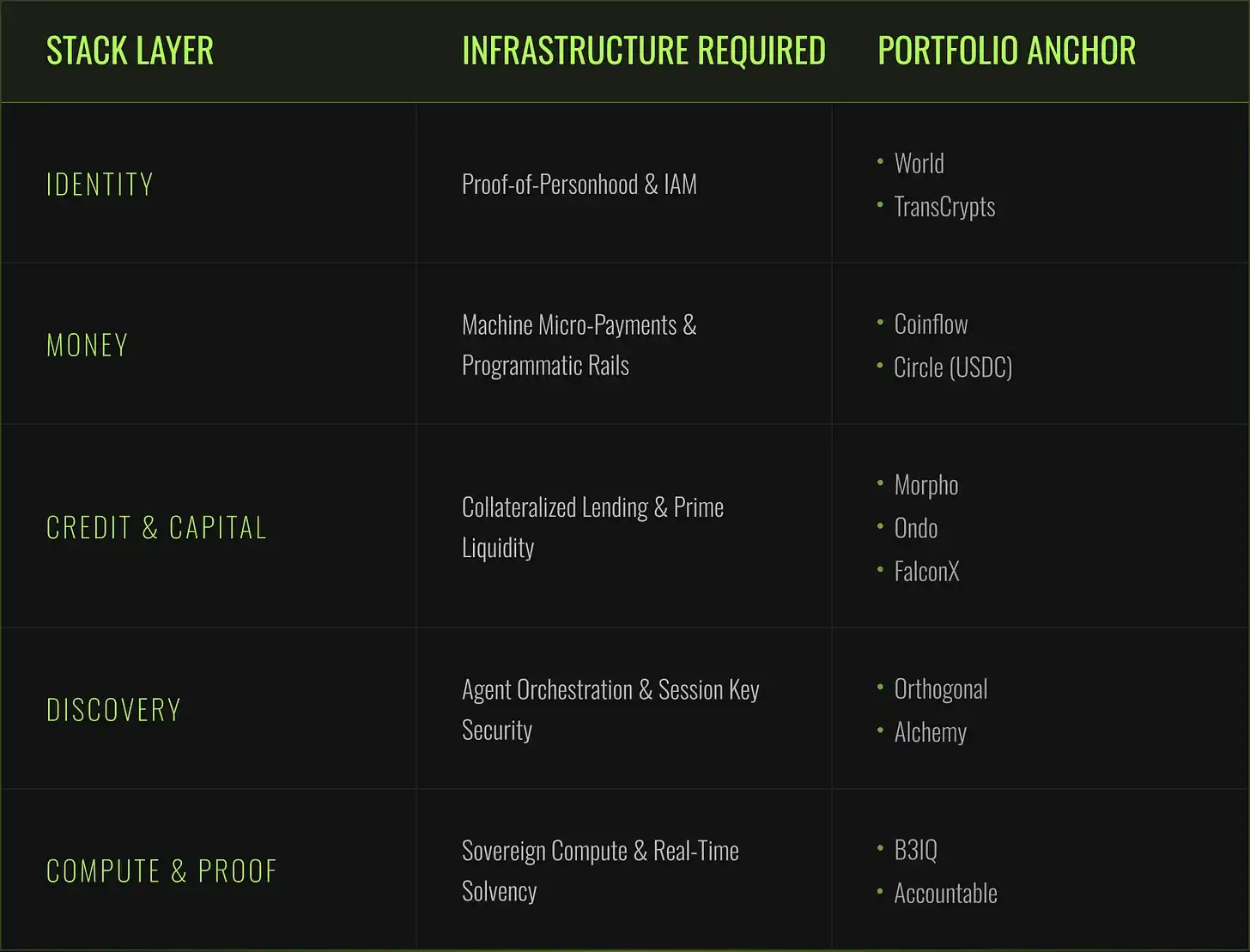
He also lists Pantera portfolio companies already building at different points in that stack. For money and machine settlement, he names Circle, Coinflow and OpenFX. For credit, capital and trading, he points to Morpho and Ondo. For identity, credentials and control, he cites World, TransCrypts and Alchemy. For compute sovereignty and real-time proofs, he names B3IQ, Orthogonal and Accountable.
Veradittakit says founders and investors often ask what is actually happening at the AI x blockchain intersection. He plans to write about it more regularly and says builders working in any of the layers covered in the essay can reach out to him or the Pantera team.
From 8 billion people to far more transaction endpoints
Veradittakit ties the argument back to his earlier founder-market fit thesis. In that piece, he wrote that the match between a specific founder and a specific market is the only thing that can keep compounding through a downturn. He grouped that edge into four traits: depth, agency, network and obsession. His examples included Offchain Labs, Ondo, Morpho, Circle and Alchemy.
He says Franklin Bi’s article broadens the addressable market in a more literal way. Builders are not just serving 8 billion humans. They are building for those humans plus the agents around them, and for enterprise agent fleets responsible for coding, finance, procurement and sales. That creates tens of billions of new decision and transaction endpoints.
Once agents have identity and memory, budget authority, the ability to choose and settle, and accountability to an owner, they become customers rather than tools, he argues. The essay cites a Gartner forecast that agents could influence $30 trillion of procurement by 2030.
On payments, Visa, Mastercard and Coinbase’s x402 are already issuing credentials that make sub-1-cent payments possible. Cloudflare, he adds, has said bots already account for more than half of HTTP requests.

What turns an AI model into an economic actor
The essay sets out three requirements.
- Identity and memory: cryptographic credentials anchored to an entity.
- Budget authority: programmable limits, rate caps and session keys.
- Autonomous settlement: the ability to discover, evaluate and pay for services onchain.
Franklin Bi’s key question, as Veradittakit presents it, is who owns those agents in the end: the humans and businesses they represent, or the platforms they run on.
If centralized cloud vendors control an agent’s identity, memory and learning loop, switching vendors means firing your digital workforce and starting over with amnesia, he argues. In that setting, blockchain supplies the property layer: portable identity, bounded delegation and settlement rails no model provider can rewrite.
How the AI x blockchain stack looks in practice
1. Money and machine settlement
AI agents are not going to fill out KYC forms, wait three days for ACH transfers or manage monthly credit-card subscriptions, Veradittakit writes. They need frictionless payment rails that run 24/7 and support transfers below one cent.
- Coinflow: settles card and bank payments into stablecoins across more than 170 countries without exposing end users to the underlying chain.
- OpenFX: processes stablecoin settlement in the tens of billions of dollars on an annualized basis and is explicitly built for software customers rather than human end users.
- Circle (USDC): launched in the previous bear market and now serves as the default unit of account for machine-to-machine micropayments and enterprise-agent settlement.
2. Credit, capital and trading
When an agent needs to borrow or deploy capital under a preconfigured mandate, it needs a programmable liquidity layer.
- Morpho: described as a credit backend already embedded by Coinbase, Robinhood, Societe Generale and Apollo. Veradittakit presents it as the default lending infrastructure agents will query and borrow from programmatically.
- Ondo Finance: turns tokenized U.S. Treasuries and equities into productive, yield-bearing collateral. The essay says Nathan Allman left Goldman Sachs to solve institutional asset tokenization, a problem that now meets the agent-budget question directly.
- FalconX, through its acquisition of bloXroute: is assembling a high-speed prime brokerage and execution stack for markets that never close, which Veradittakit says matches the only operating schedule AI agents recognize.
3. Identity, credentials and control
In a digital environment flooded with synthetic content, proving human intent and agent authorization becomes central.
- World: builds basic proof-of-personhood primitives, using cryptography to show that a unique human actor exists in a production environment, with the goal of countering botnets and sybil attacks.
- TransCrypts: puts employment, education and legal credentials on user-controlled rails so agents can verify permission claims without exposing sensitive underlying data.
- Alchemy: provides the developer platform for agent-specific wallets and session-key patterns. Instead of handing a master private key to an agent, developers can issue fine-grained permissions, including counterparty restrictions, expiry timestamps and instant revocation.
4. Compute sovereignty and real-time proofs
Veradittakit argues that institutions need model weights and execution traces to remain outside locked vendor environments if they want genuine agent capability.
- B3IQ: offers "sovereignty as a service" through a rent-to-own compute network.
- Orthogonal: operates as an orchestration and discovery layer for agent services, providing metered access and native billing across decentralized networks.
- Accountable: lets financial institutions and autonomous funds prove solvency in real time with cryptography, without exposing private balance sheets.
What Pantera looks for in category-defining founders
Control alone is not enough to make a product compelling, Veradittakit writes. The winning products will use decentralized infrastructure to deliver lower transaction costs, tighter privacy, faster customization or execution reliability that closed platforms cannot match.
When Pantera evaluates teams building at this intersection, he says the firm looks for four traits.
- Deep domain expertise: founders have lived inside the problem, not just read about it. His example is Ed Felten leaving Princeton and the White House to build Offchain Labs / Arbitrum.
- Strong agency: the ability to see market structure clearly enough that large institutions start building on your rails. He points to Paul Frambot founding Morpho at age 20 and building a default credit engine for DeFi.
- An unfair network: distribution and partnership advantages that create room to keep shipping through weak markets. He uses Jeremy Allaire’s work with Coinbase to turn USDC into a global settlement standard as an example.
- Obsession: conviction to keep building across cycles after attention moves elsewhere. His example is Nikil Viswanathan and Joe Lau building Alchemy into a default Web3 developer platform.
He also singles out people working at Goldman Sachs, Citadel, Stripe, Block or frontier AI labs. Skills that once looked merely adjacent to digital assets, he says, are now exactly what the "80 billion customer economy" needs.
Veradittakit closes that section by inviting teams building core layers for the agent economy to contact him or Pantera Capital.
Market, regulation and product notes included in the piece
Beyond the AI-agent thesis, the article also includes a run of market, regulatory, product and Pantera-related notes.
Bitcoin, ETF flows and market positioning
The piece says bitcoin traded near $78,000 and rose about 24% in August, making it the strongest August since 2017. It briefly moved above $81,000 heading into the weekend. U.S. spot bitcoin ETFs absorbed about $3.3 billion during August. The article describes that as the best month since October 2025 and says the move briefly pushed the asset class back above $100 billion.
Pantera general partner Cosmo Jiang says bitcoin has gone through roughly a 10-month drawdown of about 50% since a peak near $126,000 in October 2025. With bitcoin holding its 200-day moving average near $69,000, he says traders are rotating from net short or cash into long exposure. He identifies friendlier U.S. policy and larger Treasury buybacks as direct catalysts, with $80,000 as the next resistance level.
Tokenized equities and USDC supply
Tokenized spot equities passed $2.5 billion in August, up about 8% month over month and more than 260% year to date, according to the article. BNB Chain, Ethereum and Solana split that market. It also says the DTCC ran live simulations with about 40 companies, including JPMorgan, Goldman Sachs, Invesco and Citadel, using tokenized equities and Treasuries as collateral.
On stablecoins, USDC supply increased by about $2 billion in seven days after six months of stagnation. Onchain trackers also showed several billions of dollars in issuance during that week, pushing circulation close to $74 billion. Bernstein kept an "outperform" rating on Circle with a $140 price target and said USDC’s share of adjusted transaction volume had climbed above 60% by 2026.
U.S. legislative and rulemaking developments
The regulatory section says the U.S. Senate is scheduled to vote on the CLARITY Act on Sept. 15. Majority leader Thune filed cloture on the motion to proceed, and after the August recess the procedural vote was placed on the Sept. 15 calendar. The House has already passed the bill, while the Senate has limited room before its next recess.
It also says that on Aug. 18, the U.S. Securities and Exchange Commission proposed a tailored issuance framework for crypto assets, including a $5 million startup exemption, financing tiers up to $75 million, a conditional Howey safe harbor and state-registration preemption. Chair Atkins said the proposal cannot replace legislation.
The U.S. Treasury, meanwhile, proposed Article 3 rules covering the issuance and U.S. offering of payment stablecoins, with a 60-day comment period. The statutory deadline for a final rule on July 18 had already been missed. The Office of the Comptroller of the Currency is now targeting completion before November, and the legal backstop effective date is Jan. 18, 2027.
M&A, tokenization hubs and reserve products
The article says Mastercard completed its acquisition of BVNK on Aug. 3, bringing a stablecoin payments stack into the global card network. Crypto M&A volume in the first half of 2026 reached a record $9.7 billion even as deal count fell.
Coinbase has established a tokenization hub in Abu Dhabi. The ADGM granted Coinbase a license to arrange investments and custody tokenized securities backed by underlying equities, extending Project Diamond into a regional issuance and custody center.
BlackRock also added a tokenized money-market product built for GENIUS reserves, launching an onchain share class for a Treasury liquidity fund and a multichain daily reinvestment reserve tool. The article says both are designed to meet qualified reserve requirements for approved U.S. payment-stablecoin issuers, and notes that BlackRock already manages about $60 billion in Circle reserves.
Portfolio news from B3IQ and Stateful
Fortune reported on B3IQ, launched by Pantera portfolio company B3 Labs. Researchers and enterprises can put down 30% to own U.S.-hosted NVIDIA machines instead of renting hyperscaler capacity locked through 2030. The team said GPU sales reached eight figures in six days and that it is expanding capacity for startups, labs and data-sensitive sectors.
On Stateful, Franklin Bi spoke with B3 co-founders Daryl Xu and Viktoriya Hying, along with New York University’s Yorke Rhodes, about the launch. The discussion said renting an H200 node for two years costs roughly the same as buying one outright. Idle periods are matched to offtakers so the machines can pay for themselves. It also said closed models have already barred research teams from work related to human trafficking and war-zone evacuation, while open-source models are catching up at the frontier. Owning hardware, the discussion argued, is what unlocks their usability.