
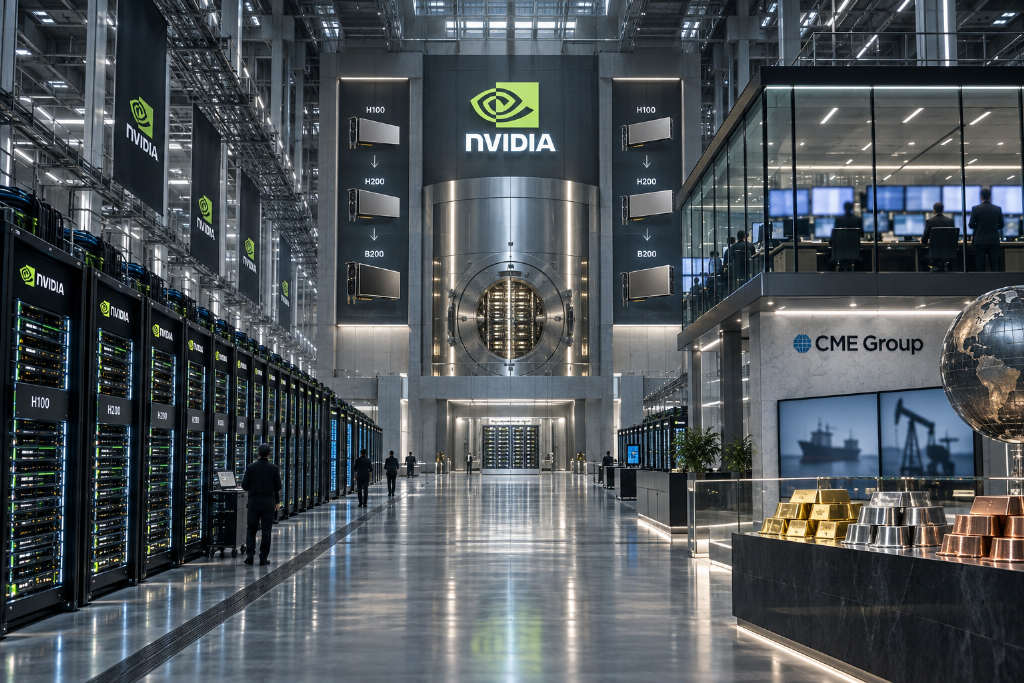
Pantera Capital investor Jay Yu says the AI compute market may develop along a path similar to oil and electricity, with GPUs eventually becoming a tradable and hedgeable asset class rather than only a technology expense.
In a recent essay titled The Rise of Compute Markets, Yu wrote that spending on data centers and compute infrastructure has already reached the trillion-dollar scale. Yet the way GPUs are actually bought and rented remains surprisingly primitive. Even with platforms such as SF Compute, Vast AI, and Runpod already in the market, a large share of GPU procurement and leasing is still handled through chat groups, OTC brokers, and one-to-one enterprise agreements.
Yu argues that this looks a lot like the early stages of electricity and oil markets: physical demand arrived first, then standardized contracts, price indices, futures, and hedging markets took shape later. If the same pattern repeats, he said, compute represented by GPUs such as the H100, H200, and B200 could, over the next five to 10 years, become an independent asset class that can be priced, traded, financed, and hedged.
From power-market pricing to GPU market structure
Yu compares today’s compute market with the development of the U.S. power market over the past 30 years. Electricity is not a perfectly uniform commodity. The economic value of one unit of power can differ sharply depending on time, location, and transmission conditions. That led U.S. power markets to develop Locational Marginal Pricing, or LMP, which calculates node-level prices based on supply and demand, transmission costs, and grid constraints.
Those physical node prices later fed into regional benchmarks such as PJM-West, ERCOT North, and CAISO SP15, some of which became reference points for derivatives trading on CME and ICE.
Yu says compute has a similar problem. The value of one hour of H200 compute depends not only on the chip model, but also on region, time, cluster size, network architecture, reliability, interruptibility, and contract terms. In other words, “one GPU-hour” cannot be treated as a fully homogeneous commodity.
He frames the comparison this way: power markets are built around Grid-Operator-Node, while future compute markets may organize around Hardware-Vendor-Cluster. Different hardware generations such as H100, H200, B200, and B300 would become separate commodity classes. Compute suppliers including AWS, Nebius, CoreWeave, and SF Compute would resemble operators. GPU clusters across different regions, time windows, and hardware configurations would resemble nodes on a grid.
The hard part, Yu writes, is whether the market can build a price trusted enough to convert thousands of distinct forms of GPU compute into a standardized tradable product.
Who needs to hedge in a compute market
If compute becomes a commodity, Yu says, natural long and short participants will emerge. He divides the AI inference supply chain into three layers.
- At the bottom are neocloud providers such as Nebius and CoreWeave. They operate data centers and own GPUs, making them the supply side of compute and, in his framework, the structural short side of the GPU market.
- In the middle are inference platforms such as Fireworks and Baseten. They buy GPUs from the lower layer and convert raw machines into inference services that developers can call directly. That makes them structural buyers of GPUs.
- At the top are AI applications such as Cursor and Perplexity. They are not buying GPUs directly. They buy tokens, though those tokens are still produced using GPUs underneath.
Yu writes that when an AI company signs a one-year GPU contract, it is taking on the risk that compute prices may fall later. On the other side, a neocloud provider that spends billions of dollars buying GPUs is exposed to falling rental rates, underutilized hardware, and rapid depreciation. Once both sides need to manage price risk, compute futures have a clear economic rationale.
How a compute version of Wall Street could form
Yu does not expect a mature compute capital market to mean OpenAI or CoreWeave directly buying and selling H200 futures on an exchange. He thinks the structure could look closer to energy markets.
Under that setup, neoclouds, inference providers, and AI companies would first source physical GPUs through brokers and OTC desks such as SF Compute, Runpod, and Compute Exchange. Intermediaries would absorb basis risk created by differences in SKU, geography, and delivery timing. They would then use standardized compute contracts on financial venues such as Architect and Pluto to hedge those exposures.
For that market to work, finance needs a price reference that everyone accepts. In Yu’s framing, the critical question is simple: what is an H200 worth right now? That is why compute indices are starting to matter.
CME and Silicon Data point to the next stage
Yu notes that companies including Ornn, Silicon Data, Compute Desk, and SemiAnalysis have started building GPU price indices. He singles out Silicon Data because CME Group announced earlier this year that it is working with the company to plan futures products based on GPU compute pricing.
He breaks the broader compute market into four emerging layers.
- The first is Physical Settlement: platforms such as SF Compute, Hyperbolic, Vast, Runpod, and Compute Exchange that actually deliver GPU compute to customers.
- The second is Index: benchmark builders such as Silicon Data, Ornn, Compute Desk, and SemiAnalysis.
- The third is Derivative Exchange: firms such as Architect and Liquid Compute that want to offer cash-settled compute futures and hedging tools.
- The fourth is Financialization Vehicles: products built on GPUs and data centers, including lending, vaults, insurance, and even synthetic dollars such as USD.AI.
Together, Yu says, these layers are beginning to resemble a full financial market structure similar to what developed around energy commodities.
The biggest problem: one H200 is not the same as another
Yu says the main obstacle to compute financialization is also the clearest way it differs from equities. One share of NVIDIA stock represents the same rights regardless of which broker handles the trade. But two products both labeled “H200” may differ materially in quality.
Location, network speed, cluster topology, interruptibility, SLA terms, contract length, and even the quality of the underlying hardware can all affect how many tokens that compute can actually produce. That, he says, helps explain why large price gaps can still appear across different GPU marketplaces and compute indices.
He adds that power markets at least have transparency requirements enforced by regulators such as the Federal Energy Regulatory Commission, or FERC. Compute markets do not yet have an equivalent framework. Yu suggests that the sector may eventually need something like a Moody’s-style GPU ratings agency to verify the quality of delivered compute.
Pantera: the deepest moat may be physical settlement
While compute futures may sound like the most obvious new financial business, Yu argues that the most defensible part of the market over the long run may be the least glamorous one: physical settlement.
He points back to oil and electricity. Financial derivatives do not create trusted prices on their own. They form around markets that already have substantial physical delivery and real trading activity. The deeper the physical market, the more reliable the price information. The more credible the index, the better the chance that futures built on top of it can attract liquidity.
Why Nvidia is compared to a central bank
Yu goes a step further and describes NVIDIA as the “central bank” of the compute economy.
The reasoning is that NVIDIA does not only supply the commodity. It can also influence the depreciation curve of the commodity itself. If NVIDIA launches a new generation such as the Vera Rubin GPU, the relative performance and market price of earlier generations may shift. In that sense, the company’s product roadmap can act a bit like monetary policy by changing expectations for the future value of existing compute assets.
Yu also writes that NVIDIA wants GPUs to maintain high utilization. If GPU-hours can be traded and resold more easily, overall equipment efficiency may rise and customers may be encouraged to buy more GPUs. He points to a mechanism that offers up to 25% residual value support. In his view, that gives NVIDIA some features of a lender of last resort: when GPU asset prices and financing markets come under pressure, manufacturer-backed residual value support can reduce part of the depreciation and financing risk.
Three forces that could move GPU pricing curves
Once compute becomes a financial product, Yu says, AI model releases themselves may start to move GPU pricing curves more directly. He identifies three “elephants” large enough to shape the market.
- NVIDIA, through new product launches that affect compute supply and hardware depreciation.
- Frontier labs such as OpenAI and Anthropic, whose new models and products could sharply increase token demand and inference demand.
- Open-source model groups including DeepSeek, Qwen, Kimi, and GLM, which continue to lower inference costs and compress token margins.
Yu’s broader argument is that as these forces interact, the AI compute market may gradually develop the pricing logic and financial layers seen in energy commodities.