



Papertrade, an onchain derivatives platform, has become one of the most watched projects in crypto.

According to DefiLlama data cited in the source article, Papertrade generated $42.24 million in protocol revenue over the past seven days, ranking third across the industry behind only Tether and Circle. That figure was above Pump.fun’s $16.06 million and Hyperliquid’s $14.56 million.
For a recently launched trading venue, the numbers are striking. So is the trade-off behind them. The article argues that Papertrade’s revenue surge is tied directly to real trader losses.
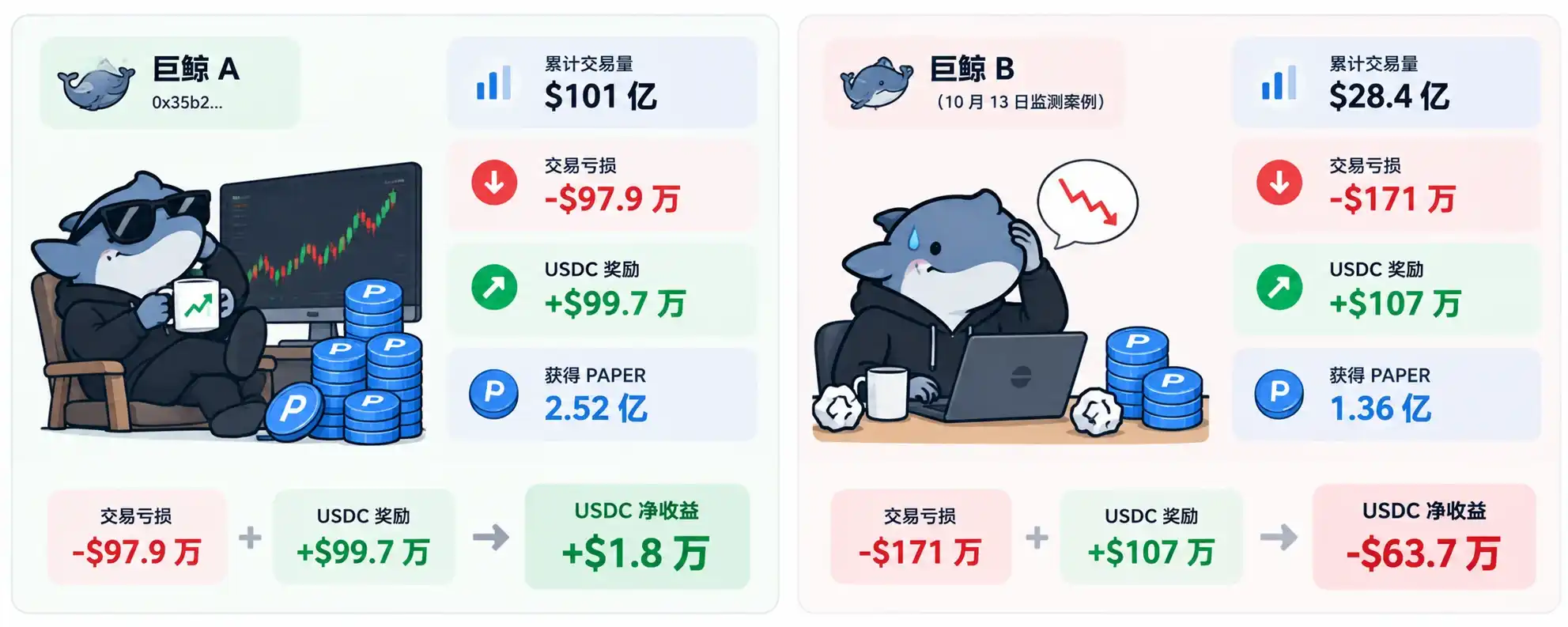
On Oct. 13, Lookonchain tracked one trader who generated $2.84 billion in notional volume on Papertrade and posted about $1.71 million in trading losses. The same trader received about $1.07 million in USDC staking rewards and 136 million PAPER tokens. After accounting for the staking rewards, the trader still faced a cash net loss of about $637,000.
Those figures sit at the center of Papertrade’s design. The protocol links actual trading losses to PAPER issuance, then allows PAPER holders to stake the token for a share of protocol income. In effect, users can absorb real losses in exchange for a claim on future cash flow.
The source article sets out to explain why some traders are willing to do that, why early whales may have come out ahead, why later users may keep losing as they chase issuance, and how Papertrade’s unusually high revenue is being produced.
How the trading engine works
Papertrade is built on HyperEVM in the Hyperliquid ecosystem and officially opened trading on Oct. 10, 2026. At launch, it mainly supported BTC and ETH and offered leverage of up to 1,000x.
On the surface, the product does not look very different from perpetual DEXs such as Hyperliquid or Aster. Users can go long or short and try to profit from market direction. Under the hood, the architecture is different.
A traditional order-book exchange matches buy and sell orders between traders. If one user opens a BTC long, the venue needs a counterparty willing to take the short exposure.
Papertrade does not depend on its own order book for matching. Instead, it uses a pool-based model that the article compares with the early structure used by GMX. The trader’s counterparty is the protocol’s own liquidity pool, and all profit and loss is settled against that pool.
If a user opens a $100,000 BTC long on Papertrade and BTC rises, the pool owes that trader the profit. If BTC falls, the loss flows into the protocol pool.
Papertrade references the mid-price derived from the best bid and ask on Hyperliquid’s order book, which means it does not need to execute an equivalent perpetual trade on Hyperliquid itself. That allows it to advertise zero order-book slippage and no traditional funding rate.
Still, trading is not cost-free. Papertrade applies what it calls Asymmetric PnL. Traders on winning positions face a profit haircut, while losing positions do not receive a matching reduction in losses.
If a trade would otherwise make $100, the amount actually received after the asymmetric adjustment and settlement-related charges can be materially below $100. If the same trade loses $100, the trader may still bear the full loss. The exact adjustment depends on price movement, the underlying asset, and protocol parameters.
That matters because even if gross directional PnL across long and short positions offsets in theory, traders as a group can still suffer a net drain due to the profit haircut. The article says that drain is one of the key sources of income for the protocol pool.
PAPER issuance is tied to realized losses
PAPER is the native token of Papertrade. The project describes it as a fair-launch token with zero initial supply, no team pre-mine, no venture allocation, and no conventional airdrop bucket.

The main way to obtain PAPER is by trading on the platform and generating eligible realized losses.
Under the rules described in the source article, when the protocol-tracked LP size is below $2 million, every $1 of eligible loss can mint 100 PAPER. That means a trader losing $100 could theoretically receive about 10,000 PAPER at the initial stage, while a $1,000 loss could produce about 100,000 PAPER.
The issuance rate does not stay fixed. Papertrade uses a declining curve. Once LP size moves above $2 million, the amount of PAPER minted per dollar of eligible loss falls as cumulative protocol growth increases.
The article presents the curve in simplified form as:
PAPER minted per $1 of loss = 100 × [120 million / (120 million + H)]²
Here, H is the cumulative growth indicator used in the issuance curve, not the current LP balance. If H reaches $120 million, the amount minted per $1 of loss falls to 25 PAPER, one quarter of the initial rate.
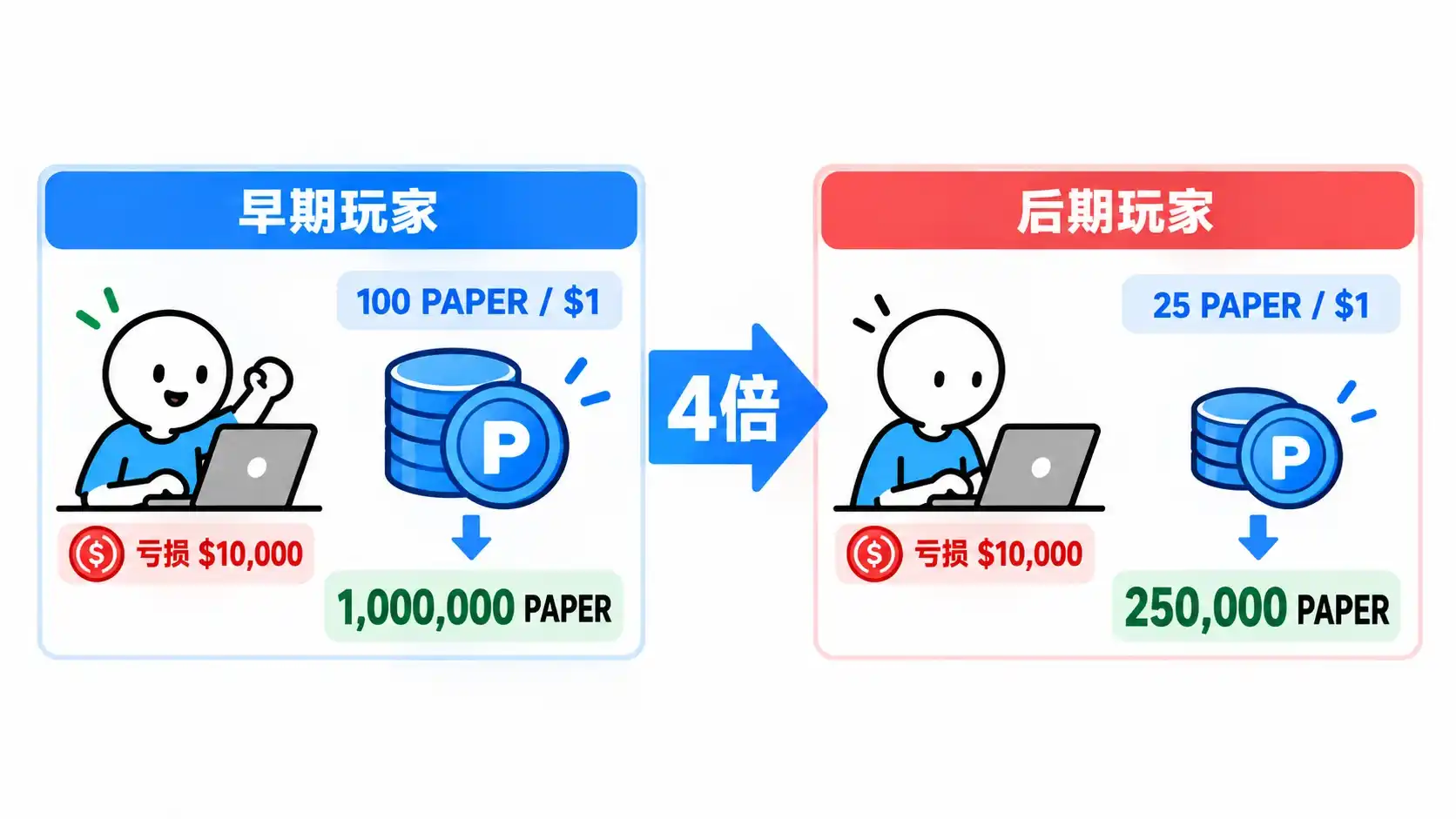
That creates a clear first-mover advantage. Two users can absorb the same $10,000 in losses and still end up with dramatically different amounts of PAPER depending on when they entered.
Why users would accept losses in the first place
The answer, according to the article, lies in how PAPER is monetized after issuance.
Papertrade uses what the source describes as a bootstrap liquidity model. Unlike many DeFi protocols that rely on outside LP deposits to build liquidity, the protocol trading pool starts from zero and grows mainly through actual trader losses.
If traders are profitable and the pool does not have enough capital to pay out immediately, the protocol can place payouts into a queue and settle them later as new funds arrive.
Users who obtain PAPER through losses can stake the token and earn a share of future USDC revenue. The article says current staking income comes from two main sources:
- Settlement fees. The protocol charges 2% on eligible realized PnL and liquidation losses. Half goes to PAPER stakers and half goes to the developer fee recipient.
- Excess LP pool income. When the protocol-tracked LP pool exceeds the $5 million distribution threshold, qualifying excess funds can also be distributed to PAPER stakers.
The article reduces the model to a simple chain: traders incur real losses, the protocol LP gains funds, losing traders receive PAPER, PAPER holders stake the token, and stakers share the protocol’s future distributable revenue.
In other words, Papertrade turns part of a trader’s real loss into the cost of acquiring a future claim on protocol cash flow.
Why hedged volume farming can still lose money
In many perpetual DEX incentive campaigns, traders try to farm points or tokens by opening offsetting long and short positions. If the exposures are equal, directional risk can be minimized while volume keeps accumulating.
The article argues that the same approach is not lossless on Papertrade.

The reason is the asymmetric PnL mechanism. The winning leg is discounted, while the losing leg still bears the full loss.
The source gives a simple BTC example. A trader opens one long and one short, each with a notional value of $100,000 and leverage low enough to avoid liquidation in the example. If BTC rises 0.1%, the long should make $100 and the short should lose $100. In a frictionless setting, that nets to zero.
On Papertrade, using the BTC asymmetric PnL parameters published at launch and factoring in a 0.2 basis-point adjustment on the winning side, the profit discount, and a 2% profit settlement fee, the long that should have made $100 ends up receiving only about $72.4. The short still loses the full $100.
The combined result is a loss of about $27.6.
So even when directional exposure is fully hedged, the trader still takes a real hit. The article adds that the profit haircut is not fixed. It tends to be steeper when price moves are small and declines as profits get larger, though it does not disappear entirely.
That means Papertrade has embedded a cost into long-short wash strategies that cannot be removed simply by hedging direction. The PAPER received from the losing side is effectively purchased through those realized losses.
1,000x leverage amplifies the problem
Papertrade also offers leverage of up to 1,000x, which helps explain why the platform was able to build huge notional volume so quickly.
A trader using $100 of margin at 1,000x can open a $100,000 BTC position. In theory, a 0.1% move against the trade is enough to wipe out the initial margin.
Under Papertrade’s liquidation rules, the article says a 1,000x position can be liquidated after roughly a 0.05% adverse price move.
That is a very small move. Even an ordinary short-term fluctuation in BTC can erase the trader’s margin.
TradingBeats data cited in the article showed that among 5,836 addresses that used 1,000x leverage during Papertrade’s early period, 4,395 experienced at least one liquidation, or 75.3%. Over the same period, 1,000x positions were liquidated 12,657 times, involving about $20.08 million in isolated margin losses.
The article does not claim that every participant ultimately lost money. It does say the figures are enough to show the level of risk facing high-leverage users.
For traders trying to mine PAPER, there is another tension. Higher leverage creates more notional volume with less upfront margin, but it does not reduce the real losses created by asymmetric PnL. It can make liquidations more likely instead.
Papertrade may remove traditional order-book slippage and funding payments, but it still leaves users with onchain gas costs, confirmation delays, and the risk that long and short legs are not executed in perfect sync. With high leverage, high frequency, and asymmetric PnL stacked together, a purely mechanical PAPER farming strategy can keep generating real losses.
The key variable is the actual acquisition cost of PAPER
The article’s central point is that volume alone does not determine whether a Papertrade participant makes money. The important number is the real cost of getting PAPER.
That is why some whales were willing to spend hundreds of thousands or even more than $1 million to acquire the token. They were not focused only on the profitability of the trades themselves. They were calculating the cost of getting PAPER and whether future staking income could offset that cost.
The source frames the total return as:
total participation return = realized trading PnL + USDC staking rewards received + realizable value of PAPER − other costs
Using the whale cited earlier, the trader produced $2.84 billion in notional volume, lost about $1.71 million in trading, received 136 million PAPER, and earned about $1.07 million in USDC staking rewards.
Of those rewards, around $943,000 had been claimed and about $130,000 remained unclaimed. Counting both, the trader’s net loss was about $637,000.
But that still leaves the PAPER position itself. If PAPER later becomes freely tradable, and if those 136 million tokens could be sold at an average price of about $0.00468 without accounting for market impact, extra fees, or future distributions, the proceeds could cover that $637,000 net loss.
That is why the article describes the whale’s behavior not simply as loss-making trading, but as using realized losses to acquire a large position in PAPER and, with it, a claim on future distributions.
For ordinary traders, the goal may be to make money from BTC or ETH direction. For users farming PAPER, realized trading losses themselves become an input cost. The question is how much each PAPER token really costs to obtain and how much future cash flow can be recovered through that token.
Why early whales had a structural edge
The token issuance model gives a structural advantage to early entrants.
When the protocol-tracked LP size is below $2 million, $1 of eligible realized loss mints 100 PAPER. As protocol growth rises, the issuance rate declines along the predefined curve.
The article gives a side-by-side example. Two traders each absorb $10,000 in eligible losses at different stages. An early participant entering at the initial issuance rate receives 1 million PAPER. A later participant entering after H has reached $120 million receives only 25 PAPER per $1 of loss, or 250,000 PAPER from the same $10,000 loss.
They took the same loss. One gets four times the tokens.
Because PAPER also carries a claim on protocol revenue, the advantage is not limited to token count. Early entrants acquire a larger share of future distributions at lower cost. Later entrants may need to take substantially more real loss to build the same claim.
The article also notes that PAPER does not have a traditional hard cap that never changes. As long as eligible losses continue to be generated, the protocol can keep minting new tokens.
Yet distributable revenue to PAPER stakers does not automatically rise in proportion to token supply. The source uses a simple example: if the protocol distributes $100,000 in USDC on a given day and total staked PAPER is 5 billion, a participant holding 1 million PAPER would receive $20. If total staked PAPER rises to 10 billion and daily distributable income stays at $100,000, that same 1 million PAPER position would receive only $10.

New issuance therefore dilutes existing holders’ share of total staking weight. If protocol income does not grow fast enough to keep up, per-token payout power falls. That dynamic is especially hard on later entrants, who may pay more to acquire the same number of tokens only to face a lower revenue share later.
In the article’s view, Papertrade contains two competitions at once: a race among traders for PAPER issuance and a race among PAPER holders for future protocol cash flow. Participants who built large PAPER positions early and at low cost can usually absorb later volatility more easily.
Where the early returns went
Data cited by Odaily on Oct. 13 showed that during the first eight hours after Papertrade launched, about $23.9 million was distributed to PAPER stakers.
During the next 37 hours, stakers received only about $2.4 million.
On an hourly basis, that works out to about $2.99 million per hour during the first eight hours versus roughly $65,000 per hour over the following 37 hours, a gap of about 46 times. The article says this points to a very short and highly concentrated earnings window at launch.
Over the same review period, traders recorded about $32.4 million in net losses. Roughly $26.3 million went to PAPER stakers, $4.3 million remained in the LP pool, and the rest went to developer fees and other destinations.
That means early competition centered on two things: getting large PAPER allocations while issuance efficiency was still high, and staking early enough to capture the heavy launch-period distributions.
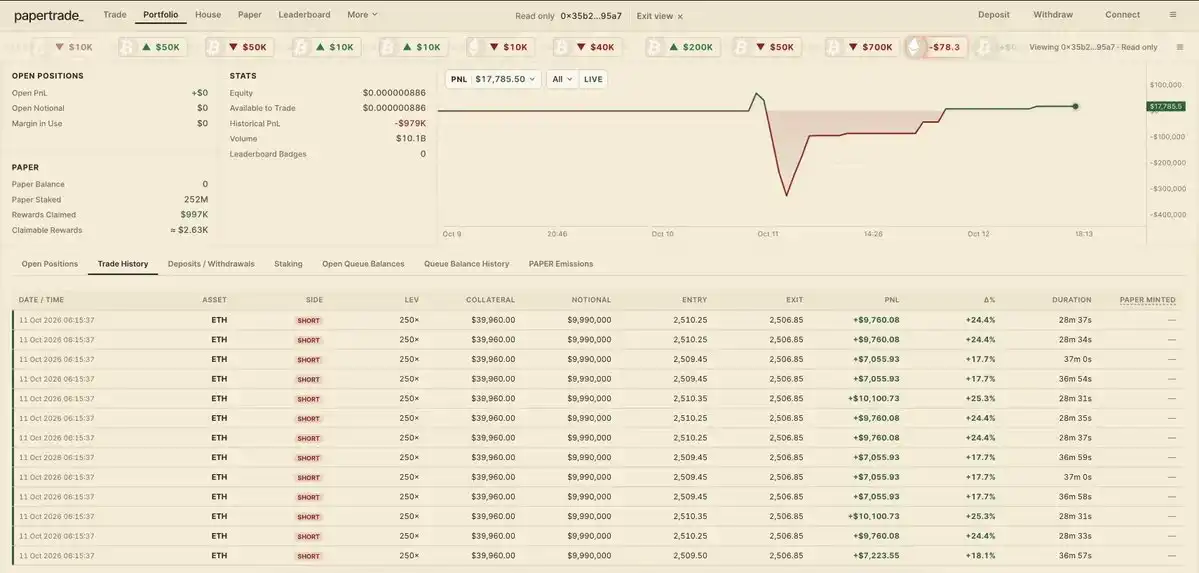
The article then cites another Lookonchain example from Oct. 12. An address beginning with 0x35b2 completed 1,012 trades on Papertrade and generated about $10.1 billion in notional volume.
The address lost about $979,000 in trading, but acquired around 252 million PAPER and accumulated about $997,000 in USDC staking rewards.
Looking only at trading losses and USDC rewards, the address showed a cash net profit of about $17,800. In other words, staking rewards were enough to cover the cost incurred to get PAPER, while the wallet still held roughly 252 million PAPER.
For that kind of early participant, once staking rewards have covered the original outlay, the remaining PAPER no longer carries the same historical cost burden. If the protocol keeps generating distributable income, those tokens can continue to produce cash flow.
Later participants face a different setup. If they must spend hundreds of thousands of dollars to accumulate the same number of PAPER, they need future distributions to recover that cost while also dealing with dilution from newly minted tokens. The token may be the same, but the economic risk is not.
What DefiLlama’s revenue number actually reflects
DefiLlama data cited in the article showed that as of Oct. 15, Papertrade had produced $42.24 million in protocol revenue over seven days, with PAPER holder revenue at $39.37 million, or about 93% of the total.
That share is unusually high. The article says the composition of that income differs sharply from the revenue profile of a conventional perpetual DEX.
Using the then-cumulative protocol revenue figure of about $48.04 million, the breakdown given in the article was:
- about $5.69 million from settlement fees;
- about $1.02 million from liquidation fees;
- about $41.33 million from excess LP pool distributions.
That means roughly 86% of cumulative income came from excess returns distributed from the LP pool to PAPER stakers, rather than standard fees charged directly on notional trading volume.
On order-book platforms such as Hyperliquid, trader PnL is mostly transferred between counterparties, while the platform earns fees. On Papertrade, the protocol pool itself is the counterparty. Trader profits require payments from the pool, while trader losses feed the pool. The asymmetric PnL design can also tilt results statistically in the pool’s favor.
Once funds in the pool exceed the distribution threshold, the excess can be paid out to PAPER stakers. So one of Papertrade’s major current revenue sources is the net gain accumulated by the pool as it settles against traders and then passes on excess capital.
That is real USDC cash flow. It is not the same kind of operating revenue as a venue that relies mainly on recurring exchange fees. If traders as a whole become profitable, the LP pool can just as easily face outflows. For that reason, the article cautions against projecting Papertrade’s current revenue level too far into the future.
What happens if most users are only farming PAPER
The article describes a tension at the heart of the model.
Papertrade wants PAPER incentives to attract more trading activity. At the same time, PAPER issuance depends on traders taking actual losses, and part of those losses supports LP income and staking distributions.
So the same losses that bring in users and boost protocol revenue also create more claims on future revenue.
The article sketches an extreme scenario in which most Papertrade participants are not there to trade market direction at all. Instead, they are there to wash trade at high frequency in order to obtain PAPER. In that case, some of the losses generated in the process would go to the LP pool or developer fee recipient, while another portion could be redistributed to PAPER holders through staking income.
If traders and stakers overlap heavily, the system starts to resemble a redistribution mechanism among participants. Some individual users may still come out ahead by entering earlier, acquiring PAPER at lower cost, and controlling a larger share of staking weight. But the article stresses that the system as a whole cannot allow everyone to receive cash returns greater than what participants collectively put in.
Internal trading does not create new money by itself, and constant token issuance does not automatically increase the USDC available for distribution.
The article says this can create a feedback loop. Early on, high staking distributions attract traders. Traders absorb losses to farm PAPER, which helps the protocol build funds and generate income. As issuance efficiency declines and total staked PAPER rises, payback periods for new entrants may lengthen. If more participants conclude that expected PAPER returns no longer cover the cost of farming, trading activity may fade. Less trading may then reduce fees and net protocol income, weakening PAPER’s appeal in turn.
At that point, the marginal power of the original incentive system starts to fall.
The article leaves room for another path. If Papertrade can attract enough users with genuine trading demand, even those who are not primarily motivated by PAPER, the platform could still generate revenue through its settlement model.
Three variables that may decide long-term durability
The article identifies three main conditions that could shape Papertrade’s long-term outlook.
1. Real trading demand that does not rely on PAPER incentives
Papertrade does offer differentiated features: leverage up to 1,000x, zero order-book slippage, and no traditional funding rate. Whether those features are enough to keep users trading over time remains unproven.
The non-symmetric PnL model is especially important here because it increases the cost of being right. If PAPER incentives fade, the question is whether traders will still accept that cost and stay on the platform. That will determine how much future revenue comes from sustainable organic trading activity.
2. LP pool stability and ability to honor payouts
The pool grows through trader losses and is also responsible for paying winning traders. If it cannot cover profitable positions, unsettled profits can be placed into a queue and paid later as more funds arrive.
That means the protocol’s ability to settle depends directly on future trading outcomes and capital flows.
The article says the team announced plans to raise the LP excess-profit distribution threshold from $5 million to $10 million on Oct. 17. Holding back more capital may strengthen the pool’s ability to absorb risk, but it also raises the bar for distributions to PAPER stakers.
The protocol therefore has to balance trader payout capacity against token-holder returns.
The article also points to an early warning sign. On Oct. 10, a trader reportedly profited by influencing the ETH reference quote on Hyperliquid and using a high-leverage synthetic position on Papertrade. According to onchain analysis cited from The Block, the wallet at one point withdrew about $1.28 million net from Papertrade.
After the incident, the project said it had begun tightening position limits to reduce the profit opportunity from similar strategies. The example shows that when the protocol itself takes the other side of trades, it must manage more than ordinary market volatility. It also faces risks tied to manipulation, extreme market conditions, and concentrated trader wins.
3. Whether PAPER issuance and real income can stay in balance
As more PAPER is minted, future protocol income has to be divided among more tokens. If distributable revenue grows more slowly than staked token supply, income per PAPER will fall.
The reverse can also be true. If the protocol keeps expanding real trading activity and grows long-term distributable income, the earnings power of each token does not necessarily have to fall even as supply rises.
For that reason, the article argues that PAPER’s long-term value should be judged more by actual income per token and whether that income can keep growing than by token count alone.
The innovation and the real test ahead
The article does not dismiss the model outright. It says Papertrade has a plausible path because it links trading losses to token issuance, accumulates liquidity quickly at the start, attracts users, and lets participants share in protocol income.
But incentives can only solve the early-user problem. They cannot replace real market demand. Once the initial wave of PAPER farming cools and traders are less willing to absorb losses just to mine tokens, the key questions become whether Papertrade can maintain active trading, continue paying profitable users, and keep producing distributable income.
The broader framing is familiar in crypto. The industry has moved from liquidity mining to trade mining to points-based incentive systems across perpetual DEXs. Papertrade, in the article’s telling, pushes the experiment further by turning trade mining into a contest over claims on future cash flow.
For early users who accumulated large amounts of PAPER at relatively low cost, that may have worked well. For later users, as acquisition costs rise and revenue rights are diluted, repeating those early whale returns becomes much harder.
Trader losses can become income for the protocol and for other participants, but token issuance by itself does not create new value. Once PAPER stops being the main reason users show up, the article suggests the more important question will be whether Papertrade is still a platform traders genuinely want to use.