
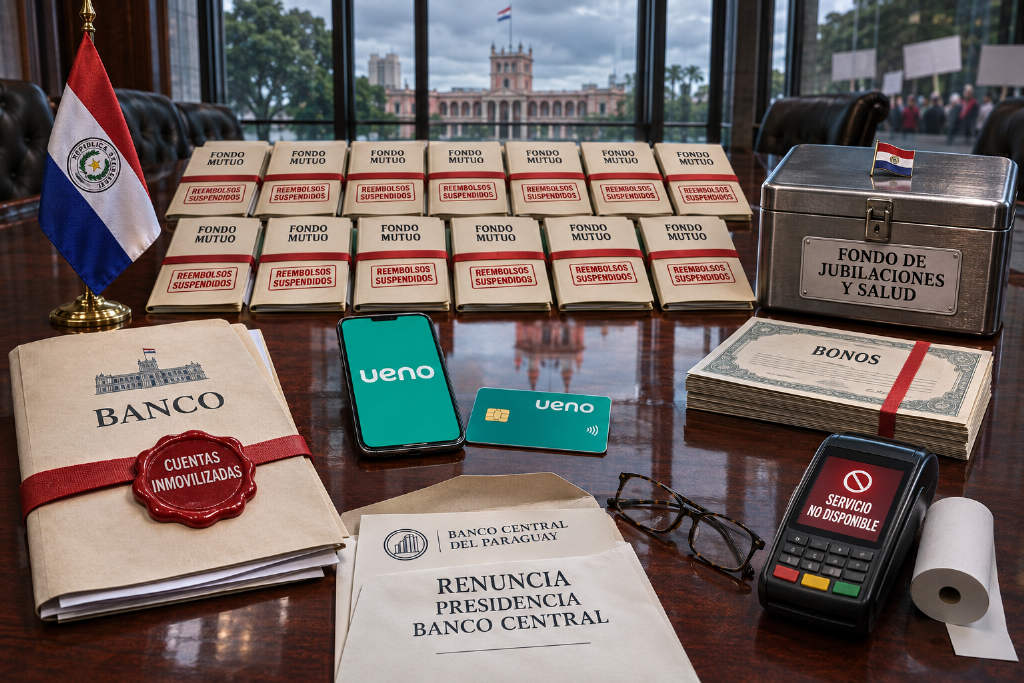
Paraguay’s takeover of Ueno Bank turned into a national financial and political crisis in less than a day. What began as the intervention of a single bank quickly spread into frozen mutual funds, blocked public money, disrupted retail payments, and growing street protests.
Crypto market account Bull Theory said on the evening of Nov. 4 Taipei time that after the Central Bank of Paraguay, or BCP, shut down Ueno Bank, the damage began spilling across the system. Ueno served roughly 60% of the country’s adult population. Redemptions were frozen at 13 mutual funds run by five institutions, Ueno-linked bonds were suspended from trading, and about $380 million from the country’s pension and health fund was stuck at the bank. Paraguay’s importers and merchants association said about two-thirds of card transactions at large retail stores were processed through Ueno, describing retail activity as “half-paralyzed.”
Depositors can currently recover only up to about $1,700 at first, and there is still no clear timetable for full access to funds. The political fallout widened at the same time. The central bank governor, who previously held a senior role tied to Ueno’s predecessor, resigned. President Santiago Peña canceled an overseas trip. Prosecutors issued arrest orders for eight bank executives, and demonstrations in the streets expanded.
From emergency intervention to a broader funding freeze
The timeline traces back to around the early hours of Nov. 4 Taipei time. In an earlier post, Bull Theory said Ueno Bank had around 3 million customers and about $2.8 billion in deposits, including several hundred million dollars in public funds. After the bank’s financial condition collapsed, Paraguay’s central bank stepped in and froze withdrawals, transfers, and card payments.
Associated Press later described a similar picture. Ueno’s customer base was said to equal about 60% of Paraguay’s adult population, and the bank managed roughly $800 million to $850 million in public funds. Of that amount, around $380 million belonged to the national pension and health fund, IPS.
According to a summary by the Asunción Times, the BCP board voted on Nov. 2 to begin a formal resolution process after the bank’s solvency ratio fell to less than half of the legal minimum. After taking control, regulators moved to inventory assets, protect depositors, and prepare a list of accounts eligible for access. The first disbursement, capped at 10 million guaraníes, or about $1,680 to $1,700, was scheduled to begin before Nov. 6, with smaller depositors prioritized.
The legal deposit insurance ceiling stands at 228.3 million guaraníes per person per institution, or about $38,000. Amounts above that threshold are, in principle, to be handled within a 15-day legal period.
13 mutual funds suspended and Ueno bonds halted
The spillover moved faster than many had expected. Paraguay’s securities regulator, SIV, suspended redemptions, cash distributions, and new subscriptions for 13 mutual funds managed by CADIEM, Puente, Ueno, BNB Asset Management, and Basa. The reason given was that those funds held positions linked to Ueno, making valuation and liquidity difficult to determine for the time being.
Public issuance and trading of Ueno bonds were also halted.
Exposure of public money has become a political flashpoint. State power company ANDE acknowledged that engineering loans, treasury funds, and employee pension accounts were trapped at Ueno. Itaipú, the binational hydroelectric company, has not yet provided a clear figure on whether it had funds there or how large any exposure might be.
Payment disruptions hit retail activity
The payments side of the economy has also been hit. Paraguay’s importers and merchants association, Asimcopar, said about two-thirds of electronic transactions at major retail chains were completed through Ueno accounts and warned that commercial activity would be “half-paralyzed.”
Water utility Essap said it would not cut off service in November because of payment interruptions tied to Ueno. The Supreme Court also suspended fee collection through the bank. Those steps showed that routine public and economic operations were already being dragged into the crisis.
Political fallout deepens
This is no longer just a liquidity event. Reuters reported that Central Bank Governor Carlos Carvallo submitted his resignation at the president’s request. From 2021 to 2023, he led the finance company that was later converted into Ueno Bank, and he has headed the BCP since August 2023. That history has fueled questions over supervision and conflicts of interest.
Carvallo said he would remain in his post temporarily to help complete the resolution process.
President Santiago Peña canceled his planned trip to Madrid for the Ibero-American Summit and stayed in Paraguay to deal with the crisis. The report also said Peña had prior business ties with the group behind Ueno, pushing the question of responsibility to the center of public anger.
After the BCP filed a complaint, prosecutors issued detention orders for eight people, including CEO Federico Miguel Vázquez Villasanti and chairman Juan Manuel Gustale. A civil court also froze assets tied to the group and its directors, at roughly the $70 million level, to prevent transfers.
Authorities call it an isolated case, markets ask what comes next
Depositors and pension recipients have gathered in downtown Asunción and outside the presidential residence, demanding full repayment and, in some cases, calling for impeachment. ABC Color said clashes with police broke out at one point, with anger directed at the president and the handling of public funds.
For a small country that has spent recent years promoting digital finance and attracting capital from neighbors such as Brazil, the trust cost is rising quickly.
In its official statement, the BCP said the situation was specific to one institution and did not mean the broader banking system was in trouble. It urged the public to rely on official channels and ignore rumors. The central bank also said it would pursue responsibility within the legal framework and refer matters to other agencies if needed.
Markets remain unconvinced. In October, Paraguay’s banking association, Asoban, had already pressed the BCP over regulatory explanations and equal treatment related to Ueno, questioning whether disclosures were complete. Bull Theory also said that the country’s 14 private banks had asked the central bank at the time to report on the solvency of other lending institutions.
Officials may describe Ueno as an isolated case, but the market is asking for verifiable numbers and whether another institution could fail the next stress test. Paraguay’s image as an emerging investment destination is now being repriced through the collapse of a digital bank.



