
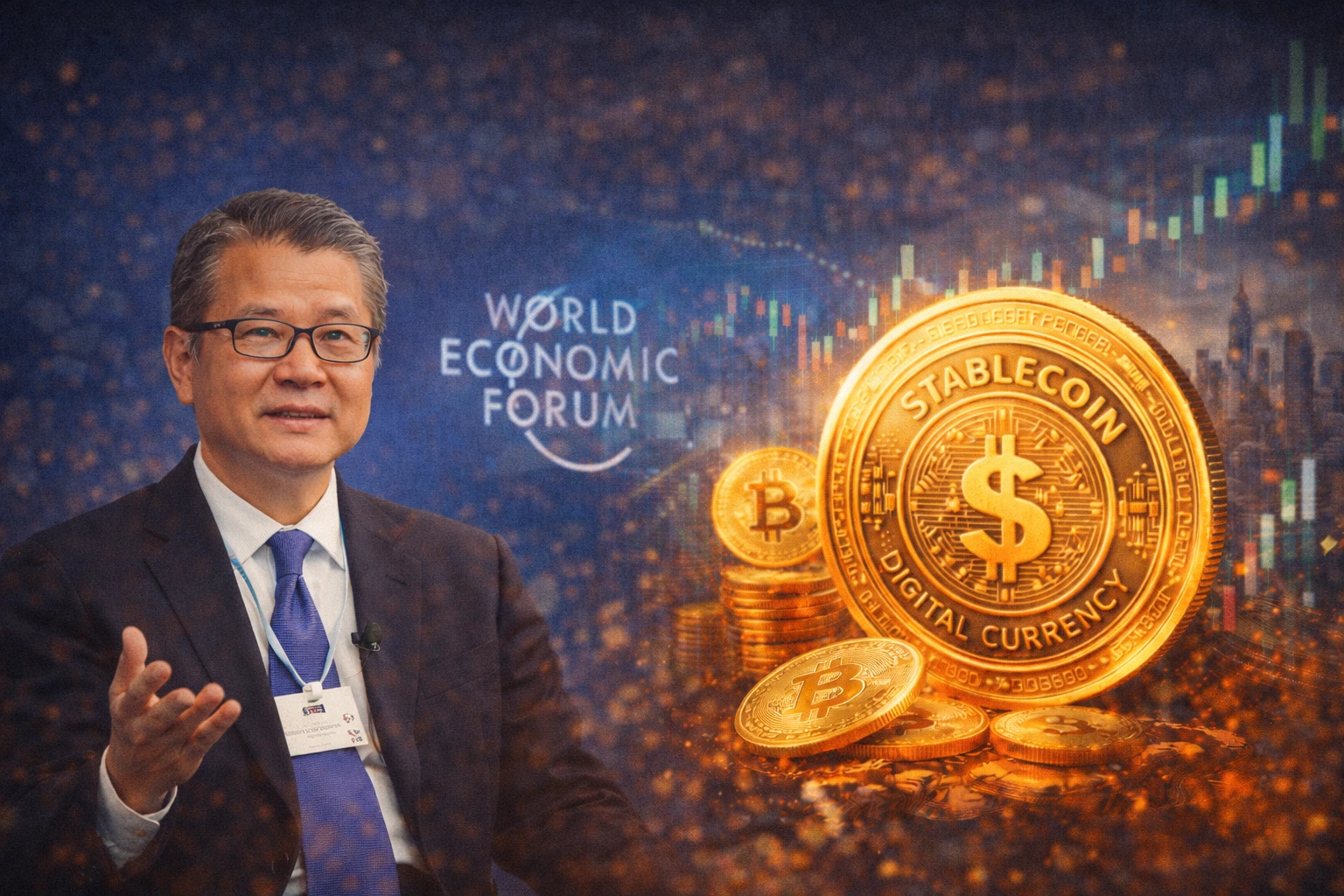
Hong Kong Financial Secretary Paul Chan used a closed-door workshop at the World Economic Forum in Davos to outline the city’s digital asset policy. His central message was clear: regulation should follow a same risk, same regulation standard, with oversight based on the nature of a business and the risks involved rather than on blockchain or crypto as standalone technologies.
Chan said digital assets should serve the real economy, while safeguards must also be built to address risks tied to financial stability, market integrity, and investor protection. The remarks reflect Hong Kong’s current direction in crypto policy: allowing innovation to develop while keeping formal rules and supervision in place.
Stablecoin issuer licenses may arrive in the first quarter
Chan said stablecoin issuer licenses could be granted in the first quarter of this year. That timeline puts fresh attention on Hong Kong’s stablecoin framework, which has been closely watched by the market. The city has already introduced a licensing regime for virtual asset trading platforms, and the Hong Kong Monetary Authority is also advancing a pilot for tokenized deposit transactions.
The structure of the framework is notable. Hong Kong is not treating digital assets as a category outside ordinary financial supervision. It is trying to assess these activities through established risk logic, asking what a product or service does and what exposures it creates.
Tokenized green bonds reach $2.1 billion since 2023
Chan also said the Hong Kong government has issued three batches of tokenized green bonds since 2023, with a combined size of $2.1 billion. That figure points to continued execution rather than a policy discussion without issuance activity behind it.
In practice, these tokenization efforts carry signaling value as well. Projects involving tokenized bonds and tokenized deposits show that Hong Kong’s digital asset agenda extends beyond exchange regulation and into broader financial infrastructure use cases.
Banks and cross-border pilots add to the picture
Recent cases cited in the report show traditional financial players moving into the space. A subsidiary of China Merchants Bank has completed the tokenization of a $3.8 billion money market fund on BNB Chain.
Another development involves cross-border testing. Hong Kong and the Central Bank of Brazil are working together on a blockchain-based trade finance pilot, with technical support from Chainlink. Taken together, these steps show Hong Kong pushing licensing, regulation, and live tokenization use cases at the same time.