
$41.49 — that's where PayPal closed on February 10. Five years ago, it was $307. Market cap has evaporated from $360 billion to under $40 billion, a drop of 86%.
That same day, the countdown began for its third CEO. Enrique Lores, a Spanish engineer who spent 37 years at HP, will take the helm on March 1. He's the third chief in eleven years, and each seems more desperate than the last.
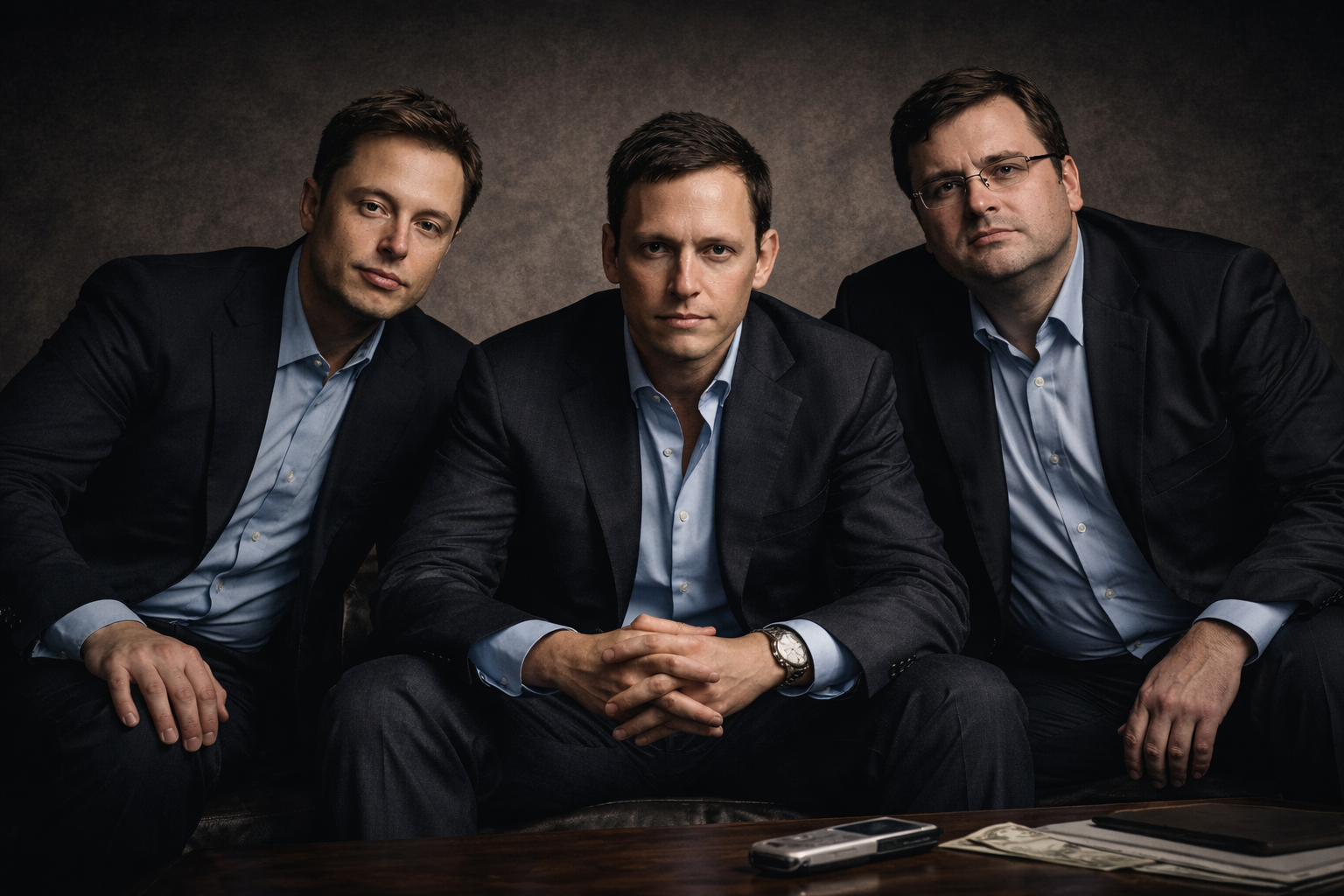
But look beyond PayPal itself. Its original team members — the "PayPal Mafia" — have reshaped the world. Musk, Thiel, Hoffman, Chad Hurley, Steve Chen... they started Tesla, SpaceX, LinkedIn, YouTube, Palantir, Affirm. Combined, they created over $2 trillion in market value. Musk alone is worth $750 billion — nearly 20 times PayPal's entire market cap.
Six People and a Gamble
In December 1998, 23-year-old Max Levchin and 31-year-old Peter Thiel founded Confinity, aiming to send encrypted payments between PalmPilots. At the same time, 27-year-old Elon Musk used $22 million from selling Zip2 to start X.com, an online bank. The two companies shared an office building in Palo Alto — neighbors and rivals.
Confinity quickly pivoted to email-based money transfers: PayPal. In March 2000, they merged. The marriage was fraught: Musk wanted Microsoft's tech stack; Levchin insisted on Unix. In September 2000, while Musk was on his honeymoon, Thiel and Levchin staged a coup, ousting him as CEO. Musk later said, "The company mattered more than any individual."
Fraud was PayPal's biggest enemy. In 2000, losses topped $10 million per month. Levchin's team built the first large-scale anti-fraud system, including CAPTCHA. It saved the company.
PayPal went public in February 2002, and eight months later eBay bought it for $1.5 billion. Nearly the entire core team left — the most spectacular talent exodus in Silicon Valley history.
Those Who Left, and the Curse They Left Behind
Peter Thiel cashed out, put $500,000 into Facebook in 2004 as its first outside investor �� a stake later worth over $1 billion. That same year he co-founded Palantir, now valued at over $250 billion.
Musk took his $165 million from the acquisition and split it three ways: $100 million into SpaceX, $70 million into Tesla, the rest into SolarCity. Any one of those has changed the world more than PayPal.
Reid Hoffman founded LinkedIn in 2002; Microsoft bought it for $26.2 billion in 2016. Chad Hurley and Steve Chen founded YouTube in 2005, sold to Google for $1.65 billion a year later. Max Levchin founded Affirm in 2012.
And PayPal itself? A company worth less than $40 billion.
The Schulman Era: Bloated and Hollow
After spinning off from eBay in 2015, CEO Dan Schulman grew revenue from $9.2 billion to $27.5 billion, active accounts from 180 million to 430 million. But quality decayed. He spent $4 billion on coupon app Honey, $2.2 billion on Japanese BNPL firm Paidy, plus iZettle and Hyperwallet. PayPal tried to compete with Stripe, Block, Apple Pay, Klarna, and Coinbase all at once.
In July 2021, shares hit $307, market cap $360 billion. Then came the five-year free fall. Activist Elliott Management forced cost cuts and layoffs. Schulman announced his retirement in 2023; the stock barely moved — the market had priced it in.
He left a large but hollow empire: average revenue per user steadily declining, a 43% market share in online payments that couldn't translate into growth.
The 839-Day Experiment
In September 2023, Alex Chriss became CEO, coming from Intuit. His diagnosis: the classic innovator's dilemma. His prescription: AI. He launched Agentic Commerce Services, expanded the PYUSD stablecoin, and talked up an AI-agent future.
The market wasn't convinced. On February 3, 2026, Q4 2025 earnings missed: revenue $8.68 billion vs. $8.79 billion expected. Branded Checkout TPV growth slowed from 6% to 1%. EPS $1.23 vs. $1.29. The board fired Chriss the same day, citing "speed and execution below expectations."
839 days — not enough time for a single product strategy to fully deploy.
Meet the Third CEO: A Disassembler
Enrique Lores, 61, spent 37 years at HP, climbing from intern to CEO. He orchestrated HP's 2015 split and the Samsung printer acquisition. The board isn't looking for a visionary; they want a disassembler. The next chapter will likely be about breaking the bloated conglomerate into focused units, deciding what to keep and what to sell.
The First-Mover's Curse
PayPal's story is a textbook case of first-mover disadvantage. It bore the costs of market education and trial, then watched latecomers harvest the rewards: Stripe's better API for e-commerce, Square's card reader for offline, Apple Pay for mobile, Klarna/Affirm for BNPL. Many were founded by former PayPal employees.
Affirm's Levchin was PayPal's CTO. Block's early investors included PayPal Mafia members. PayPal didn't just fail to retain talent — it bred its own deadliest competitors.
Stripe's valuation hit $129 billion in December 2025 — 3.5 times PayPal's entire market cap. PayPal still claims 43% of global online payment market share, but loses 2-3 percentage points each year. In developer ecosystems, enterprise payments, cross-border transactions, it's no longer the primary option.
Twenty-eight years after Confinity's office poster promised "World Currency," digital payments have indeed replaced cash. But PayPal didn't finish the job. It lit the fire, and the fire illuminated others' paths.