

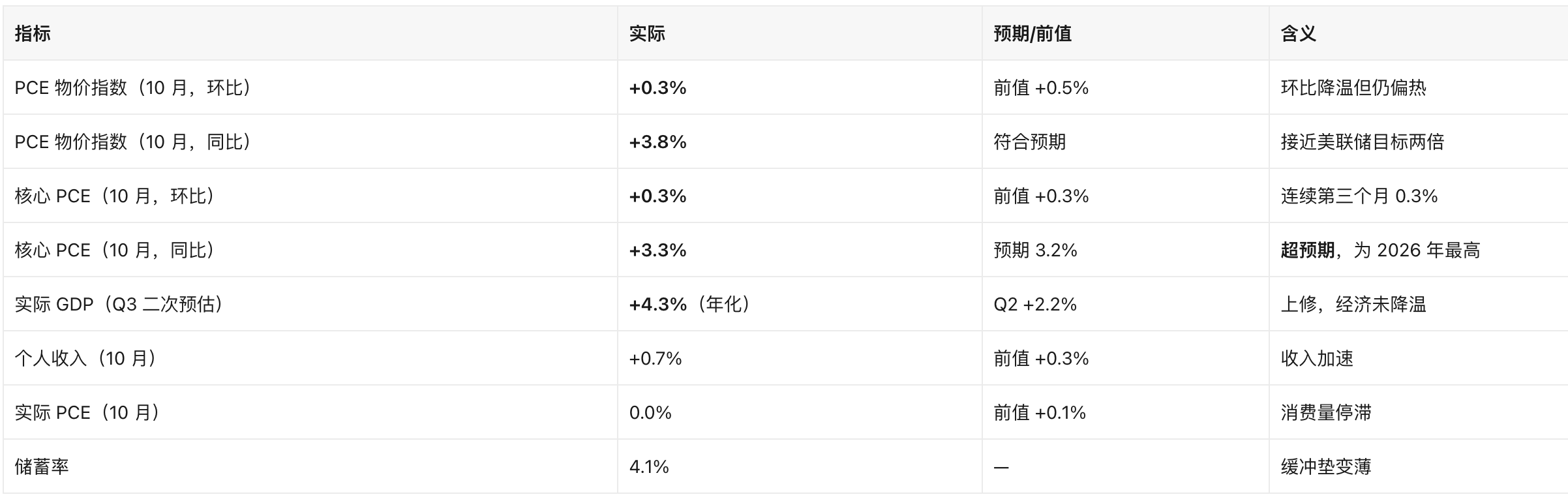
U.S. markets repriced the Federal Reserve’s December outlook after October core personal consumption expenditures (PCE) inflation rose 3.3% year over year, above the 3.2% forecast. Headline PCE was 3.8%. The second estimate of third-quarter gross domestic product (GDP), released the same day, was revised up to 4.3%. Inflation had remained above 3% for 10 consecutive months, while economic growth showed no clear cooling. Market expectations shifted from a December rate cut toward the possibility of a hike.
The Office of the U.S. Trade Representative proposed Section 301 tariffs targeting 14 economies, with rates of up to 20% for China and the European Union. The proposal could not take effect before January 25, 2027. Even so, the combination of tariffs and firm inflation revived stagflation concerns. U.S. stocks fell as much as roughly 1,100 points intraday.
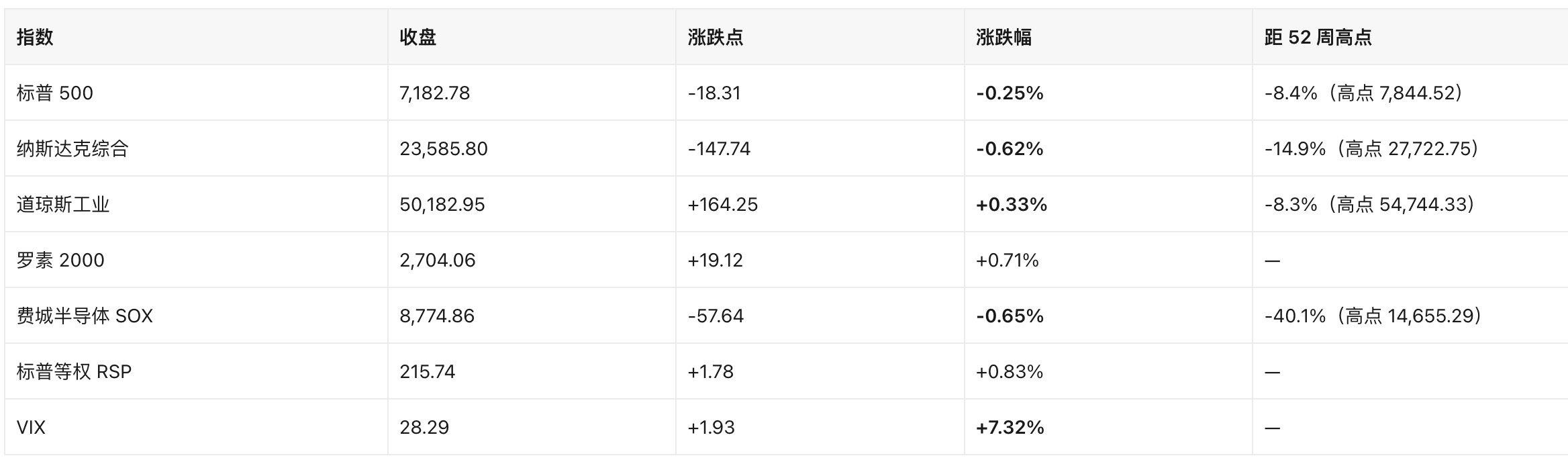
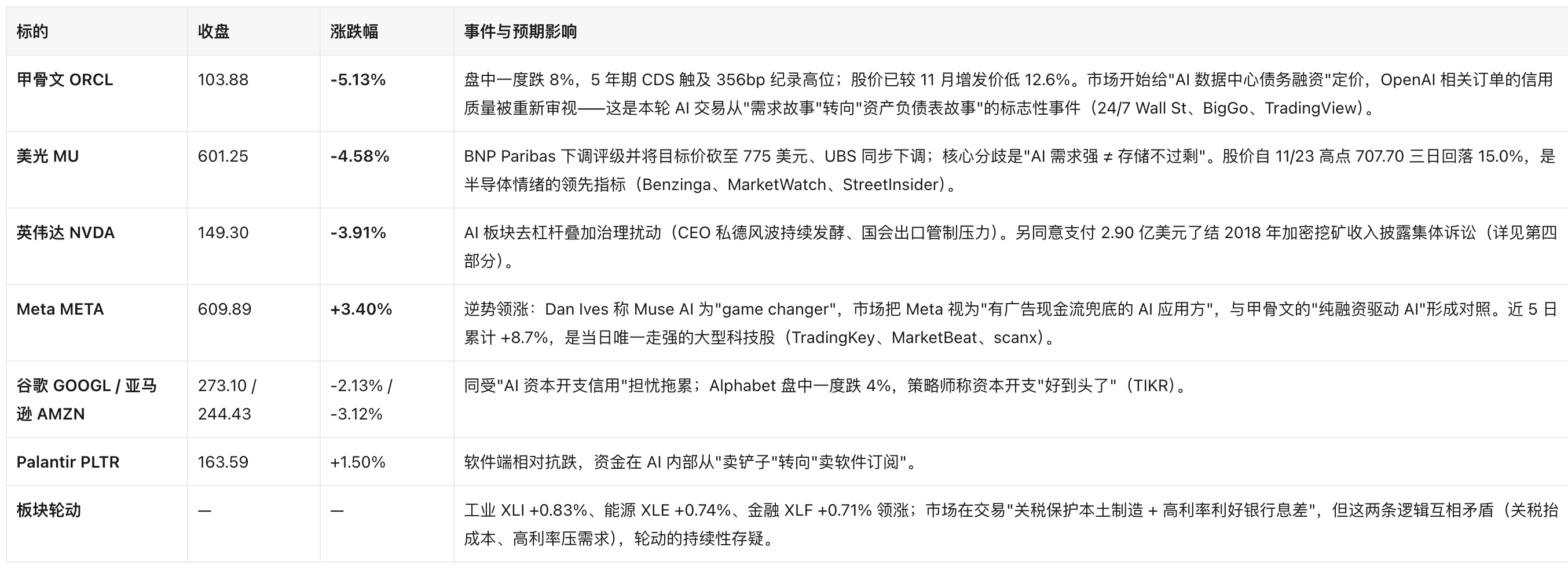
The Dow Jones Industrial Average reversed course and ended 164.25 points higher. The S&P 500 closed at 7,182.78, down 0.25%, while the Nasdaq finished at 23,585.80, down 0.62%. The Russell 2000 and the equal-weight S&P 500 ETF, RSP, which gained 0.83%, advanced. The session pointed to rotation from long-duration AI stocks toward cash-flow assets rather than a broad risk-off move. Oracle fell 5.13%, after dropping as much as 8% intraday, and its credit default swaps (CDS) reached a record 356 basis points. Bloomberg reported that the Nasdaq 100 had entered bear-market territory.
Inflation data and tariffs reset expectations
The October PCE report and the revised third-quarter GDP estimate were released at 8:30 a.m. ET on November 25. Both pushed up expectations for real interest rates, putting pressure on long-duration assets. The tariff proposal arrived around the same time and added to concerns about a renewed rise in goods inflation.
Sector performance on November 25 reflected that rotation. The technology ETF XLK fell 0.83%, and the health-care ETF XLV lost 0.56%. Industrials ETF XLI rose 0.83%, energy ETF XLE gained 0.74%, financials ETF XLF advanced 0.71%, and consumer staples ETF XLP added 0.46%. Technology was the only major sector to decline. The equal-weight index outperformed the market-cap-weighted benchmark by 1.08 percentage points.
Yahoo Finance said the inflation report reinforced expectations of a December rate hike and possibly more increases next year. The Financial Times said the GDP revision kept a December hike on the table. Reuters reported that policymakers remained divided over the causes of persistent inflation. The report described the session as a full market transmission from strong data to hike expectations and simultaneous pressure on stocks and bonds.
Bonds, gold and oil moved in different directions
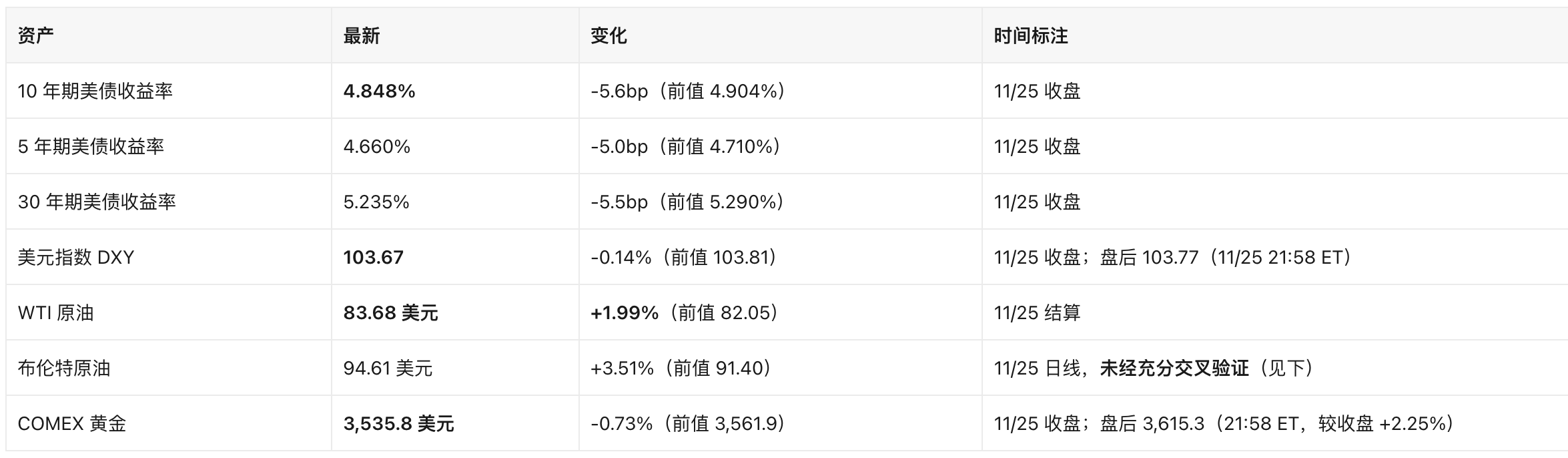
The 10-year Treasury yield fell 5.6 basis points, an unusual move as rate-hike expectations strengthened. The report attributed the decline to safe-haven demand and concerns about AI-related credit risk outweighing the inflation repricing: bond markets were trading growth concerns, while equities were pricing in lower valuations. The VIX rose 7.32% to 28.29, indicating greater demand for hedges. The report linked the Dow’s reversal to bargain buying and short covering ahead of Thanksgiving, rather than an improvement in fundamentals.
Gold fell as low as $3,425.2 intraday, near a 15-month low, before rebounding to $3,615.3 after hours. Bloomberg said the tariff plan strengthened rate-hike bets and weighed on gold. Safe-haven and inflation-hedging demand later brought buyers back, leaving the direction unsettled.
West Texas Intermediate crude settled at $83.68, up 1.99%. Brent’s daily series showed $94.61, up 3.51%, consistent with reports of a roughly 3.5% gain. The move was linked to Yemen’s Houthi group claiming an attack on Saudi Arabia’s Ras Tanura refinery and reports of ships being struck in the Strait of Hormuz. However, the hourly Brent series rose only to about $90.8, while the overnight front-month quote fell to $90.67. The roughly $4 gap may reflect a contract-roll stitching difference. The report said the figure should be treated cautiously because it had not obtained the official ICE settlement price.
AI stocks showed a split over financing risk
The day’s trading was described not as a collapse across AI stocks but as a credit-risk divide within the sector. Meta and Palantir, which were characterized as having cash flow, held up better. Oracle and Nebius, whose expansion relies on debt financing, came under selling pressure. Nebius fell 12% intraday. The report cited a strategist saying that AI capital spending had reached a point where it could no longer keep improving, and said money rotated from AI hardware toward financials, industrials and energy.
Oracle’s share-price decline and record CDS spread brought the financing side of AI capital spending into focus. Bloomberg reported that the Nasdaq 100 had moved into bear-market territory.
Crypto treasury firms slow purchases and sell assets
Strategy slows Bitcoin buying and repurchases preferred shares
Strategy (MSTR) bought just 457 BTC from November 16 to November 22, spending $29.6 million at an average price of $64,898. As of November 22, the company held 851,305 BTC, with an aggregate cost of $64.23 billion and an average cost basis of $75,446.
At Bitcoin’s November 25 closing price of $60,601.64, Strategy’s holdings were worth about $51.59 billion, leaving an estimated unrealized loss of $12.64 billion against cost. The company’s market capitalization was $33.77 billion, or 0.65 times the value of its Bitcoin holdings. That calculation includes only common-equity market capitalization and excludes debt, preferred stock and cash. The discount persisted.
During the week, Strategy sold 1.9257 million MSTR shares through its at-the-market (ATM) program, raising $176.7 million net. It used $29.6 million to buy Bitcoin and the remainder to repurchase STRC preferred shares. The company bought back 2,183,747 STRC shares for $211.8 million. Its authorization for digital-credit securities buybacks rose from $3 billion to $4 billion, with $1.12 billion remaining. The MSTR common-stock buyback authorization had $1 billion left, while $17.92 billion remained under the common-stock ATM program, leaving potential dilution exposure.
Market coverage described Strategy as pausing Bitcoin purchases to replenish cash reserves. The company’s move of $1 billion from its USD Reserve into cash was consistent with the market interpretation that it was shifting from unrestricted buying toward protecting dividends and credit. MSTR closed at $79.96, up 3.11%. It stood 13.6% above its 52-week low of $70.37 and 59.7% below its 52-week high of $198.40.
Index changes were another near-term pressure. MSCI removed Strategy from global indexes under a new rule for non-operating companies. Passive funds were required to sell by November 30. Media estimates put the amount involved at about $2.8 billion, a figure MSCI had not confirmed.
Bitmine retains ETH and declares a cash dividend
Bitmine (BMNR) held 6.09 million ETH. Its crypto assets, cash and cash equivalents totaled $11.1 billion. At an ETH price of $1,694.68, the ETH position was worth about $10.32 billion, consistent with the company’s disclosed figures. Bitmine’s unrealized loss on ETH exceeded $10 billion, but it still declared a $0.01-per-share cash dividend. BMNR closed at $13.44, up 1.97%.
The report said Ethereum treasury companies had broadly entered a selling phase. Bit Digital sold 29,825 ETH and repaid $50 million to Galaxy.
Next Technology sells BTC and shifts toward AI software
Next Technology Holding (NXTT) sold 500 BTC on November 21 at an average price of $58,468, raising $29.22 million. It retained 5,333 BTC. The company said in a notice that it did not currently expect to buy more Bitcoin and would redirect funds toward AI software research and development. NXTT closed at $3.61, up 8.08%. The report described the share move as a positive market response to the shift from selling crypto to investing in AI, and said it could serve as a reference for how similar companies are priced.
Crypto-linked equities, ETF flows and policy developments
OceanPal (SVRN) completed a private investment in public equity (PIPE) transaction funded with NEAR tokens on November 24 to launch a new crypto treasury strategy. The report classified it as a third-generation treasury company focused on assets other than BTC or ETH. Given its small size and limited disclosures, it was added to a watchlist only and not presented as a trading reference.
The report found no U.S.-listed company that had newly announced a Bitcoin treasury. A full-text search of SEC EDGAR 8-K filings from November 23 through November 26 found no new buyer. It characterized the shift in corporate crypto-treasury activity as a move from companies entering the market to companies exiting, citing NXTT’s Bitcoin sale, Bit Digital’s ETH sale and broader reductions by Ethereum treasury firms.
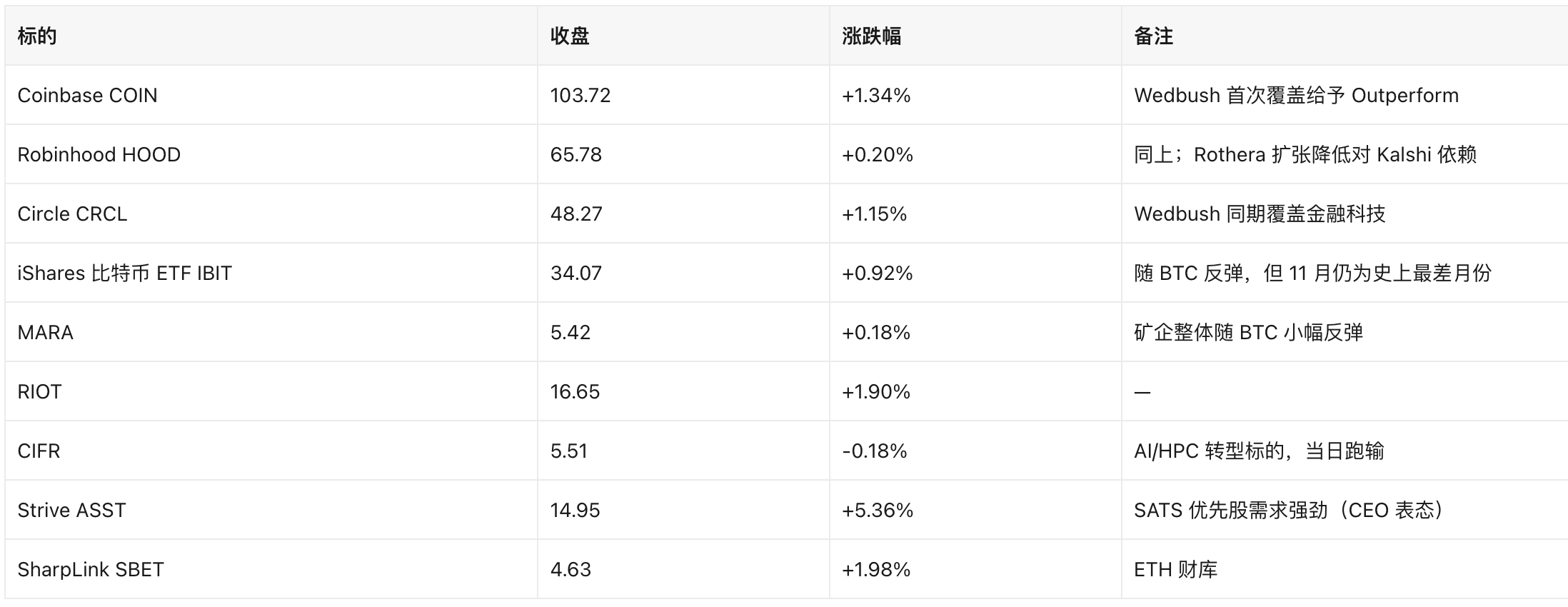
The source material did not provide individual figures for the broader crypto-linked U.S. equity watchlist at the November 25 close.
U.S. spot Bitcoin ETFs recorded nearly $5 billion in net outflows in November, a monthly record. On November 24, they saw $570 million in outflows, marking a sixth consecutive trading day of net withdrawals. The official net-flow figure for November 25 was not available, and the report did not estimate it.
On product and compliance matters, Fidelity filed for a spot Chainlink ETF, Franklin Templeton added HYPE to a crypto ETF, and Commodity Futures Trading Commission (CFTC) staff issued guidance on expense allocation requirements for BTC and ETH ETFs. Nvidia (NVDA) agreed to pay $290 million to settle a 2018 investor class-action lawsuit. The suit alleged that Nvidia understated the contribution of crypto mining to gaming graphics-card revenue in 2017 and 2018.
The U.S. House Financial Services Committee advanced the Strategic Bitcoin Reserve Act. The Block described its path to passage as narrow; the bill remained at a procedural stage. If enacted, it could prompt a reassessment of how companies holding Bitcoin are valued. Senators Elizabeth Warren and Chris Van Hollen led a call to repeal the SEC’s Regulation Crypto and innovation exemption, underscoring continued disagreement over regulatory direction.
Ukraine passed legislation to legalize and tax crypto markets, with the law set to take effect in July 2027. The Hong Kong Monetary Authority launched a platform for tokenized debt securities. UniCredit began offering principal-protected Bitcoin exposure to retail customers in Italy.
Bitcoin rebounds while monthly losses and ETF outflows persist
Bitcoin traded at $60,601.64, up 2.14% over 24 hours, after briefly falling below $58,000. It was 9.9% above its 52-week low of $55,149.57, according to the report. Ether traded at $1,694.68, up 1.96% over 24 hours, and had fallen more than Bitcoin. CoinDesk said Bitcoin was relatively resilient as stocks declined.
Bitcoin was down more than 25% for November to date, while Hyperliquid led losses among altcoins. James Butterfill, head of research at CoinShares, said the market could be near the tail end of a bear market. On the day, the Nasdaq fell 0.62% while Bitcoin rose 2.14%. The report said the opposing moves suggested crypto may have already undergone deleveraging, reducing its short-term correlation with U.S. equities. Crypto-linked stocks remained exposed to both token prices and equity-market risk appetite.
Tariffs and geopolitical risks shape the outlook
The proposed Section 301 measures cover 14 economies. China and the European Union face rates of up to 20%, India up to 25%, and the proposal also includes a 17% negotiating offer. The report outlined a possible chain of effects: higher import costs could keep core goods inflation sticky, reinforce December rate-hike expectations and compress valuations for long-duration assets such as AI and crypto, while benefiting some domestic manufacturing and industrial goods.
Flexport and other organizations confirmed that the measures would not take effect before January 25, 2027. They remained proposals subject to a comment period, not an immediate policy change. The report said the day’s market decline was more about repricing expectations than an immediate hit to cash flows. Open questions included the timing of possible EU and Chinese retaliation and whether U.S. retailers could pass costs on to consumers; Walmart was under pressure that day.
Yemen’s Houthi group claimed an attack on Saudi Arabia’s Ras Tanura refinery, while ships were reported attacked in the Strait of Hormuz. The report traced a possible impact through a higher Brent risk premium, gasoline and diesel refining margins, transport and chemical costs, and renewed inflation expectations. OilPrice said oil traders were ignoring threats to Gulf supply, suggesting that the market viewed the events as a short-term disruption rather than a structural supply cutoff. Higher oil prices supported energy shares, with XLE up 0.74%, while airlines, transport and consumer sectors could face pressure. Any crypto impact would come indirectly through inflation and rate expectations.
A U.S.-backed consortium signed an agreement to acquire Lukoil’s overseas assets. The report said a restructuring of Russian crude flows could increase non-OPEC supply over the medium term, weighing on oil prices, although Middle East risks overshadowed that effect in the short term. Ukraine’s crypto legalization and tax law is scheduled to take effect in July 2027. The report said the legislation could offer a model for crypto compliance in Eastern Europe and, over the longer term, benefit compliant trading platforms and stablecoin payments, while noting that the scale and timing of any impact remained distant.
Dates and risks to watch
November 26, Thursday: U.S. equity and bond markets were closed for Thanksgiving. No economic data or Federal Reserve speeches were scheduled. The report warned that thin liquidity could amplify moves in overseas markets, particularly in Asia. Crypto markets remained open around the clock, and Thanksgiving was expected to be a particularly illiquid period in which sharp wicks could occur. The levels to watch were $58,000 for BTC and $1,650 for ETH.
November 27, Friday: U.S. stock markets were scheduled to close early for Black Friday. The New York Stock Exchange and Nasdaq would close at 1 p.m. ET, or 02:00 Beijing time on November 28; the Treasury market would close at 2 p.m. ET. No major data releases were scheduled. Black Friday retail sales were identified as the first high-frequency window for observing possible consumer stockpiling or price increases tied to tariff expectations.
November 30, Monday: MSCI index changes were due to take effect, and the passive selling window for Strategy was set to end. Media estimates put the passive funds requiring reductions at about $2.8 billion. The report called this the largest single-point risk for crypto-linked equities the following week. Month-end rebalancing and potential selling by trend-following CTA strategies if the S&P broke below key levels were also on the watchlist.
December 8–9: The Federal Open Market Committee (FOMC) meeting and Summary of Economic Projections (SEP) were scheduled. Markets were pricing a December hike; an upward revision to the dot plot could put further pressure on long-duration assets.
December 23: The next PCE report, covering November, was scheduled for release. The Bureau of Economic Analysis (BEA) was also due to publish its third estimate of third-quarter GDP.
The risk checklist in the report included whether Oracle CDS would widen further from 356 basis points and whether large technology companies would face a weak reception for AI bond issuance; whether the EU or China would retaliate during the tariff comment period; and whether Strategy’s remaining $17.92 billion ATM capacity and its 0.65 market-cap-to-Bitcoin-value ratio would make further share issuance to buy Bitcoin uneconomic, increasing pressure to sell assets to protect preferred shareholders. It also cautioned against treating intraday moves in indexes or Bitcoin during thin Thanksgiving liquidity as trend signals.
Index, equity, ETF, commodity and crypto prices were sourced from Msx market data. Holdings and financing figures came from SEC EDGAR 8-K filings. The source stated that the material was for information and analysis only and did not constitute investment advice.



