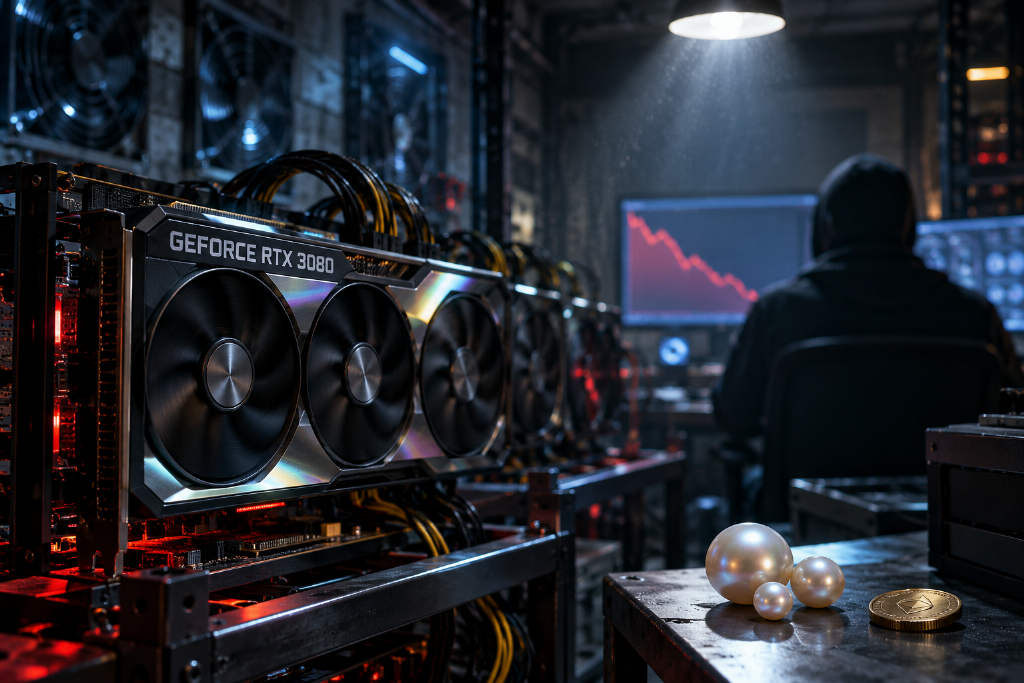
PEARL, ticker PRL, is the native token of the Pearl blockchain. Pearl mainnet went live on April 27, 2026, with a maximum supply of 2.1 billion tokens. The project has recently drawn attention because its mining model uses matrix multiplication, a core workload in AI models, instead of traditional hash-based mining. At the same time, the token price has pulled back from its recent high, cutting the dollar value of mining rewards.
According to CoinGecko data cited in the source article, PEARL reached an all-time high of about $2.46 on the evening of Oct. 21, Taiwan time. By 1:30 p.m. on Oct. 27, it was trading at $1.75, down about 29% from that peak. Circulating market capitalization was about $626 million, while fully diluted valuation, assuming all 2.1 billion tokens are mined, stood at about $3.66 billion.
How Pearl ties mining to AI computation
Bitcoin miners spend their time performing hash calculations designed specifically for mining. Pearl replaces that work with matrix multiplication, the same kind of repeated computation used when AI models generate each token of output. The project describes the design as "2-for-1": when GPUs run models for AI clients, the computation also produces mining proofs.
The mechanism comes from a paper published in April 2025 by Ilan Komargodski and Omri Weinstein. The blockchain itself was adapted from btcd, the open-source Bitcoin node software. The development team, Pearl Research Labs, also offers AI model inference services.
Supported hardware and mining software
Pearl's official GitHub repository provides a vLLM mining program, but it currently supports only data center GPUs such as the H100 and H200. Consumer RTX cards need third-party mining software, including SRBMiner-MULTI and PeakMiner, to connect to mining pools.
A Kryptex mining pool guide says the algorithm relies on tensor cores, the parts of a GPU built for matrix calculations. That is why Nvidia cards are described as the most efficient option for this workload.
Theoretical daily output for RTX cards
F2Pool estimated on Oct. 27 that every 1 TH/s of hashrate could produce about 0.0136 PRL per day. TH/s is the unit used by mining pools to show hashrate, and a higher figure means a larger theoretical share of daily rewards. Using hashrate and power figures published by Kryptex, together with a token price of $1.75, the source article listed the following estimates:
| GPU | Hashrate (TH/s) | Mining power (W) | Daily output (coins) | Approx. USD |
|---|---|---|---|---|
| RTX 5090 | 400 | 525 | 5.44 | $9.52 |
| RTX 4090 | 293 | 450 | 3.99 | $6.97 |
| RTX 3080 Ti | 129 | 295 | 1.75 | $3.07 |
| RTX 3080 | 105 | 240 | 1.43 | $2.50 |
| RTX 3070 | 73 | 170 | 0.99 | $1.74 |
| RTX 3060 Ti | 61 | 150 | 0.83 | $1.45 |
| RTX 3060 | 47 | 120 | 0.64 | $1.12 |
| RTX 2060 Super | 39 | 110 | 0.53 | $0.93 |
For an RTX 3080, the theoretical output is about 1.43 PRL a day, worth roughly $2.50 at the quoted market price. Its mining power draw is listed at 240 watts, which works out to about 5.76 kWh per day. Electricity costs depend on the user's local rate and are not included in the estimate.
The RTX 5090, by comparison, is estimated to produce about 5.44 PRL a day, or around $9.52. That is close to four times the RTX 3080's dollar output, though daily electricity use also rises to 12.6 kWh.
Costs are not included in the headline figures
The source article notes that these are theoretical numbers only. They do not include electricity, mining pool fees, or hardware depreciation. Actual pool payouts can also vary with share fluctuations and changes in network difficulty. Token price matters just as much. Since PEARL has fallen about 29% from its peak, the same number of mined coins now converts into about 29% less in dollar terms.
On the supply side, the F2Pool page showed a block reward of about 2,218 PRL, while the official setting targets one block every 3 minutes and 14 seconds. Based on that, the network adds about 988,000 PRL per day, worth roughly $1.73 million at a price of $1.75.
CoinGecko data cited in the report put circulating supply at about 360 million tokens, or 17% of the 2.1 billion cap. That leaves more than 80% still unmined, and puts fully diluted valuation at about 5.8 times circulating market capitalization. Castle Labs had previously estimated that about 122 million PRL were mined in the first six days after launch, when mining difficulty was at its lowest.
PIP-3 could shut out RTX 20, 30, and 40 series cards
The biggest uncertainty for consumer GPU miners is a proposed fork. On July 30, the Pearl team introduced improvement proposal PIP-3. The draft would move mining from integer operations to FP8 floating-point operations, a number format more commonly used in AI models.
Under the proposal, only Nvidia Hopper and Blackwell architectures are on the whitelist. Kryptex interpreted that to mean RTX 20, 30, and 40 series cards would fall outside the specification. Kryptex also summarized an AMA in which the founder said on Sept. 15 that the RTX 5090 and RTX PRO 6000 would still be able to mine after the fork.
PIP-3 remains a draft and no activation date has been set. Under current conditions, an idle RTX 3080 connected to a mining pool could theoretically generate about $2.50 a day before power costs. But if the fork is activated in line with Kryptex's current reading, that card would no longer be eligible to mine. Kryptex said miners should factor that risk into any payback calculation.
PEARL and PRL refer to the same token
The report also notes that PEARL and PRL are the same asset. PRL is the ticker used by F2Pool for Pearl's native token, while CoinGecko and Gate label it as PEARL. In each case, the maximum supply is 2.1 billion.
Can RTX 30 series cards still mine PEARL now?
Based on the figures cited in the article, RTX 30 series cards can still mine PEARL at present. For an RTX 3080, the theoretical daily output is about $2.50, with power consumption of 5.76 kWh. That said, the FP8 fork draft only lists Hopper and Blackwell architectures. If that proposal is adopted, mining eligibility for RTX 30 series cards would change.