


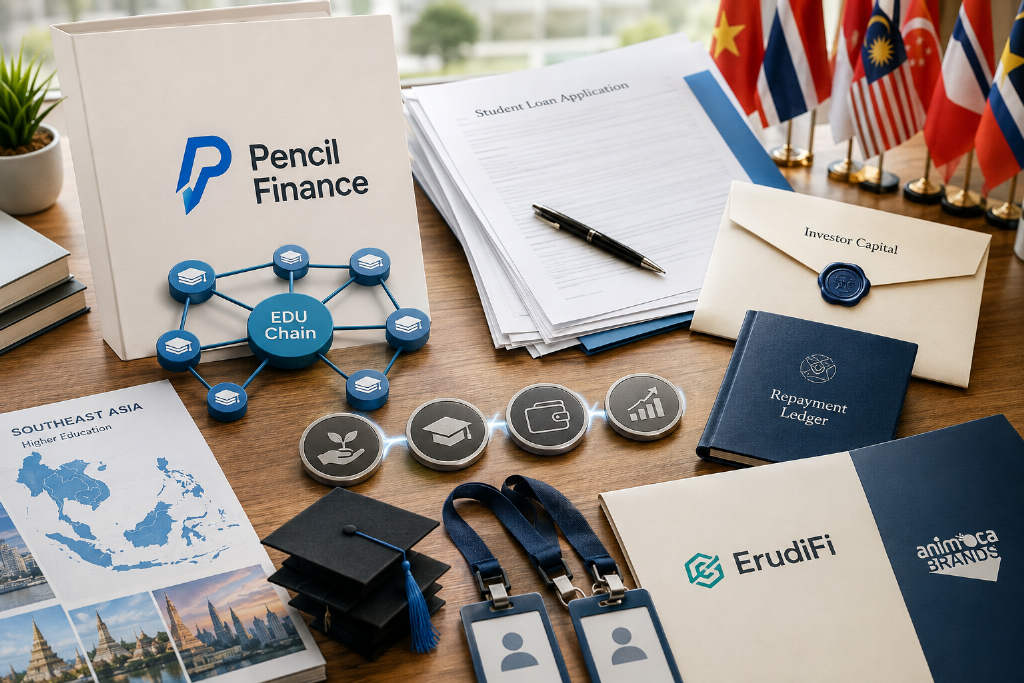
Pencil Finance, a decentralized lending protocol incubated by Animoca Brands, said it has completed a $1 million student-loan cycle entirely on-chain, from raising investor capital to recording repayments and returning principal and yield to funders.
The loans were issued by education-financing company ErudiFi. Pencil Finance packaged them as an on-chain private-credit investment, allowing backers to supply capital and track repayments through blockchain records.
The protocol described the transaction as the first fully on-chain student-lending cycle, though that claim could not be independently verified. Animoca Brands, Open Campus, and NewCampus funded the bundle in July 2025.
Recorded on EDU Chain
In a post on X, Animoca Brands said: 「The protocol deployed loans in the aggregate amount of US$1 million to borrowers, serviced through repayments, and returned the capital to the bundle’s funders with yield, with every step recorded transparently on blockchain」.
The protocol runs on EDU Chain, an education-focused Ethereum-based network built using Arbitrum Orbit. Pencil Finance was co-incubated by Animoca Brands and the developer community HackQuest.
Most capital went to Southeast Asia
ErudiFi said it deployed most of the bundle through student loans and tuition financing across Southeast Asia, including Indonesia and the Philippines. Over 12 months, the company said the capital supported loans for more than 6,600 students at 118 institutions, with about 1,050 students receiving funding directly attributable to Pencil Finance.
The investment structure was split into senior and junior tranches. The senior tranche offered fixed returns and repayment priority. The junior tranche offered variable returns and absorbed the first losses from defaults.
Borrower profile and company statement
Across ErudiFi’s portfolio, the company said half of borrowers are women, 93% come from lower-income households, and 52% are using formal credit for the first time.
Frank Li, co-founder of Pencil Finance, said in a statement: 「Education lenders in emerging markets are creditworthy but invisible. Global capital can’t verify their performance, so it never reaches them. Putting the lending cycle on-chain changes that: every repayment is recorded and auditable by anyone, in real time. This bundle built a public track record that makes the next bundle easier to fund.」