



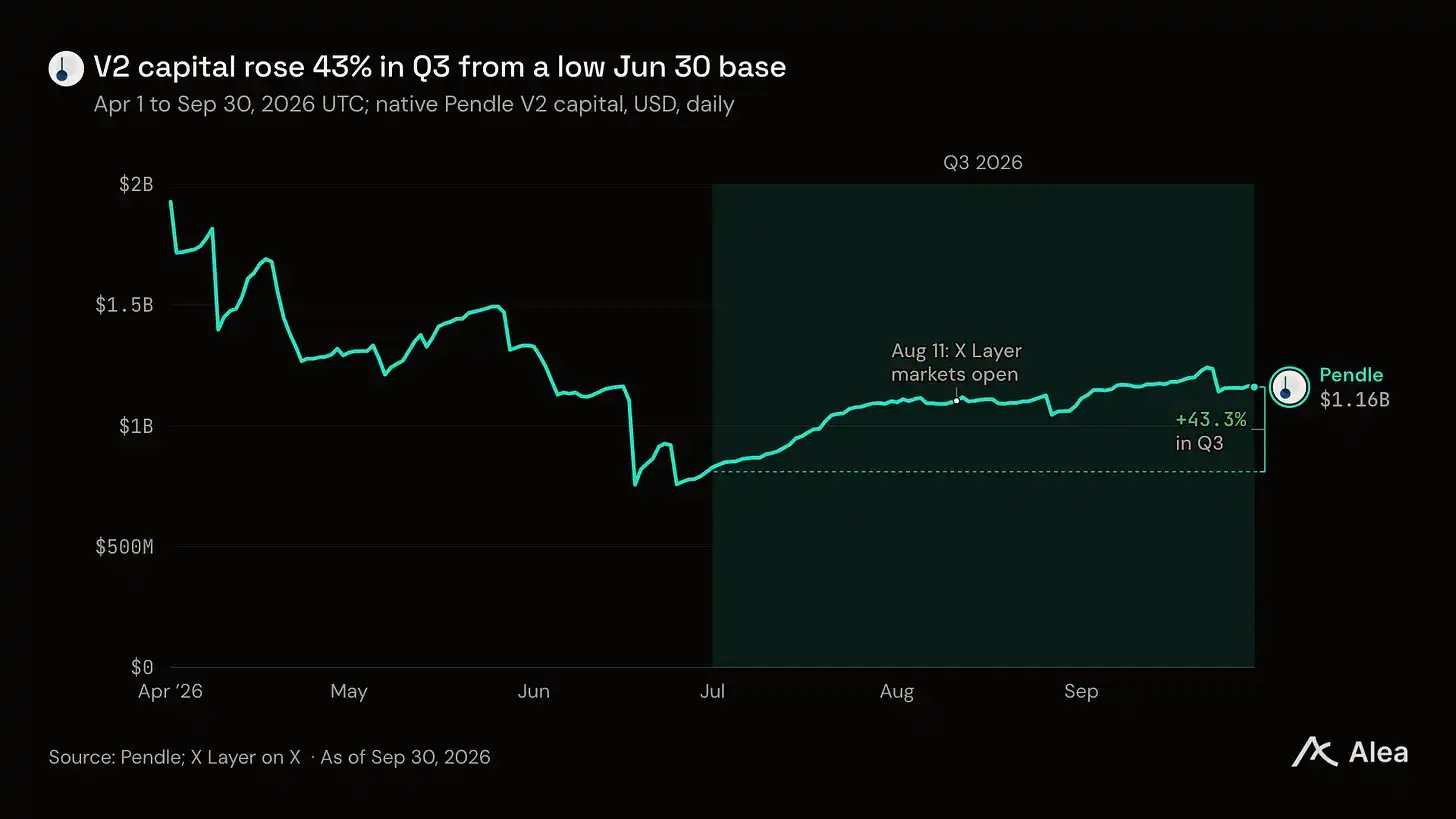
Pendle reduced its PENDLE incentive emissions by an estimated 58% in the third quarter of 2026, but Pendle V2 did not lose scale. According to a report by on-chain research firm Alea Research, the protocol’s core version rebounded 43% from its June 30 low and ended the quarter with $1.16 billion in total value locked, its first quarter of positive growth since September 2025.
The report frames the quarter as a break from a familiar DeFi pattern, where protocols often rely on high token subsidies to hold TVL in place. In Pendle’s case, the recovery came after emissions were cut by more than half.
RWA-backed dollars replaced Ethena as the main asset base
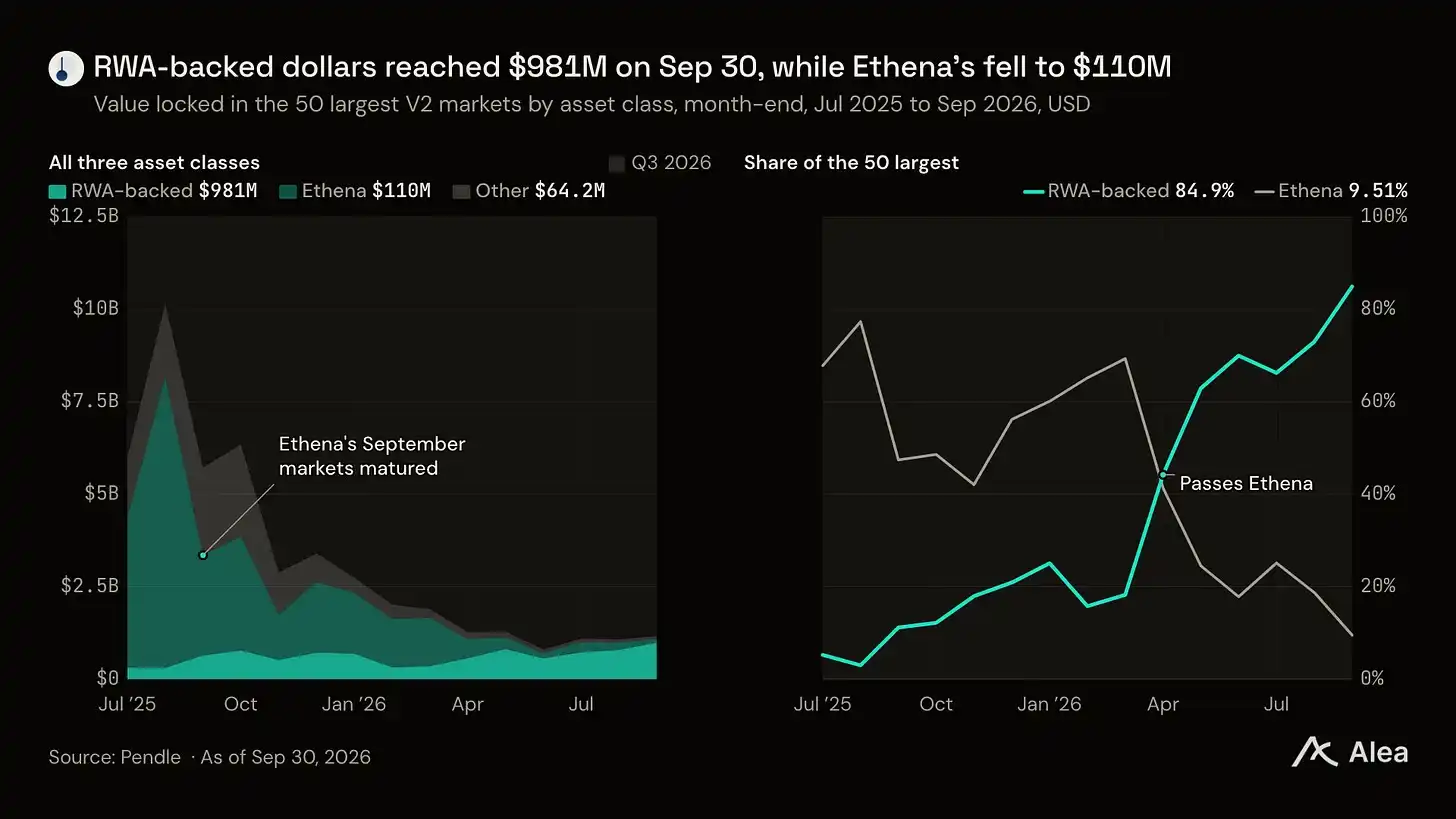
Alea Research said the biggest shift in Q3 was inside Pendle’s pool composition. Across Pendle’s top 50 core pools, tokenized dollars backed by real-world assets rose from 70% on June 30 to 85% by the end of September.
re.xyz, Agora’s AUSD, and Sky all posted more than 2x growth in pool size over the period. Ethena, once the dominant source of yield-bearing dollars on Pendle, moved the other way. Its share fell from 77% in August 2025 to less than 10%.
That rotation, rather than a return to aggressive protocol spending, is presented as one of the main reasons capital returned after incentives were cut.
PT collateral in lending markets doubled to $496 million
Pendle’s model splits yield into principal tokens, or PTs, and yield tokens, or YTs. PTs lock in fixed returns if held to maturity, while YTs capture floating yield from the underlying asset along with all airdrop points.
Even with competition from Exponent, Spectra, RateX, and TermMax, Pendle held an average 87% share of sector TVL in the third quarter, the report said. It also noted that by the end of September, the value of Pendle PT accepted as collateral in lending protocols was more than six times the total deposits across Exponent, the second-ranked competitor.
Use of PT as collateral expanded sharply during the quarter. The amount accepted by leading lending protocols doubled and passed $496 million. Pendle’s own PT Looping leverage tool completed testing and went fully live on Sept. 23.
The protocol had already launched a dedicated Morpho vault on Aug. 12 that lets users post PT as collateral to borrow USDC. By the end of September, that vault had reached $60.1 million. Alea Research added that PT Looping generated $50 million in looping volume while still in testing.
External issuers and new chains started paying for distribution
As Pendle cut back its own token inflation, outside sponsors stepped in. The report said external asset issuers and public chains provided more than $311,000 in partner rewards to Pendle liquidity providers during Q3.
Monad and OKX-backed X Layer, both newer additions to the Pendle ecosystem, together accounted for one-fifth of Pendle’s total network TVL by the end of the quarter. One example came from Agora’s AUSD market on Monad. In mid-July, Agora’s official weekly subsidy briefly climbed to $75,000, which the report said translated into roughly 3.4% annualized external subsidy on $114 million in pool assets.
Pendle’s funding-rate arbitrage protocol, Boros, also expanded during the quarter. On Aug. 26, Boros opened cross-exchange arbitrage on Gate. By the end of September, it had accumulated $22.8 million in open interest.
Buybacks rose to 3.2x emissions
Pendle takes a 5% cut of floating yield earned by YT holders and also collects standard trading fees. The protocol uses 80% of retained net fees to buy back PENDLE on the secondary market and distribute it to stakers.
On Aug. 17, Pendle lowered the official emissions cap for individual liquidity pools. It followed that on Sept. 18 with an "Emissions Rebuild" plan that tied token emissions more tightly to actual business contribution. Under that framework, a pool that generates $1 in weekly fees receives only $0.25 worth of PENDLE emissions, while pools funded directly by issuers can receive matching support.
Over the full third quarter, fees sent 1.36 million USDT to the buyback pool. The report said that equates to an annualized buyback yield of about 1.3% of circulating market capitalization. Based on a $6 million annualized buyback run rate implied by the fee window, active vePENDLE stakers could receive about 1.25% in annualized real yield.
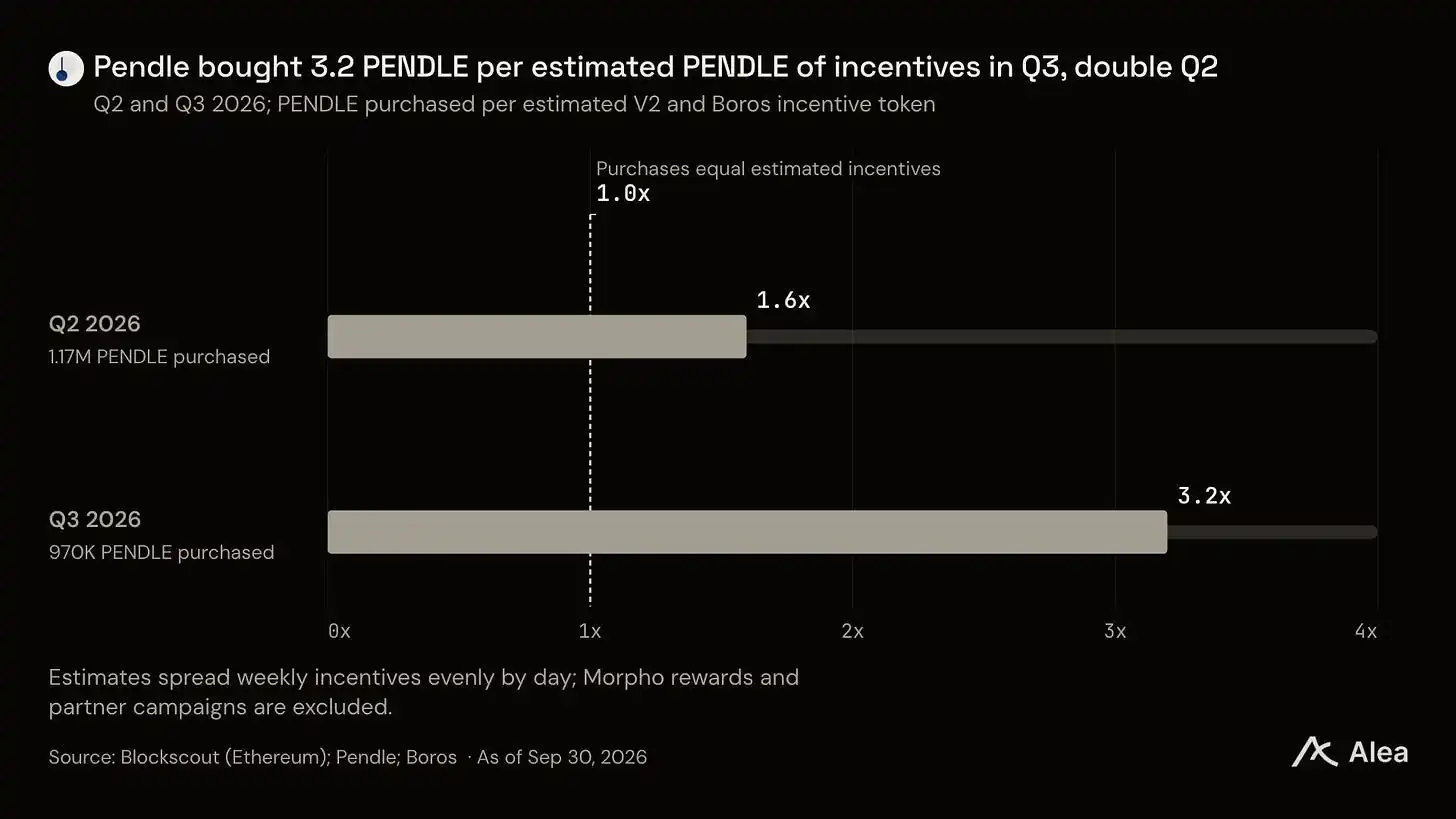
The ratio between buybacks and emissions widened sharply. In Q3, every 1 PENDLE emitted was matched by 3.2 PENDLE bought back and burned using protocol profit. In Q2, that multiple was 1.6x.
Looping arbitrage gained traction, but Q4 maturities are the next test
Alea Research described PT-backed leverage loops as one of the quarter’s most important structural changes because they create an arbitrage engine that does not depend on Pendle paying users to stay.
Using Sept. 30 data, the report gave one example. Buying PT-reUSD locked in an 11.7% fixed annualized yield to maturity. Borrowing USDC against that PT on Morpho cost 9.3%. At an 81% loan-to-value ratio, the loop could generate about 22% annualized net profit on the user’s own capital.
The report also pointed to a stress event on Aug. 25, when asset-price volatility triggered $36.1 million in collateral liquidations on Morpho. The lending system absorbed the move without any bad debt that penetrated the system, which Alea Research cited as evidence of PT collateral resilience.
That said, the next quarter carries a much larger maturity burden. Roughly 90% of capital currently parked in Pendle is set to reach physical maturity in the fourth quarter of 2026. The single largest market is re.xyz, with $236 million due on Dec. 10.
Year-end TVL will depend on rollover rates
Historical rollover data leaves little room for error. In Q3, only 34% of maturing capital stayed in follow-on pools, equal to $131 million out of $382 million. Using that retention rate as a baseline, the report said Pendle faces $702 million in maturing capital that will need to be rolled in Q4.
Pendle attracted $610 million in new inflows during the third quarter. If it can keep that pace in Q4, Alea Research estimates Pendle V2 would end the year at about $1.07 billion.
Holding the line at $1.16 billion by year-end would require a stronger outcome. The report said re.xyz would need to retain three-quarters of the capital maturing on Dec. 10, while other maturing markets would need to keep one-third of their funds.
Projects are already preparing for that rollover test. TokenLogic has proposed adding December PT-AUSD to Aave’s collateral rollover list. USD.ai, which faces $155 million in maturities on Oct. 15, saw its new February pool absorb 5% of rollover funds the next day.
Alea Research’s conclusion for Q3 is that Pendle shifted from a model built on protocol-funded subsidies to one supported by issuer spending and lending-driven arbitrage demand. The maturity wave in Q4 will show how durable that shift is.