
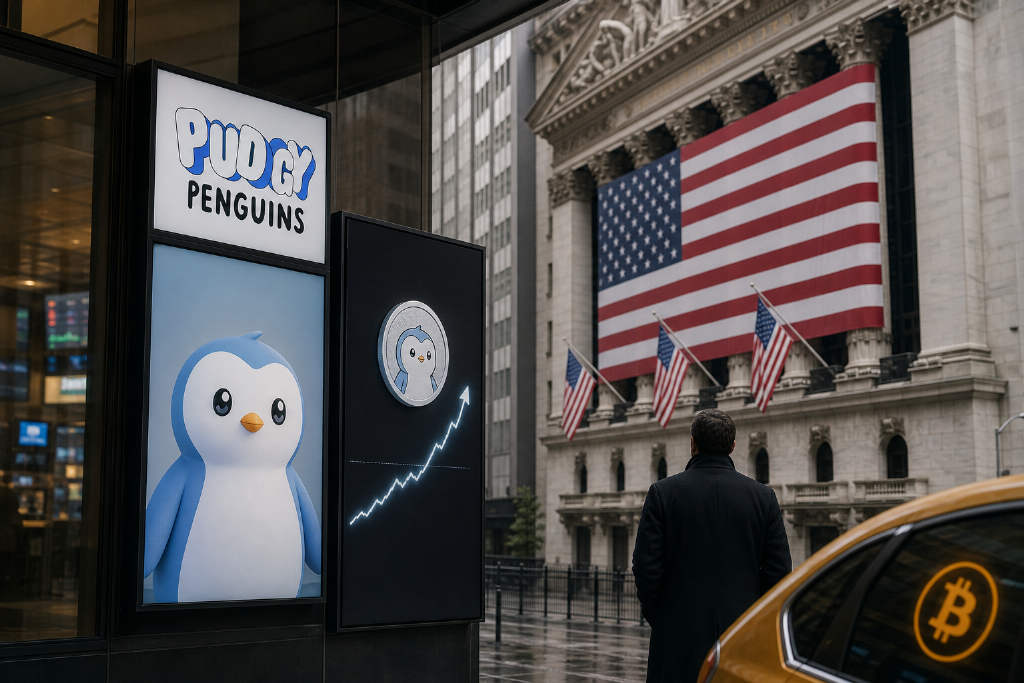
PENGU, the token tied to Pudgy Penguins, posted one of the stronger meme-coin moves of the past week. Bitget data showed the token at $0.00935 on Aug. 26 after it had earlier climbed above $0.01. From $0.0058 on Aug. 17, that amounts to a gain of nearly 70% and marks its highest level since May.
The rebound stands out because PENGU had previously fallen more than 80% from its all-time high of $0.044. The report asks why a meme coin born during the NFT downturn suddenly took off in August, and points first to a broader market recovery.
Beginning on Aug. 17, BTC rose to a high of $81,000, up more than 20%, while major altcoins including ETH also moved higher. Some meme coins benefited from returning liquidity. Even within that backdrop, the report says PENGU’s rapid move had an extra push behind it.
A vague X post became the key catalyst
On Aug. 23, Pudgy Penguins CEO Luca Netz posted a message on X with no text at all. The post showed a pair of eyes, a penguin, a building, and an arrow marked “SOON.”
Crypto traders quickly read the building as a hint that Pudgy Penguins could be headed for a public listing. That interpretation became the main narrative engine behind the latest rally.
According to the report, Decrypt had previously reported that in August 2025 Netz said publicly that the company planned to complete an IPO before 2027. He said, “If we can’t IPO in the next two years, I’ll be disappointed in myself, and you should hold me accountable.” At the same time, he said the company was on track to generate $50 million in revenue in 2025.
One year later, the report says, that earlier pledge was reignited by a cryptic post and pulled back into the center of the market story around PENGU.
Why the IPO narrative matters
For Pudgy Penguins, an IPO would mean more than a financing event. The report frames it as a shift from a Web3 company known for selling toys to an IP business that investors may compare with Disney or Pop Mart.
It would also give the crypto sector a chance to see an NFT-native IP asset judged through a traditional valuation framework. In that view, a listing by Pudgy Penguins could become the first such case for the NFT sector and a test of whether on-chain IP can produce real cash flow rather than rely on token issuance alone.
Retail expansion added fuel
The report points to physical retail growth as another support for the move. On Aug. 24, Pudgy Penguins announced its entry into the South Korean retail market and continued rolling out products including trading cards, comics and larger plush toys.
That marked another expansion of its retail footprint after North America. The article describes the offline business buildout as a continuing source of fuel for the current rally.
The token-equity gap remains unresolved
The report also lays out the problem facing PENGU holders. As the company moves closer to a possible IPO, the token can start to look more like a pre-listing marketing chip than a direct claim on the business.
If an IPO happens, the assets that carry most of the economic value, such as cash flow, brand value and IP licensing, would sit inside the equity entity and accrue to shareholders.
PENGU, by contrast, does not currently have an automatic buyback mechanism, a revenue-sharing arrangement, or an on-chain reward structure tied to merchandise sales. Even if the brand continues to sell more products, the report says it remains unanswered whether that value will flow back to the token.
Tokenized stock idea raises more questions
The article adds that Netz has previously proposed a tokenized stock structure, but that idea opens another set of issues. If equity and token exposure were linked, it could amount to an implicit acknowledgment that PENGU has characteristics of a security. That would raise questions about how the U.S. Securities and Exchange Commission would view the structure and how existing holders would be treated.
If no link is created, then equity remains equity and the token remains the token. In that case, the filing of a prospectus could end up marking the ceiling of the token narrative rather than the start of a new phase.
For now, the report argues that the next question is not simply whether PENGU can keep rising. It is whether the IPO story can turn into reported financial results quickly enough, whether that pace can outrun token unlock supply, and whether any value shown on those financial statements would ever be shared with token holders once an IPO actually arrives.