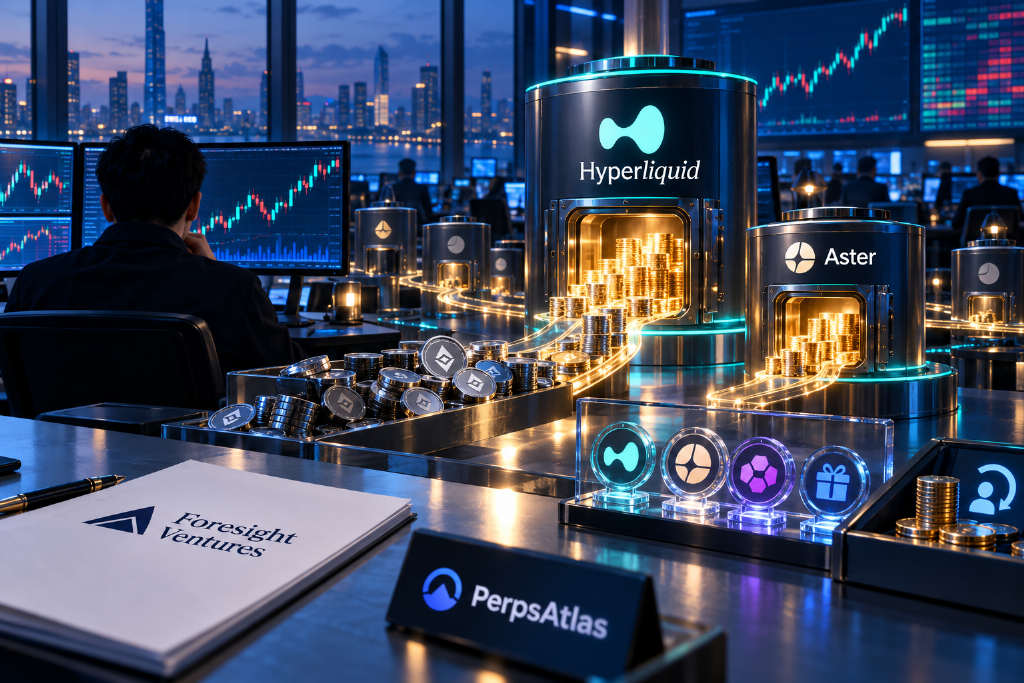
Perpetual decentralized exchanges pulled in roughly $125 million in user fees over the past 30 days across 38 platforms tracked by PerpsAtlas, based on an analysis published by Foresight Ventures. Hyperliquid by itself brought in $84.55 million, and the top five venues accounted for 85.6% of the total.

That kind of revenue is not small anymore. Foresight Ventures says the harder question now is who actually gets that value. Traders create the order flow. Traders pay the fees. Yet the economic setup on many platforms still centers on tokens and the people who hold them.
Fee revenue is supporting token value, but traders may not be the main beneficiaries
The piece argues this is not some theoretical argument. Under Aster’s official setup, 99% of daily platform fees are used to buy back ASTER under its 2026 tokenomics update. Those bought-back tokens go to veASTER stakers, and the same amount is burned from reserves. Hyperliquid, for its part, uses its Assistance Fund to convert part of fee revenue into HYPE and burn it.
In both examples, trading revenue is turning into a major prop for token economics. But token holders are not always the same people paying those fees. Far from it.
Foresight Ventures also points back to an earlier report, titled “Perp DEX incentive mechanisms need a second answer,” which said about 86% of HYPE-holding addresses had never taken part in perpetual futures trading. The firm says addresses are not a perfect stand-in for individual users, and token holders may add value in other ways. Still, it argues the number highlights a pattern that deserves attention: the people generating revenue in trading markets and the people capturing token value are not naturally the same crowd.
That disconnect, in its view, has become easier to spot now that Perp DEXs are past the cold-start stage. Tokenomics helped fix early bootstrapping issues. But once platforms started producing real revenue, the incentive picture changed. Traders take on transaction costs and generate the fees, while platforms use that income to buy back tokens and reward token holders first, not always the users who produced the revenue in the first place.
Aster is framed as a clean example. On top of the fee buyback structure, the platform added an ASTER holding threshold to its VIP Program in November 2025, linking what used to be volume-based fee tiers to token holdings. Foresight Ventures says the business logic is obvious: holding requirements can create extra buy pressure and boost token demand. But for professional traders, the priority is clear too. Predictable trading costs. Not taking on token price risk just to cut fees.
The article says the problem gets deeper after a token generation event. Early participants may get large token allocations through an airdrop at very low cost and keep enjoying holder perks. Later traders, even if they drive the same or higher volume, may need to buy tokens on the secondary market to reach the same tier. So you end up with two groups contributing trading activity to the same platform while facing a wide gap in access to benefits.
Foresight Ventures is not arguing the model is useless. Its point is tighter than that. The main question this structure keeps answering is how to strengthen token demand, not how to improve the actual economics for traders. Or, as the article puts it, tokenomics can support token value, but they cannot replace trader economics.
Points campaigns keep growing, while users absorb the costs upfront
The analysis then shifts to the points war now playing out across the sector. Arcus Season 1 hands out 250,000 points every week. Variational Omni distributes 150,000 points weekly. Points are still an efficient way to pull in early users, the article says, but the trade-off for traders can be badly lopsided.
Platforms get volume and fee income now. Users, meanwhile, take the slippage, funding costs and capital lock-up now, while the reward is valued only at some unknown point later. Costs are real. Immediate too. The timing of a TGE, the final token valuation and the conversion rate from points to tokens are usually out of the user’s hands.
Foresight Ventures points to the Points Farming ROI model from Decentralised News. Under that model’s assumptions, a delta-neutral farmer generating $2 million in cumulative trading volume over two months would face an all-in cost of about $670 and would need the project to reach roughly a $555 million fully diluted valuation just to break even. The firm says the model is only a simulation, but it captures a real imbalance: users pay known costs, while the odds of getting them back depend on a token valuation they cannot set. And even that math assumes the project actually issues a token.
StandX is offered as a more direct example. The platform launched a mainnet points campaign in December 2025, distributing points through trading, market making and holding DUSD. In May 2026, it reduced issuance rates for several point categories by 50%. Then, on Oct. 15, 2026, StandX formally scrapped its TGE and started winding down its perpetual futures business. The article points out that the platform had once hit peak TVL of more than $200 million, yet still decided not to issue a platform token.
That, Foresight Ventures says, is the toughest asymmetry in points farming. A platform can cash in on trading activity and fee revenue early, while users may carry the full cost and still never get the TGE they were waiting for.
At the same time, fixed points quotas push the competition toward capital scale and strategy efficiency. Platforms keep tweaking points weightings. Farmers keep trying to figure out how to squeeze out more points at lower cost. What started as a reward for trading slowly turns into another competition built around score optimization.
Once traders are spending more and more time working out how to maximize points, the incentive system itself starts looking like a new kind of trading competition, the article says.
Foresight Ventures also says points can pump up platform volume fast, but they do not prove users genuinely value the product. Points can buy short-term volume. They cannot buy lasting trading demand. When the reward expectation fades, the things that keep traders on a platform are still liquidity, execution quality, capital efficiency and the trading experience.
A Trader-first case: product design before token design
The third section moves from incentives to product design. If fee revenue is serving token economics first, and trading incentives rely more and more on expectations of future rewards, then the more basic issue is simple: should a Perp DEX be built around tokens, or around what traders actually need?
Foresight Ventures says that when it invested in and incubated PopDEX, the standout point was not some louder points campaign. It was the team’s choice to take a different path from day one: fix real trading problems around cost, liquidity, execution and capital efficiency first, then think about how incentives can help growth.
Before its Open Beta, PopDEX had TVL nearing $70 million, according to the article. Based on platform-disclosed Closed Beta data, cumulative trading volume reached $4 billion, and the number of markets grew from 12 to 66. Foresight Ventures says that means PopDEX is entering the public market with at least some liquidity, volume and asset coverage already there, instead of depending entirely on reward expectations to bootstrap from zero.
On the technical front, PopDEX is built as an on-chain central limit order book, or CLOB, on Morph Tachyon, a high-performance trading chain. The article contrasts that with Perp DEXs using off-chain matching and on-chain settlement, saying PopDEX picked a more decentralized architecture in an effort to satisfy professional traders’ demands for both performance and transparency.
According to Morph’s published specifications, Tachyon targets block times of about 100 milliseconds, throughput of up to 200,000 TPS and instant finality. On top of that, PopDEX offers sub-second execution, gasless trading, a unified account and multi-asset markets covering crypto, equities and commodities. It also plans to open mobile access during the Open Beta phase.
Still, the article says architecture is just a means to an end. For actual traders, execution results are what count. How much slippage does a large order take? Can positions be opened or closed in time during volatile moves? Can capital be used efficiently across different positions and strategies? Those are the questions that hit PnL directly. They matter more than flashy TPS numbers.
That is the heart of what PopDEX calls Trader-first. Foresight Ventures says technical spending has to show up in more competitive all-in trading costs, steadier execution and more efficient capital use. On-chain trading has mostly moved past the stage of asking whether it works at all. The next phase of competition is about who can deliver those things on every single order.
The article adds one caveat. TVL and technical specs do not automatically mean the best execution experience. PopDEX still has to be tested by larger-scale real trading in Open Beta. Even so, Foresight Ventures says the growth logic is already plain: instead of asking traders to swallow today’s costs in exchange for a possible future airdrop, make the product itself the reason they keep trading. If a product can attract users on its own merits, incentives no longer have to cover up product weaknesses and can instead reward real trading contribution.
From future expectations to a live reward pool: MegaPop
The final section turns to MegaPop, which PopDEX introduced during Open Beta. Foresight Ventures says Trader-first shapes not just how the platform is built, but also how it shares the value created by trading.
Unlike traditional points systems, MegaPop does not ask users to keep decoding a score model that gets more complex over time just to work out which actions matter most. Instead, it sends part of the distributable value generated by trading fees into a weekly rolling reward pool, giving eligible real trades a shot at prize draws.
The article breaks down the contrast in very simple terms:
- Traditional points: Trade → Earn Points → Accumulate → Wait → Future Distribution
- MegaPop: Trade → Earn Pop Tickets → Weekly Pop Draw → Reward
That is where the phrase “Trade. Pop. Repeat.” comes from, the article says. Users earn Pop Tickets through trading, get a chance to win prizes each week, and then move into the next cycle as new trading periods start. Instead of waiting on a distant TGE, every real trade comes with an immediate and recurring reward path.
The economic foundation for that system is PopDEX’s 100% Value Return framework. Under the current design, all distributable value formed by trading fees is fed into that value-return structure. Up to 60% goes to referral, affiliate and ecosystem growth incentives, while 40% acts as the base source for the weekly prize pool. The article stresses that this is not a full cash rebate of every original fee. It is a redesign of value distribution around actual trading contribution.
For Foresight Ventures, the biggest difference between the two systems is not just when rewards show up, but what users are competing for in the first place. In traditional points systems, rewards are usually tied to how many points a user stacks up, giving large-capital and high-volume users a built-in advantage. MegaPop brings in nonlinear outcomes through a weekly Pop Draw. Trading size decides how many tickets a user gets, but it does not directly decide the final prize. Even traders who are not high-frequency or large-size participants can still have a shot at higher-tier rewards. More tickets mean more chances to win. Not guaranteed returns.
In that framing, points systems are a competition over who can collect more points. The suspense in MegaPop is about who gets the next prize.
As Open Beta begins, PopDEX is opening its on-chain order book, multi-asset markets and mobile experience to a wider group of traders. MegaPop ties that product rollout to a continuously rolling reward pool built on real trading activity. Foresight Ventures says this creates a growth loop worth testing: a better trading experience attracts real order flow, trading fees provide the economic base for the prize pool, and the rolling prizes strengthen participation incentives. Unlike points systems that rely on future token valuations, the staying power of this model depends more on whether the platform itself can produce real trading revenue.
The article stops short of making a final call. Whether MegaPop can drive lasting retention and trading growth still has to be tested by the market. But the choice it represents is already plain in Foresight Ventures’ account: a good trading product should keep traders on its own, and the value created by real trading should give traders a chance to share in it.
The piece ends with a blunt line: most DEXs are built for tokens. PopDEX is built for traders.
Disclaimer: Markets involve risk, and investing requires caution. This article does not constitute investment advice. Users should consider whether any opinion, view or conclusion in the article fits their own circumstances. Any investment decision made on that basis is at the user’s own risk.