
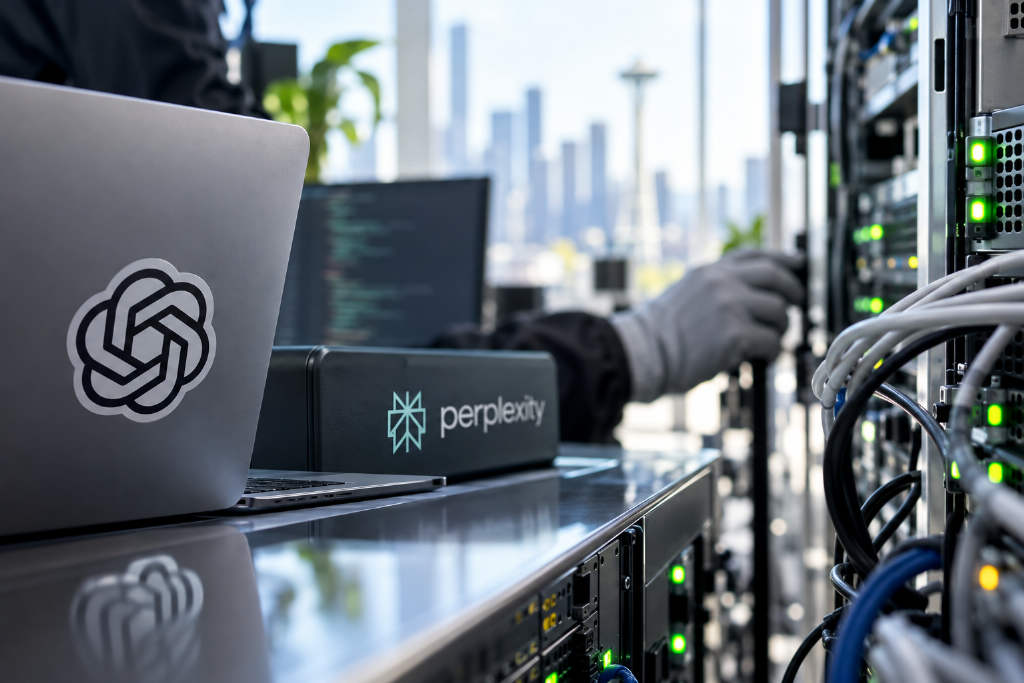
OpenAI published a Perplexity customer case study on Sept. 14, centered on Perplexity co-founder and Chief Strategy Officer Johnny Ho. In the case study, Ho said Perplexity now uses GPT-6 Astra to draft communications, edit software, and monitor production systems, and that the team checks its work much less frequently than it did with earlier model generations.
Better coding models have improved the search engine
Perplexity is an AI-powered answer engine, and its ability to process large amounts of information is central to the product. Ho said he has observed that whenever a model gets better at writing code, Perplexity’s search engine also improves. The reason, he said, is that the model can write better programs to search the web and internal information sources, then summarize the results more tightly.
Ho said the harder part is not that information-processing step itself, but applying those capabilities to systems used in the real world. He said GPT-6 Astra has made that job easier: 「We can have the model write communications, edit real-world systems, and monitor our production software. That wasn’t possible with previous generations of models.」
Using model-built test programs to stand in for external services
Ho said one of the most useful applications of AI for him is code testing. When there is no time to test manually, he asks GPT-6 Astra to build a small test program around an application.
That program is used to generate realistic responses that imitate what another service would return, such as a language model API or a connector. Once the model stands in for those services, the team can inspect how the application responds and test the entire workflow from start to finish.
Ho summed it up this way: 「We’re actually able to hand over complete end-to-end systems to it, and we check it much less often than previous generations of models.」
How OpenAI categorized the case study
OpenAI placed the case study under startups, North America, and technology, with API listed as the product used.
The report also noted that Perplexity does not rely on a single model provider. Chain News reported in July that the company had fine-tuned its own version based on the Chinese open-source model GLM. The source article also pointed readers to a Perplexity Computer guide for details on its paid plans and features.