


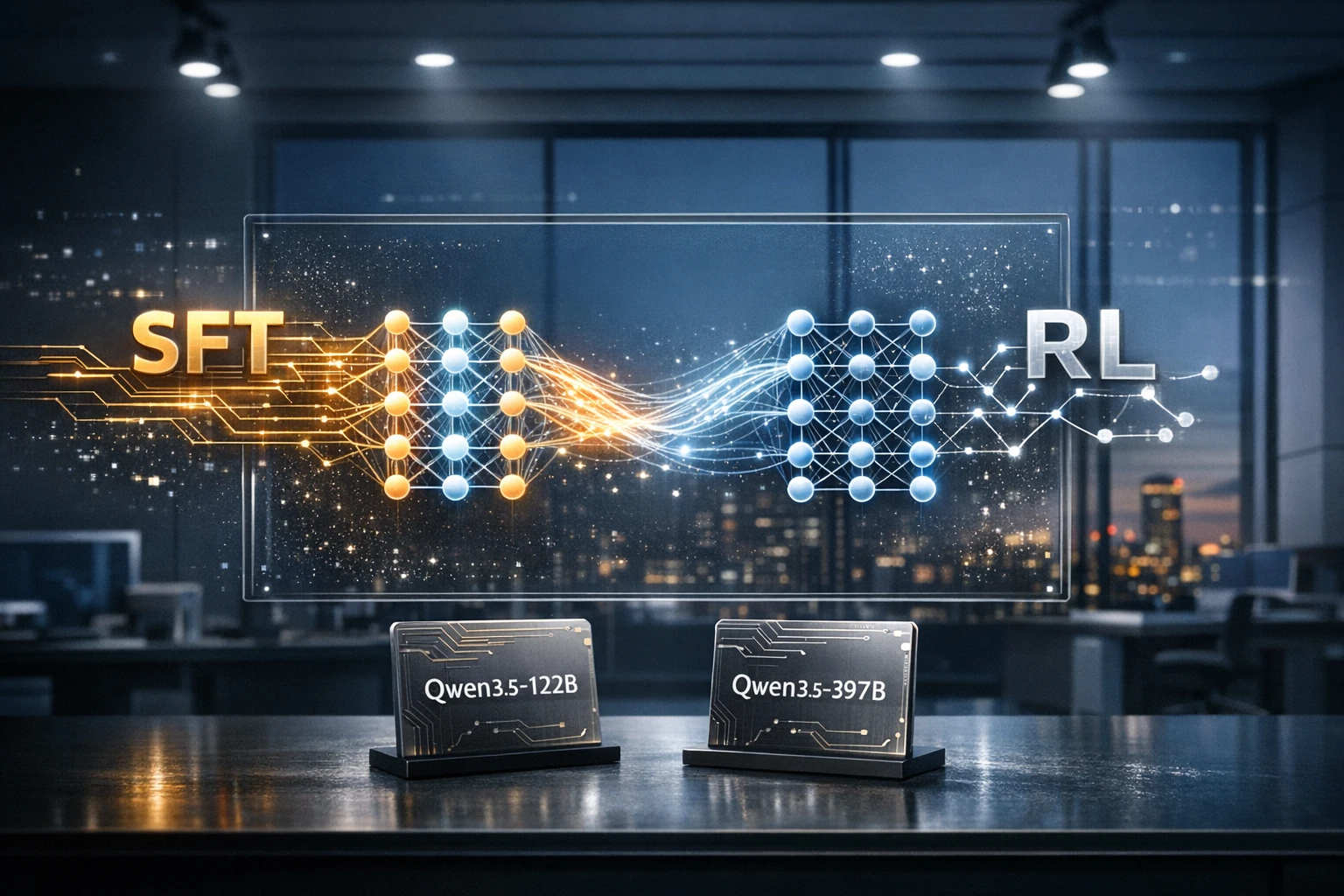
Perplexity has published the post-training pipeline for its web search agent, built on the open-source Qwen3.5-122B-A10B and Qwen3.5-397B-A17B models. According to the company’s report, the resulting Qwen3.5-397B-SFT-RL model achieved higher search accuracy on the FRAMES multi-hop benchmark while keeping inference cost at 2.0 cents per query, compared with 8.5 cents for GPT-5.4 and 15.3 cents for Claude Sonnet 4.6.
Two-stage training starts with reliability before search behavior
The training stack is split into two parts. The first is supervised fine-tuning, or SFT. At this stage, the goal is not to maximize reasoning depth but to stabilize model behavior: following instructions, keeping language consistent, and producing answers in the right format. Perplexity frames this as the behavioral foundation that has to be fixed before optimizing for search quality.
The second stage uses reinforcement learning with GRPO. Instead of relying on a separately trained judge model, GRPO compares outputs within the same batch and extracts learning signals from those comparisons. That reduces training overhead and makes the setup easier to scale.
The RL data comes from two tracks. One is a synthetic multi-hop reasoning dataset created by Perplexity, where the model has to retrieve one fact, then use that result to search for the next, usually across 2 to 4 steps. The other is rubric-based dialogue data that carries over SFT constraints such as formatting and language consistency, so those habits are not lost during reward optimization.
Rewards are gated by correctness, then adjusted for efficiency
A central issue in search training is defining what “good” behavior actually is. A model can produce answers that look structured and convincing while still being wrong. Perplexity’s answer is a gated aggregation scheme: preference scores are counted only if the final answer is correct. If the model misses the answer, polished wording does not help.
The rule is simple. Accuracy comes first.
Efficiency is measured in relative terms rather than by a fixed cap. Perplexity compares the number of tool calls used by a correct output with the average number of calls used by other correct outputs in the same batch. If peers solved the task with 3 searches and one model needed 7, that output still loses efficiency points even if it reached the right answer.
FRAMES results show gains in both score and cost
On FRAMES, Perplexity said Qwen3.5-397B-SFT-RL reached 57.3% accuracy with only one tool call, beating GPT-5.4 and Claude Sonnet 4.6 by about 5 percentage points. When the tool-call limit was raised to four, the reported accuracies were 73.9% for Qwen3.5-397B-SFT-RL, 67.8% for GPT-5.4, and 62.4% for Claude Sonnet 4.6.
The pricing figures stand out just as much. Based on public API pricing and excluding cache optimization, Perplexity put per-query cost at 2.0 cents, versus 8.5 cents for GPT-5.4 and 15.3 cents for Claude Sonnet 4.6. That puts the reported cost of the Perplexity setup at less than a quarter of GPT-5.4 for the same class of task.
The broader message from the report is narrow but clear: Perplexity chose not to build its search agent on GPT or Claude, and instead used open-source Qwen3.5 as the base. With a tightly designed post-training process, it claims better results on web search while preserving a much lower inference bill.