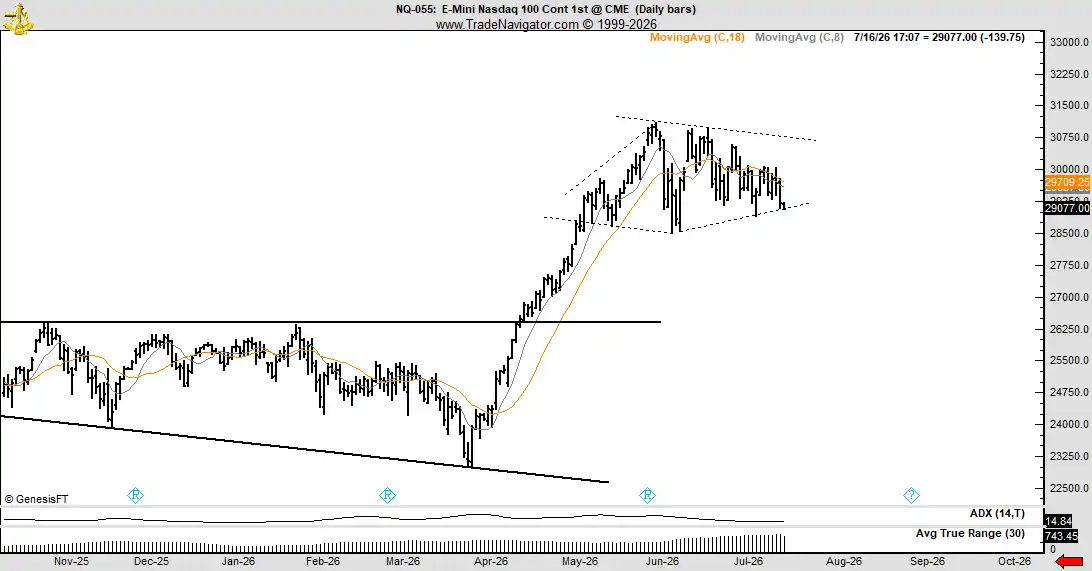
Veteran trader and chart analyst Peter Brandt said the daily chart of Nasdaq 100 E-mini futures, or NQ, may be forming a diamond pattern that could mark a market top. In a recent interview, Brandt also said Bitcoin could first rebound by $10,000 before dropping to $40,000, where it may form a bottom in early October 2026. He tied that view to Bitcoin’s historical cycle patterns and warned that the asset could be setting up for a false breakout while trading around $60,000. Even with that near-term bearish outlook, Brandt said he remains constructive on Bitcoin over the longer run. He added that the cryptocurrency could reach $300,000 to $500,000 by 2029.
BlockBeats reported on July 17 that trader and chart analyst Peter Brandt said the daily chart of Nasdaq 100 E-mini futures (NQ) may be forming a “diamond” pattern, which he said could signal that the market has already topped.
In a recent interview, Brandt also said Bitcoin could first rebound by $10,000 and then fall to $40,000, with a bottom forming in early October 2026.
Brandt said the warning was based on Bitcoin’s historical cycle patterns. He added that Bitcoin could be headed for a false breakout. With Bitcoin trading around $60,000, he said the asset faces near-term downside risk.
At the same time, Brandt said he remains bullish on Bitcoin over the long term and expects the price could reach $300,000 to $500,000 by 2029.
This article was originally published by Bit.Fan. For more cryptocurrency news and market insights, visit www.bit.fan. Disclaimer:
The market information, project data, and third-party content displayed on this platform are for industry information sharing only and do not constitute any form of investment advice or return commitment.
Cryptocurrency trading carries high risks. Users should fully assess their risk tolerance and make independent decisions. All profits, losses, and legal responsibilities are borne by the users themselves.