


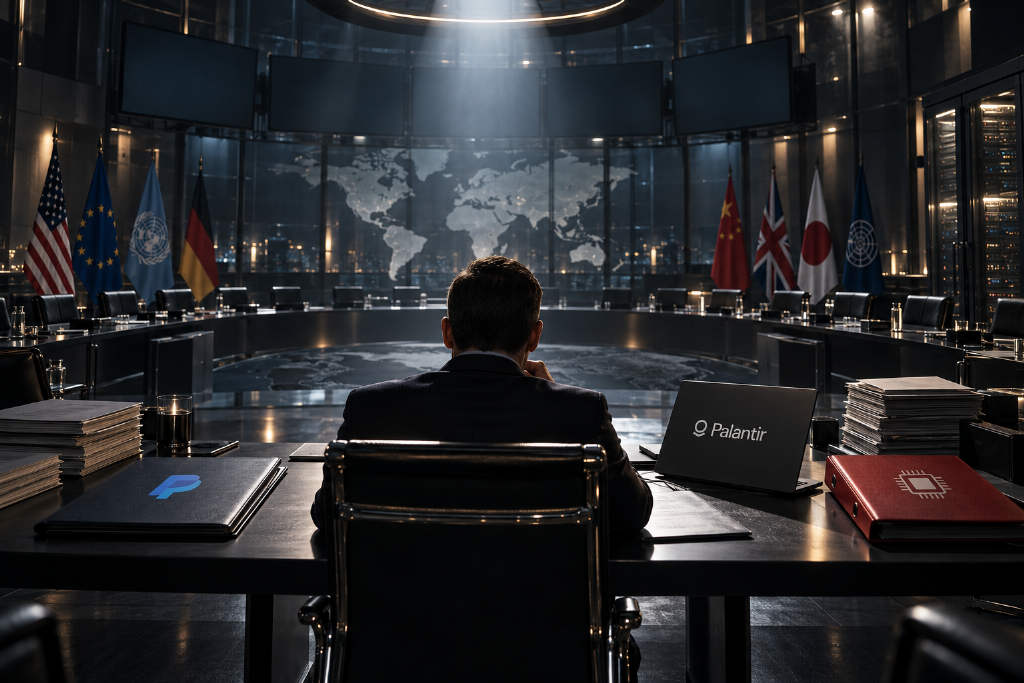
Peter Thiel — PayPal and Palantir co-founder, Founders Fund founder — spent nearly an hour on Kaleidoscope’s podcast The Builders spelling out how he sees AI risk, regulation, Effective Altruism, and the ceiling on machine intelligence. In TechFlowPost’s assembled version of the talk, his core point was sharp and simple: the bigger threat is not an AI apocalypse in the standard sci-fi version, but the way apocalypse talk can be used to sell a unified, long-lasting system of global control.
Walter hosted the episode, which aired on Oct. 22, 2026. TechFlowPost published notes and translated excerpts on Oct. 27, and framed the discussion with one of Thiel’s closing thoughts: AI may figure out the optimal answer to everything, but if humanity disappears, nobody will remain to take in the beauty of a sunset.
The backlash against AI, in Thiel’s view, comes from layered social anxiety
Walter began with the obvious shift in mood. Over recent months, public resistance to artificial intelligence has jumped — criticism over energy use, copyright fights, fear of job loss, even fear of human extinction. Thiel said yes, the backlash is real. But pinning down one single cause, he argued, is hard. He sees several different anxieties stacking up at once.
There is still deep uncertainty, he said, over who gains from AI and who gets shoved aside by it. He does expect AI to bring a major productivity boost at the macroeconomic level. But that kind of growth, in his telling, is also highly disruptive. And when people feel the future slipping out of their hands, fear often hardens into direct hostility toward the technology itself.
Still, Thiel said the gravest risk is not some Terminator-style physical wipeout of humanity. He reached for the theological and philosophical idea of the Antichrist to describe what he thinks is the more believable modern route to domination: not ruling the world by causing catastrophe outright, but by magnifying fear of catastrophe until the public willingly gives up power.
As he said in the interview, “People talk every day about AI destroying the world in a final judgment scenario, but they completely ignore the risk of the Antichrist. In modern society, the tyrant is no longer a madman who conquers the world by building a bomb, but a totalitarian ruler who uses your fear of catastrophe and, in the name of saving humanity, builds a unified global system of control.” His point: modern tyranny is more likely to rise through the management of fear than through brute force by itself.
Then he pushed it further with another line from the conversation: “If humanity’s choice is reduced to ‘doomsday or a single global totalitarian government,’ we must never rush thoughtlessly into the second option. Both are deadly. We need to be alert to doomsday, but we need even more desperately to resist an all-encompassing global totalitarian surveillance state.” In his framing, things get dangerous fast when the debate is cut down to a fake choice between catastrophe and centralized world rule.
His criticism of Effective Altruism and AI safety politics
Walter then shifted to the ideological current that people such as David Sacks have publicly tied to parts of the anti-AI movement: Effective Altruism, or EA. For a lot of the public, that world begins and ends with Sam Bankman-Fried, or SBF. Thiel said it goes deeper than that in AI.
He traced the movement’s roots to the East Bay in the early 2000s, naming places like Berkeley and Oakland. In his telling, those were not the places where great technology giants were built. They were where a certain moral and political style formed. He described Effective Altruism as a movement with a heavy savior complex: people who do not build products themselves, yet cast themselves as judges of humanity’s future.
In AI, he said, that impulse shows up most clearly in the language of existential risk. Thiel’s view is that the movement keeps presenting AI as an imminent threat to all humanity, then presents itself as the only believable rescuer. And that, he said, turns into a way to pressure governments for sweeping regulatory and review powers. To him, this is less about science than about political rent-seeking and moral coercion carried out under the banner of human survival.
TechFlowPost summed up this section in much the same way, saying that from SBF to more hardline AI safety advocates, the pattern is to talk in the language of concern for humanity while using doomsday fear to gather political influence and regulatory leverage.
The "Antichrist" framework and the danger of a single global regulator
Walter brought up a Thiel formulation that had already gotten wide attention in the United States: the Antichrist would not take world power by directly causing an AI apocalypse, but by warning about apocalypse again and again until people surrendered power in panic.
Thiel expanded on that. In older religious or medieval imagery, he said, the Antichrist is often pictured as one tyrant ruling the world at the end of history. Modern political philosophy looks different. In the 17th or 18th century, people might have imagined a mad ruler conquering the world with a superweapon. In late modernity, Thiel argued, fear of technological disaster is more likely than technology itself to produce mass submission.
He pointed to radical environmentalism as one example of politics organized around imminent catastrophe. In AI, he cited Eliezer Yudkowsky and books with titles that, as he described them, basically say, "if someone builds this, everyone dies." Thiel said those works often spend huge effort laying out technical risk scenarios, then become strikingly uniform and vague when they reach the policy answer: create a unified global regulatory authority.
Walter asked if that proposed global authority is really what worries Thiel most. Thiel said yes. Once politics gets reduced to "One World or None," he said, people usually pick the first option under fear. But if the choice is restated as "Antichrist vs. Armageddon," then it becomes obvious that both outcomes can be fatal.
His case was plain enough. A global surveillance-and-control structure built in the name of preventing technological risk could choke off freedom, diversity of thought, and civilizational vitality just as fully as physical destruction. So yes, he said, society should pay attention to existential technological risk. But no, that concern cannot be allowed to become a pretext for permanent centralized rule.
Why he rejects calls to pause AI development
Thiel was just as blunt on whether AI research should be paused. Faced with calls from parts of Silicon Valley to sign open letters, slow development, or draw hard red lines around large models, he said he is not merely against the pause camp — he wants to "push the accelerator all the way down."
His line in the interview was explicit: “I absolutely do not belong to the camp calling to hit the pause button on AI. In the present era, given global competition and economic stagnation, we have to push the AI accelerator to the floor.”
He gave two reasons. First, geopolitics. Technological progress, he said, is never a sealed domestic exercise. If Silicon Valley slows itself out of moral anxiety, non-democratic rivals will not stop too. And if that happens, the West loses the initiative in setting future technology and safety standards.
Second, the economy. Thiel argued that the deeper problem in the world right now is not technology moving too fast, but much of the physical economy outside computers and the internet being stuck for a long time. He pointed to housing, energy, and healthcare costs as examples of sectors burdened by weak productivity growth. In his view, AI is one of the very few general-purpose infrastructures in recent decades that could raise total factor productivity.
TechFlowPost’s summary made the same point: AI may bring short-term pain and job restructuring, but it can free people from repetitive, mechanical work and push them toward more creative and relational kinds of activity. Thiel said something close to that in the interview itself — rough in the short run, expansive in the long run.
Competence, evil, and the problem of mediocrity
Later, Walter moved to one of Thiel’s more provocative themes: his suggestion that, in some situations, he would rather deal with an aggressive "evil" actor than with a mediocre, incapable one. Thiel said he was not defending wrongdoing. Not that. He said he was trying to clear up a basic distinction: what is the real opposite of good? Moral evil, or plain incompetence?
He illustrated it with a contrast. A powerful but fuel-hungry Ferrari might look morally suspect to extreme environmentalists. An old Lada that dies after a short drive is not morally evil, he said. It is just bad. Just incompetent. In ordinary life, Thiel argued, what people usually suffer from is not theatrical wickedness but mass mediocrity, inefficiency, and bureaucratic deadness.
He put it this way: “What exactly is the opposite of evil? Moral goodness, or mediocrity and incompetence in terms of ability? A Lada that stalls and dies after two kilometers is not moral evil. It is simply incompetence and junk. In today’s world, which is full of mediocre bureaucrats, a doer who gets things done, even if denounced as evil, is far better than a thousand sanctimonious bureaucrats who accomplish nothing.”
To build out the point, Thiel compared Christopher Marlowe’s Faustus with Goethe’s Faust. In his reading, Marlowe’s figure is a second-rate fraud who does little and ends in damnation. Goethe’s Faust, by contrast, enters a dangerous bargain and plainly has moral defects, yet uses that force to reshape the world and achieve large things, eventually receiving salvation. Thiel said he prefers Goethe’s lens over what he sees as Marlowe’s hypocrisy.
He then mapped that contrast onto technology founders. Bill Gates, he said, is linked with virtue signaling, while Elon Musk often engages in what Thiel called vice signaling, sometimes in a deliberately unruly way. But in a world soaked in public-relations language, Thiel argued, a builder who openly shows flaws and ambition may be more honest than a polished moral performer.
His line on that point was: “Bill Gates is keen on sending virtue signals, while Elon Musk often sends vice signals. But in our intensely hypocritical real world, openly showing one’s flaws and vices is, in fact, far more honest than pretending to be a saint.”
René Girard, mimetic desire, and why outlier founders matter
Walter also asked about René Girard, the philosopher who influenced Thiel during his Stanford years, and Girard’s theory of mimetic desire. Thiel said the theory still matters a great deal in the AI era. Maybe more than ever.
He said Girard liked to cite Aristotle’s idea that humans differ from other animals partly because they are better imitators. Thiel connected that to Darwin: humans share ancestry with apes, but humans are even more capable of imitation, and that ability sits near the center of language learning and socialization.
The trouble, he said, is that imitation also fuels collective madness and homogenized competition. Most people do not really know what they want; they copy the desires of neighbors, colleagues, and peers. Once everyone wants the same crown or the same trend, the result is destructive internal competition and zero-sum struggle. Silicon Valley is no exception. In Thiel’s telling, many founders just follow the crowd and produce a huge number of similar, low-value projects.
Walter asked whether that helps explain why figures such as Musk and Steve Jobs are so rare. Thiel said yes. What makes them unusual, he argued, is a kind of immunity to the gravitational pull of imitation. Musk’s push for reusable rockets and Mars colonization looked absurd under standard business logic, yet he kept going with a near-obsessive first-principles vision for decades.
TechFlowPost summarized this section by saying Musk and Jobs changed the world because they escaped the pull of consensus and had a rare first-principles mindset that was not homogenized. Thiel’s own line in the interview was: “Human beings are, by nature, intensely imitative creatures. The masses always get trapped in endless conformity and homogenized competition, while great builders must possess an intensely obsessive, even seemingly incomprehensible, independent vision.”
What AI cannot replace: consciousness and human relationships
In the final stretch, Walter asked the biggest question of the lot: if AI is nearing or even exceeding human cognitive limits across many fields, what is still uniquely human? If much intellectual labor gets automated, what gives human existence meaning?
Thiel started with language. He said Noam Chomsky of MIT had long treated complex natural-language generation as a uniquely human crown of intelligence, but that belief took a hit with the rise of large language models two years ago. Even so, Thiel said he still holds a Cartesian view: there is a hard problem of consciousness that machines do not cross.
In his view, AI is still an extraordinarily sophisticated statistical and computational architecture. It does not have subjective consciousness, and never truly will. What sets humans apart is not just task performance, but the capacity to experience the world through subjective awareness.
He used the image of a sunset to make the point: “AI may be able to calculate the optimal answer to everything in the world, but if human beings no longer exist on Earth, no one will be left to appreciate the beauty of the sunset. To a computer, a sunset is only a string of hexadecimal color codes. Only the human mind can give this universe real meaning.”
He expanded on that in the interview itself. A person standing by the sea at sunset can feel awe, scale, poetry. A supercomputer cannot. It only processes wavelengths, pixel values, brightness, and hexadecimal color data. If humanity vanished, he said, then even a planet full of superintelligent systems would not preserve the meaning of that beauty, because no conscious subject would remain to experience it.
Thiel added a second boundary: the relational side of human life. Drawing again on Girard, he said human beings are defined not only by solitary thought but by family, friendship, loyalty, and the emotional bonds that hold a civilization together. In that sense, AI should serve as leverage. It should free people from heavy physical and mental drudgery so they have more time to watch sunsets and deepen real human ties.
Episode details and source material
The guest on the episode was Peter Thiel, and the host was Walter. TechFlowPost identified the original source as the The Builders podcast and linked to the YouTube episode here: https://www.youtube.com/watch?v=H9Bdv3t5VtQ .
Taken as a whole, the interview was not saying AI carries no risk. Far from it. It was saying risk narratives should not automatically end in a single global regulatory answer. Thiel extended that criticism to Effective Altruism, to calls for an AI pause, to bureaucratic mediocrity, and to the social pressure of imitation. And when he got to what remains irreducibly human in an AI age, his answer rested on two things: consciousness and relationship.
