
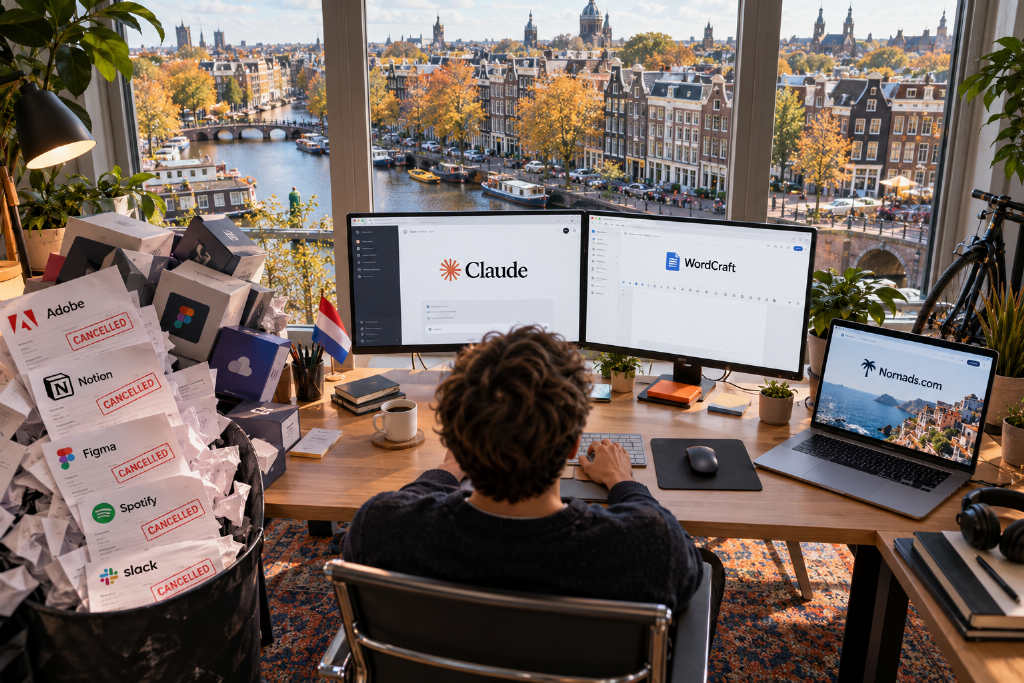
Independent developer Pieter Levels said on Oct. 11 that he has canceled almost all of the software subscriptions he used for work and has also started dropping personal subscriptions. His approach is blunt: if he needs a tool, he asks AI to build it; if there is a suitable open-source project, he has Claude reshape it into something that fits his workflow.
He summed up the idea in a short line: "Software is dead."
Why his decision is getting attention
Levels is one of the best-known figures in the indie developer world. In 2014, he launched a challenge to ship 12 startup projects in 12 months. One public spreadsheet he originally made to help himself find cities to live in while traveling later became Nomad List, now known as Nomads.com.
He also built Remote OK and the AI photo product Photo AI. According to data he disclosed in March this year, Photo AI alone was generating $105,000 in monthly revenue and $80,000 in monthly profit at the time.
That background matters. When someone whose business depends on building and operating online products starts replacing paid software with AI-generated tools, the question becomes harder to ignore: if AI can make something that is good enough for a specific need, does it still make sense to keep paying for a full subscription package loaded with features that may never get used?
His case for a "personal software" era
Levels argues that software consumption is shifting. The old model was to buy software first and then work around the functions it offered. The new model, in his view, starts with the need itself: describe the task, then let AI produce the tool.
The point is not to rebuild a full commercial suite every time. It is to create a small tool that solves one concrete problem. For many users, that is enough.
In his framing, the interaction can be as simple as chatting with AI: generate a weekly report, turn this data into a filterable dashboard, build a utility that batch-resizes images. The user states the need, and AI handles the build process in the background. In many cases, people may not even think of what they are using as software in the traditional sense. It may just be a private tool generated for them on demand.
Two practical use cases
The article breaks this into two common scenarios.
- One-off tasks. If all you need is a single analysis report, AI can return the result and the job is done.
- Reusable tools. If you need to swap data, adjust parameters and compare outcomes repeatedly, AI can generate a small tool that you can keep using with new inputs.
One example in the article is apartment hunting. Monthly rent is only part of the cost. A renter may also need to calculate commuting expenses, the deposit, agency fees and moving costs. Instead of recalculating every listing by hand, a user could ask AI to build a housing cost calculator tailored to those inputs. Enter the numbers, and it becomes easier to see how much cash is needed upfront, what the monthly cost looks like and which option is cheaper when several apartments are compared side by side.
That does not require a full rental platform or a dense menu of features. It only needs to answer the question the user actually cares about.
Products are already moving in that direction
The article notes that this is not just a thought experiment. In June 2025, Claude upgraded its app-generation capability, allowing users to create, modify and share small AI-powered tools through chat.
Levels also described his own use cases in more concrete terms. He said he used AI coding to build an image resizing service and created an image editor for Photo AI to replace Photopea.
For him, the goal was narrow: solve the image-processing needs inside his own product. Once that piece was covered, one more subscription became unnecessary.
Still, the article makes a clear distinction between building a tool that is good enough for a specific workflow and reproducing a full commercial software package. There is a long gap between the two. For indie developers and ordinary users, though, a small tool that handles one real task may already be sufficient.
WordCraft shows both the promise and the hard part of open-source replacements
If the target is not a personal utility but a product that can replace Microsoft Word across different users and work settings, the difficulty rises quickly.
On Oct. 8, the ArtCraft team, which had previously released the image editing project PhotoCraft, unveiled WordCraft. This time the target was Microsoft Word.
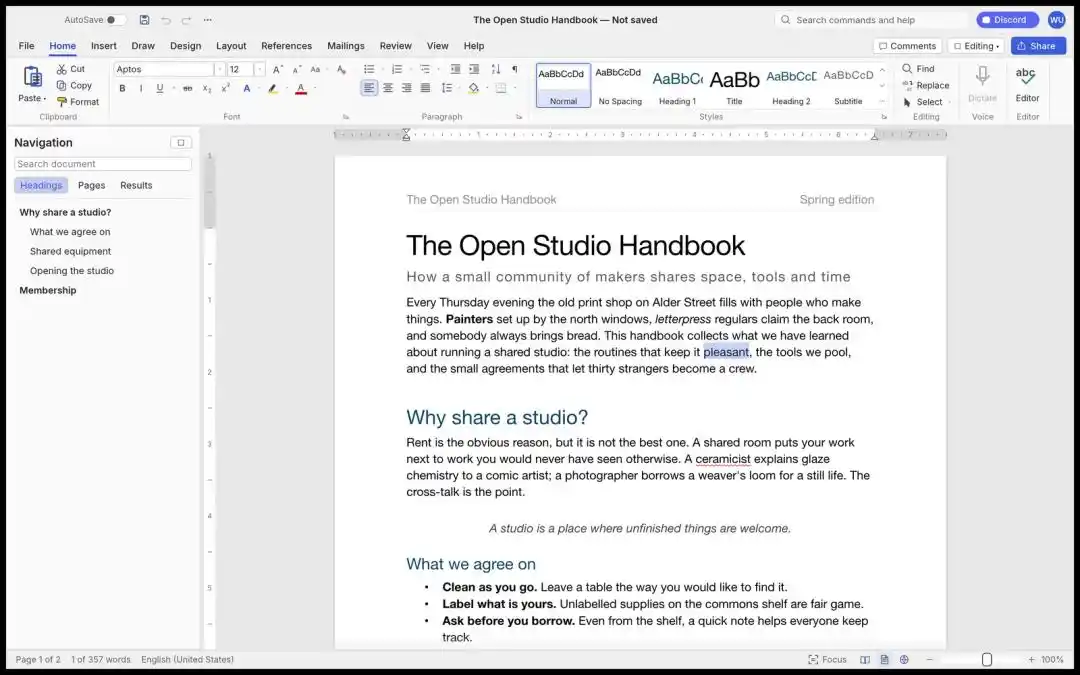
According to the official description, WordCraft is built in Rust, free and open source, and supports reading and writing .docx files. Its feature list includes familiar document editing functions such as the ribbon interface, styles, tables, revisions and table of contents. It can run on desktop and in the browser, and it also offers interfaces that AI agents can call so both humans and AI can operate documents.
On paper, that is an attractive package: familiar controls and no license fee. But replacing Word in practice depends on more than matching visible features. File compatibility is the real test.
A lightweight editor for personal use only needs to handle the kinds of files its owner already knows. A Word replacement for broad use has to open, edit and save documents sent by colleagues, clients and partners without breaking them.
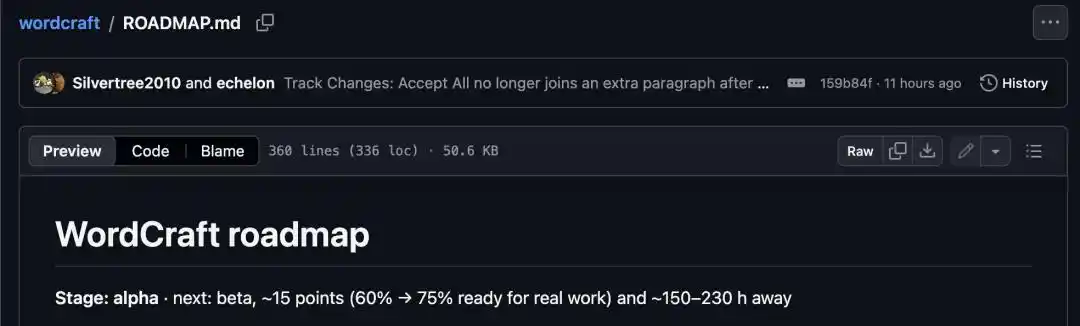
The official description says WordCraft is still in early testing and that both functionality and stability need more work. By the team’s own assessment, the project is about 60% complete if the goal is to fully replace Word in real work scenarios, and that estimate includes file compatibility and stability.
The next items on the roadmap include compatibility checks for complex documents, preserving charts intact and matching Word’s pagination behavior. In day-to-day office work, those issues show up in very practical ways: whether a file from a colleague opens correctly, whether charts remain intact after edits are sent to a client, and whether page numbers and paragraph layout stay consistent when the file is opened on another computer.
WordCraft highlights the appeal of a free alternative, but it also exposes the real challenge in replacing mature software. Menus can be copied. The messy edge cases of actual work still have to be solved one by one.
What he still pays for after cutting SaaS tools
On Sept. 9, Levels shared a list of service replacements and said that AI coding and self-built services were saving him about $25,000 per month.
He said switching content moderation to AI saved about $10,000 a month, while using a customer service platform with an AI support bot saved another $5,000 a month. He also cited savings from building his own image processing, webpage screenshot and website monitoring services, reducing both software and API costs.
The article adds an important qualifier. This is the cost structure of someone operating multiple websites, and the total includes both software expenses and labor costs. An ordinary user who only edits a few images from time to time cannot simply map his savings onto their own situation.
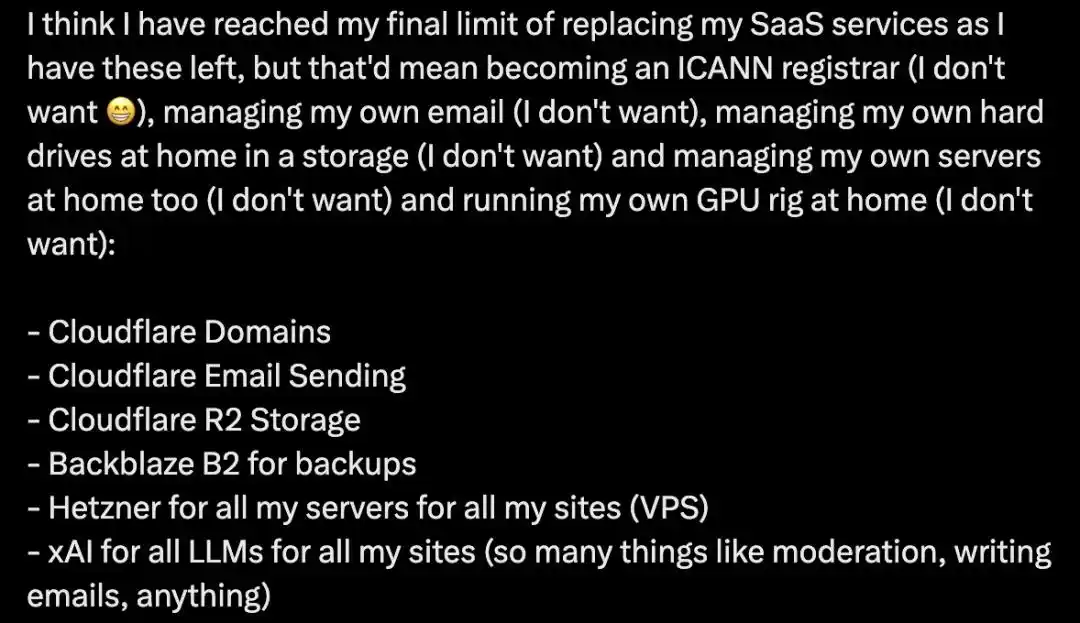
More interestingly, Levels also listed the services he still pays for in the same post: domain registration, email delivery, cloud storage, data backup, server hosting and the AI models used by his websites.
His reason was straightforward. He does not want to become his own domain registrar, maintain an email system or manage hard drives, servers and GPU hardware at home. Those are jobs he is still willing to outsource.

In a blog post published on Oct. 11, he also listed personal subscriptions he is keeping, including Claude Code, YouTube, Spotify, internet access and personal cloud storage.
That leaves a more nuanced picture than a simple anti-subscription stance. A user may be able to build the tool, but the services needed to generate and run that tool still cost money. Content, connectivity and storage do not disappear just because software can be written on demand. His spending logic is selective: replace what is worth replacing, keep paying for the work he does not want to take on himself.
The maintenance bill still exists
For ordinary users, the appeal of personal software may be strongest at the moment a renewal notice arrives. A tool gets used only a few times a month, yet the subscription keeps running. A simple task like batch-resizing images opens into a screen full of menus and options.
If the need is clear and the result is easy to verify, asking AI to build a small utility may be worth trying. But the article argues that another cost has to be counted as well.
If the tool suddenly stops working, who fixes it? If important data is lost, how is it recovered? If an integrated service changes its rules, who updates the workflow?
Building your own tool also means taking responsibility for maintenance. Even if AI helps with the repair, someone still has to describe the problem, check the output and deal with failures. Levels can make these trade-offs because he has years of development and operating experience behind him. Ordinary users may not have that background, and they may not want a second shift after work spent debugging software.
If the subscription fee disappears but several evenings are lost in return, the economics look different. Stability, ongoing updates and timely fixes are part of the value of off-the-shelf software. A portion of the annual subscription is effectively paying for that convenience.
A new question for software companies
The article ends on a practical question. If users can now make a tool that is good enough on their own, how much trouble can a software company still save them?
Levels’ choices suggest that some spending may shift away from ready-made applications and toward AI platforms and cloud providers that help users generate and run software. Canceling app subscriptions does not mean the end of paying. It may simply mean paying different vendors.
For users, the next renewal decision may come with a new calculation: can this need be handled by a small AI-built tool, and if so, is the subscription money saved worth the time required to maintain it?
The article was originally published by the WeChat public account "Xinzhiyuan" and written by ASI Qishilu. MarsBit republished the piece.



